

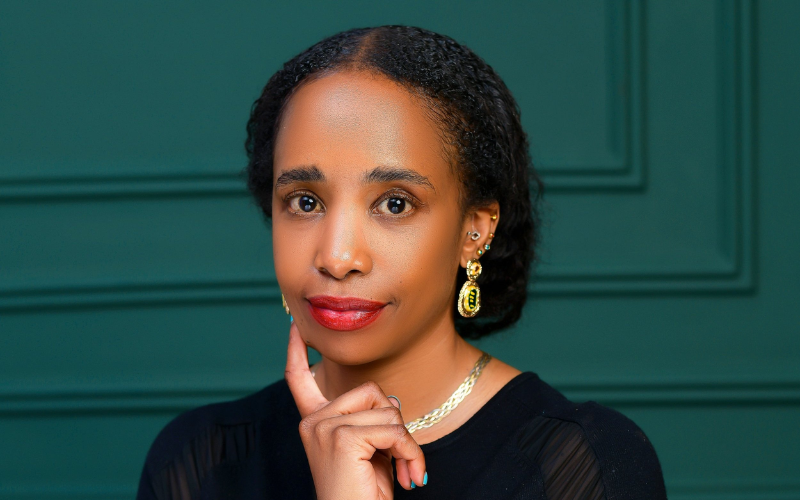
When Kenyan visual artist Sebawali Sio received an invitation to join a London group exhibition exploring grief, she described the feeling as something inside her exhaled.
Grief is a subject that has been in her practice for a long time, particularly how materials hold emotion and how water holds memory.
The curator of this show, Mercurial Pearl, reached out to her after seeing her recent paintings and sculptures exploring water and memory, and she felt it resonated with the show’s exploration of loss and renewal.
The exhibition titled Your Grief Belongs to You and It Can Be So, So Pretty opened on November 12 at Galleria Objets in London and runs until November 16.
It brings together one artist from Kenya, France, Ukraine, Brazil, and Mexico, each examining grief through their cultural and personal experiences. The cross-cultural perspectives show up in how each artist’s background informs how they process absence through colour, materials, and subjects.

Mercurial encouraged them to think beyond their work and to see how their works speak to each other. This shifted Sebawali’s approach and thought of how her three sculptures, titled Sitting Lady, Up Jumps the Bogie 2, and The Winds II, could be moments of stillness in the room amidst the other narratives. “Some pieces from the other artists confront grief directly, while others whisper around its edges. There’s also a beautiful tension between private mourning and public expression,” she says.
Sio explains grief as something fluid that moves, changes shape and eventually merges with life again. The three pieces for this exhibition were born after she spent time by the sea following a personal loss. She began her creative process with sketches and writing, lines from her journal, and her reflections of water.
Her colour palette for this exhibition is muted greys, pale blues, and off-whites, which are colours that she feels exist between states.
The textures are uneven and tactile, while she used materials like translucent washes and resin that absorb and release moisture to depict how grief seeps through time.

“Art gives grief form. When grief becomes visible through art, it transforms into a shared experience and maybe even softens,” she expresses.
Through this exhibition, her understanding of grief has changed. In the studio, grief felt inward and wordless. But standing among other artists’ interpretations, she felt how art can dissolve distance and make something intimate be universal.
Sebawali says this opportunity has expanded her will to work with artists from different continents and to see what dialogues in art can look like across mediums and life experiences.
She hopes the viewers of this exhibition feel less alone and that they recognise an aspect of themselves in the works.
“I would love for the show to spark conversations that don’t rush to fix grief and how grief is expressed differently in many cultures and dialects. And maybe the audience will leave with a sense that grief, while difficult, can also be a space for transformation,” she says