

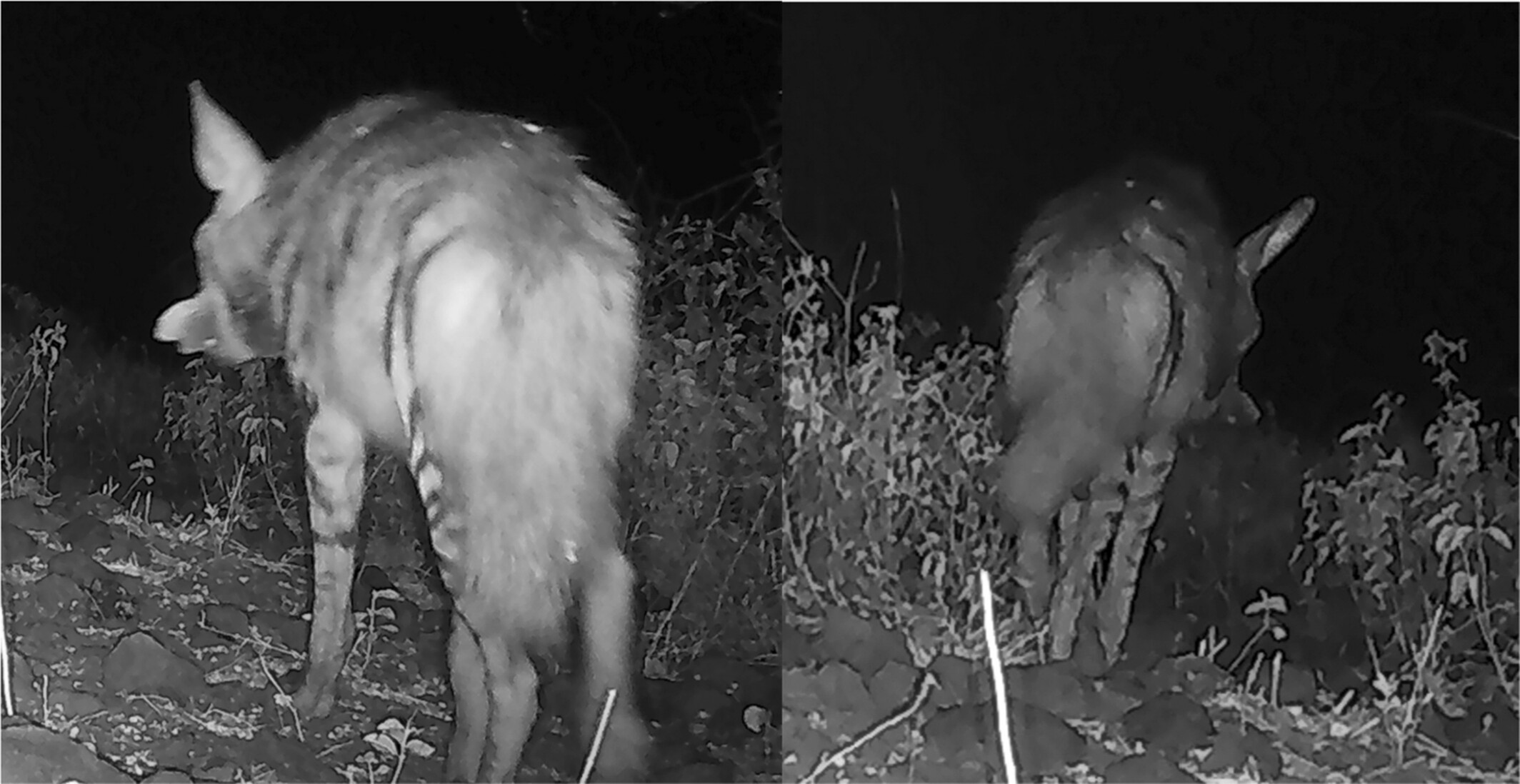
A close-up image of the honeycomb. This adult striped hyena was photographed carrying the large honeycomb in its mouth at the Kwenia Vulture Sanctuary, in Kajiado
For the first time ever, scientists have caught a hyena
red-handed eating honey.
The hyena was captured in Kajiado with a massive, dripping
honeycomb clenched between its jaws.
The scientists described the honeycomb as “large, with what
appears to be honey protruding from both sides of the striped hyena’s mouth,”
leaving little doubt that the animal intended to eat it.
The moment was captured by a camera trap at 5:44am inside
the Kwenia Vulture Sanctuary in Kajiado County on October 9, 2024.
With that single
image, one of the most elusive carnivores in Africa had rewritten has own
rulebook.
The photo was verified by 23 scientists from Kenya and the
Netherlands. It was reported last week in the Ecology and Evolution journal as
the first documented evidence of honey consumption by any hyena species on
earth.
“Here, we present the first documented evidence of honey
consumption by a hyaenid species,” the scientists wrote.
The discovery stunned
researchers because striped hyenas are known mainly as scavengers who feed on
carcasses and bone fragments in the shadows of larger predators.
Yet here was a hyena behaving like a honey badger, making
off with a rich, sticky prize more commonly associated with omnivores and
opportunistic foragers.
They said: “This observation suggests ingestion of honey,
beeswax and bee larvae, providing nutritional, medicinal or hydration benefits.
Our finding expands current knowledge of hyena dietary plasticity and
highlights the limitations of conventional diet analysis methods in detecting
rare food items such as honey.”
The finding expands scientific understanding of how
carnivores adapt to harsh, dry environments such as southern Kenya.
Honey consists mostly
of water and sugars, offering a quick burst of energy and moisture at a time
when water sources can be scarce.
The authors explained: “Honey is comprised mainly of water
and sugars, making it a highly nutritious food source, providing energy and
potentially serving as a substitute for water in scarce environments.”
In Kajiado, honey has long been part of community life, both
as a traditionally hunted food and more recently through an expanding practice
of beekeeping. Whether the hyena raided a wild hive, a beekeeper’s colony or
scavenged a discarded comb is unknown.
The paper is titled, “Do Striped Hyenas Have a Sweet Tooth? First Evidence of Honey Consumption by a Hyaenid”.
One of the reasons honey consumption has never been
documented before in hyenas is methodological. For decades, researchers have only
studied bone, hair or other durable remains inside faecal samples to determine
what an animal has eaten.
Honey, beeswax, and bee larvae do not leave such identifiable
traces. The study addresses this directly: “Unless the animal is physically
observed eating or DNA primers targeting honeybees are used, it is simply not
possible to detect honey consumption in traditionally used dietary analysis
methods.”
Camera traps, therefore, offer an advantage because they
capture rare, fleeting and unexpected behaviour that might otherwise go
unnoticed for decades.
The authors also explained why honey could be valuable to a
carnivore living in a semi-arid environment.
It is energy-rich and offers sugars and moisture that may
help an animal endure dry seasons. Beeswax contains antimicrobial and
anti-inflammatory properties, and honeycomb can include bee larvae, which are
an excellent source of protein.
“Honey is comprised mainly of water and sugars, making it a
highly nutritious food source, providing energy and potentially serving as a
substitute for water in scarce environments,” the authors said.
Such nutritional
benefits may make honey an attractive option during periods when carcasses are
scarce or when competition with other carnivores intensifies.
But there are hints that striped hyenas may have a natural
taste for sweetness. The study references behavioural observations from captive
hyenas in the Netherlands, where striped hyenas have been recorded eating
fruits such as bananas, grapes and galia melons.
Community reports in parts of Kajiado further support this
idea, with residents saying striped hyenas occasionally raid watermelon farms.
This discovery helps fill a gap in understanding the
ecology of striped hyenas in Kenya. They remain one of the country’s more
elusive carnivores, often overshadowed by lions, leopards and cheetahs.
Their nocturnal habits and tendency to avoid humans make
them difficult to observe directly.
The Kwenia Vulture Sanctuary, where the photo was taken,
supports a range of carnivores, including spotted hyenas, leopards, servals and
caracals.
The camera trap network that captured the honey-eating
moment was run by members of the local Maasai community in partnership with the
Kenya Bird of Prey Trust and Kwenia Vultures Sanctuary Trust.
The authors conclude that dietary plasticity in hyenas is
“likely underestimated” and that more camera trapping and molecular diet tools
could uncover similar behaviours across Kenya and beyond.