

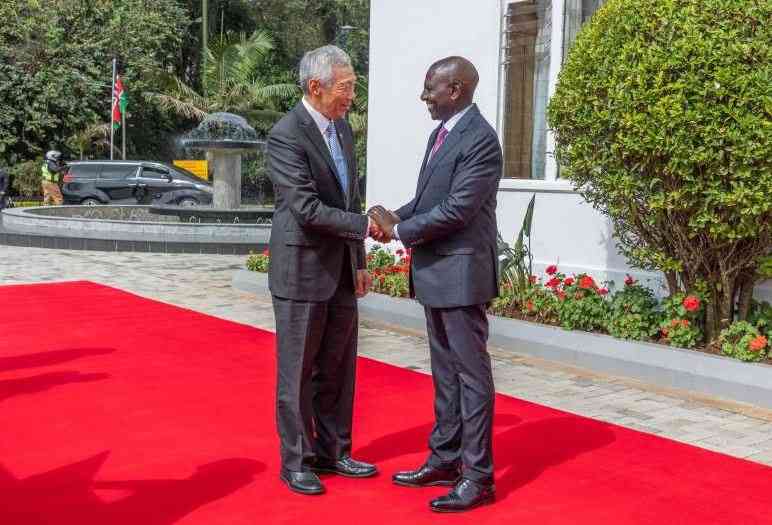
Kenya’s political elite has developed a growing obsession with the “Singapore model,” frequently invoking the Southeast Asian city-state as the ideal pathway to national prosperity.
The appeal is obvious: Singapore rose from a fragile post-colonial outpost to a global economic powerhouse within a generation. But this comparison while politically convenient, ignores the crucial historical, structural, and moral foundations that fuelled Singapore’s success. More importantly, it blinds Kenyans to the real obstacle to national progress: Our entrenched culture of political corruption.
Singapore’s transformation cannot be understood outside its unique context. As someone who lived there for four years as a PhD student, I witnessed firsthand how a small island nation—with no natural resources, limited land, and a population of just six million—managed to thrive through disciplined governance and strategic planning.
Its very limitations compelled its founding leaders to prioritise efficiency, social cohesion, and long-term thinking. Kenya, by contrast, is a vast country blessed with abundant natural resources, fertile land, and a population of over 50 million. Yet from the very beginning, our nation was built on a political system rooted in patronage, ethnic mobilisation, and near-institutionalised corruption
Follow The Standard
channel
on WhatsApp
Yet the greatest myth in comparing the two countries lies not in geography but in governance. Singapore’s rise was built on a leadership culture defined by integrity, discipline, and uncompromising accountability. Public offices are treated as a national duty, not a shortcut to wealth. From it very beginning Singapore leadership confronted corruption decisively, and leaders held themselves to the same standards they demanded of citizens.
Kenya’s political reality is the opposite. Here, corruption is not aberrational, it is the governing principle. Elections routinely elevate leaders who treat public office as an opportunity for looting rather than service. Institutions meant to safeguard integrity are weakened or manipulated for political gain. Public resources meant for development vanish into private pockets with impunity. Under these conditions, the “Singapore model” becomes empty rhetoric. No country can achieve disciplined development while nurturing a political ecosystem built on bribery, patronage, and self-enrichment.
Compounding this is Kenya’s ethicised politics. While Singapore intentionally forged a unified national identity that transcended racial lines of its major inhabitants i.e. the Chinese, Indians and Malay, Kenya from the very beginning normalised ethnicity as the main currency of political mobilisation. Here, elections are fought through tribal alliances rather than ideas, and public appointments often reflect ethnic arithmetic rather than merit.
Kenyan politicians admire Singapore’s skyscrapers, cleanliness, infrastructure and general efficiency while ignoring the invisible foundations beneath them: Honest leadership, strong institutions, long-term planning, and disciplined citizenship. Singapore succeeded not because it built tall buildings, but rather, because it built systems; transparent, meritocratic, and insulated from political interference. Kenya does the opposite, routinely dismantling institutions that threaten political interests.
Kenya’s greatest obstacle to development is not a lack of models, but a political class that preaches reform while perpetuating corruption and inefficiency. The dream of becoming the “Singapore of Africa” will remain a hollow slogan until leaders embrace integrity, accountability, and disciplined leadership; the true lessons behind Singapore’s success.
Follow The Standard
channel
on WhatsApp
By Martin Muthee Gakuubi