

Acting
director of meteorological services Edward Muriuki.
Kenya’s short rains season failure has been blamed on an
ongoing La Niña and a negative Indian Ocean Dipole, a powerful climate driver
that shifts rainfall away from East Africa.
Met department reported that November, usually the peak
month for the October-December rains, was unusually dry across the country.
Acting director of meteorological services Edward Muriuki
also said the December-February 2026 period will be largely hot and dry.
He said any remaining rains this season will stop between
this week and the fourth week of December.
“La Niña is currently underway, with cooler-than-normal
ocean temperatures across the central and east-central Pacific and matching
atmospheric patterns over the tropical Pacific. These conditions are expected
to continue through December 2025 to February 2026,” Muriuki said.
He added: “La Niña typically brings drier-than-normal
conditions to parts of East Africa, though its impact can vary.”
The Indian Ocean Dipole (IOD) is a see-saw of warm and cool
waters in the Indian Ocean that shifts where rain forms. When the warm water is
near East Africa (Positive IOD) it brings more rain, and when it shifts toward
Indonesia (negative IOD) it brings drought in Kenya.
“The negative Indian
Ocean Dipole (IOD) is still active, but it has been getting weaker over the
past three weeks. For the week ending 23 November, the IOD index was −0.60 °C.
Climate models indicate that the IOD is likely to return to neutral conditions
in December,” Muriuki explained.
Some isolated episodes of rainfall may occur in December,
but these will not significantly change the overall picture of a failed season.
Even where rain is expected, the projections still show it falling far below
normal averages.
“Most parts of the
country are likely to experience near-average to below-average (generally
depressed) rainfall, while parts of the northeastern region are likely to
receive below-average (highly depressed) rainfall,” Muriuki said.
Localised flooding remains a possibility in areas that may
experience heavy episodes, especially in poorly drained towns and along rivers.
However, the wider pattern is dry.
Muriuki said temperatures are projected to rise sharply
across the country. “Temperatures are expected to be warmer than average over
the whole country, with prolonged periods of heat likely to intensify daytime
temperatures, elevate nighttime minimums, and contribute to generally
hotter-than-usual conditions throughout the month,” he said. The trend will
extend into early 2026.
He noted that most parts of the country will be generally
sunny and dry in January and February. “However, some areas, particularly the
Lake Victoria Basin, Highlands West and East of the Rift Valley (including
Nairobi), the South Rift Valley, southeastern lowlands, and the coastal region,
may experience a few rainy days in January and February.”
The department said this caps one of the driest short rains seasons in recent years. November is typically the peak of the OND rains, yet
most parts of Kenya received less than 40 per cent of their long-term means for
the month.
“With the exception
of Garissa and Makindu, which registered near-normal rainfall totals, all other
observation stations reported deficits ranging from below-average to severely
depressed levels, highlighting the pronounced rainfall suppression across the
country,” Muriuki said.
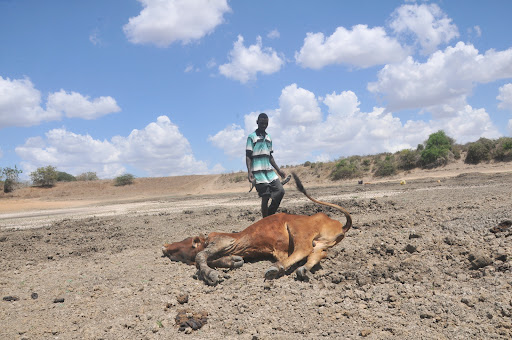
The combination of high temperatures and depressed rainfall
poses risks to food security, water availability, livestock, and public health.
The department warned that in arid and semi-arid regions, the anticipated near-to below-average rainfall is likely to reduce soil moisture, affecting crop
growth and pasture availability.
“The near-to below-normal rainfall, coupled with poor
spatial and temporal distribution, may negatively affect crop production, over
most parts, especially over parts of the Central and Eastern sectors of the
country, including the Coastal region. In the ASAL areas of the Northeast and
parts of the Southeast, the limited rainfall may hinder pasture regeneration,
potentially leading to reduced livestock production,” Muriuki said.
He further cautioned that reduced rainfall may lead to lower
water levels in rivers, dams, and reservoirs nationwide, while
warmer-than-average conditions may increase the risk of heat stress and
vector-borne diseases.