

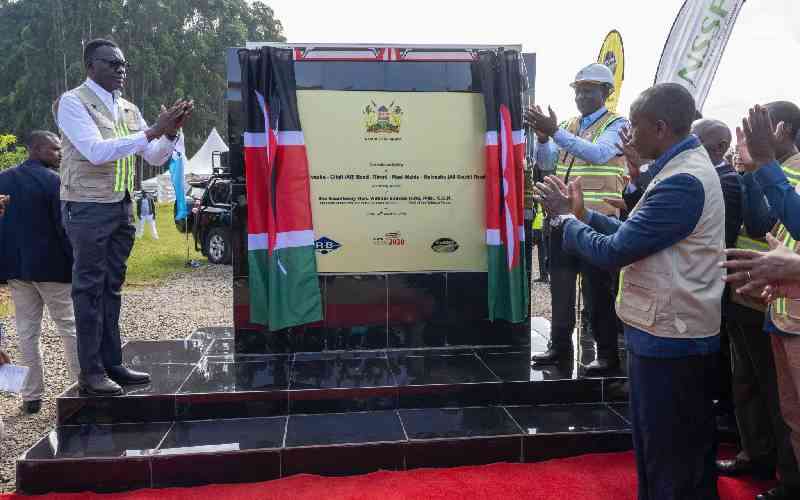
President William Ruto during the launch of the Rironi-Mau Summit road project, on November 28, 2025. [PCS]
Politics aside, Friday, November 28, 2025, was not just the ceremonial start of a construction project, but the physical manifestation of Kenya’s ambition. The dualling of the approximately 170-kilometre Rironi-Naivasha-Nakuru-Mau Summit highway, is more than an upgrade to asphalt and concrete; it is the construction of a new economic destiny for the nation.
The Mau Summit-Rironi expansion, a core artery of the Northern Corridor, stands as the most critical infrastructure pivot point in the country’s journey towards achieving the aspirations of Vision 2030 and fulfilling the promise of the Bottom-Up Economic Transformation Agenda (BETA). It is a strategic move designed not merely to solve a traffic problem, but to radically lower the cost of doing business, enhance regional trade competitiveness, and fundamentally uplift the millions of lives connected by this route.
For decades, the single carriageway linking the capital city of Nairobi to the Great Rift Valley, Western Kenya, and the wider East African Community (EAC) hinterland has been a notorious bottleneck. The pain points, the crippling gridlocks at Rironi, the slow, winding climb through Limuru, and the treacherous, accident-prone Salgaa blackspot, have collectively imposed a hidden, punitive tax on the Kenyan economy.
Follow The Standard
channel
on WhatsApp
This congestion has translated directly into exorbitant logistics costs. Cargo takes inordinate amounts of time to travel from the port of Mombasa, through Nairobi, and out to landlocked neighbours like Uganda, Rwanda, and the Democratic Republic of Congo (DRC). Vehicles operate inefficiently, fuel consumption soars, and the high rate of accidents drains resources, both human and financial. The existing road was no longer an asset; it was a constraint, actively suppressing our national competitiveness and making Kenya a more expensive place to manufacture and trade.
The dualling project is the decisive move to eliminate this constraint. By expanding critical sections to dual four-lane and six-lane carriageways, including the highly trafficked Naivasha–Nakuru West segment, the project is introducing a new era of mobility defined by speed, safety, and reliability.
The significance of this launch was amplified during President William Ruto’s State of the Nation Address on November 20. The President placed transport infrastructure squarely at the centre of his administration’s long-term transformation plan, unveiling an ambitious blueprint to dual 2,500 kilometres of major highways over the next decade.
The project is necessary to move Kenya from a developing nation to a competitive global player.
Crucially, the financing model underpinning this Sh180 billion venture: a Public- Private Partnership (PPP), is as transformative as the road itself. By leveraging the private capital of the CRBC-NSSF consortium and using a tolling mechanism, the government is delivering a generational public good without resorting to the unsustainable borrowing patterns of the past. This strategy, anchored by the newly established National Infrastructure Fund, is designed to ring-fence privatization proceeds and attract long-term patient capital. This responsible financial architecture, allows the government to deliver large scale infrastructure while restoring fiscal discipline and confidence, which saw foreign reserves recently surpass $12 billion. This is not just a road; it is a testament to financial ingenuity.
The Mau Summit-Rironi highway is the backbone of the Northern Corridor, and its dualling will solidify Kenya’s position as East and Central Africa’s dominant logistics and commercial hub.
Firstly, the impact on regional trade will be profound. The new highway is expected to cut travel time between Nairobi and Eldoret by nearly half. This dramatic time saving directly translates into lower vehicle operating costs (VOCs) for transporters and a guaranteed, predictable turnaround time for cargo. When the cost and speed of moving goods from the port of Mombasa to Kampala or Kigali improve, Kenya’s Northern Corridor becomes inherently more competitive than alternative routes, attracting greater volumes of transit trade. This secures vital foreign exchange earnings and strengthens diplomatic and commercial ties across the continent, directly aligning with Kenya’s AfCFTA goals.
Secondly, the reliability of the dual carriageway acts as a magnet for Foreign Direct Investment (FDI). Multinational corporations considering setting up manufacturing or assembly plants in Kenya demand predictable, world-class infrastructure. The dualling, coupled with the extension of the Standard Gauge Railway (SGR) to Kisumu and Malaba, scheduled to begin in January 2026, creates a powerful, multi-modal transport network. This convergence of efficient road and rail logistics makes the Naivasha Special Economic Zone and Inland Container Depot (ICD) exponentially more viable, positioning it as the primary logistics centre for the entire region. The project, therefore, is directly supporting the President’s focus on industrial transformation.
While the macro-economic benefits are undeniable, the most immediate and tangible change will be felt by the communities and counties along the route— Nakuru, Naivasha, Limuru, and beyond. For Nakuru City, the construction of a full viaduct section will ensure that urban traffic flows smoothly, preventing the new highway from simply shifting the bottleneck into the heart of the city. This design sophistication is vital for preserving Nakuru’s planned growth as a regional economic powerhouse.
For Naivasha, the dual carriageway cements its status as a logistics anchor. Better road access ensures the Naivasha ICD, which links the SGR network to the road system, can operate at maximum efficiency, turning the town into a dynamic trading and warehousing hub, stimulating land appreciation and creating thousands of new, localized jobs.
The most transformative effect, however, will be on the agricultural supply chain.
The Rift Valley is the country’s breadbasket and horticultural heartland. Farmers producing fresh produce, flowers, dairy, and potatoes currently battle high spoilage rates due to long transit times. The accelerated movement enabled by the new highway means farmers can get their goods to Nairobi and Mombasa markets, and potentially directly to the airport for export, faster and in better condition. This reduces post-harvest losses, increases profit margins for millions of smallholder farmers, and injects liquidity into the grassroots economy, a direct realisation of the BETA promise.
Furthermore, the expansion includes provisions like dedicated service lanes, bus bays, and truck lay-bys. This formalizes and structures the roadside economy, creating safer, cleaner, and more formalised business opportunities for small traders and hospitality services in towns like Gilgil and Mau Summit, where thousands of new service sector jobs will be created.
Finally, we cannot overlook the human element: safety. The new highway design, featuring improved drainage, lighting in fog-prone zones, service lanes, and grade-separated interchanges, will drastically reduce the road carnage that has plagued the route. By mitigating blackspots like Salgaa, the dualling saves lives and reduces the economic burden of crashes on families and the national healthcare system.
As the construction begins, the focus must immediately shift to meticulous execution. The ambitious two-year completion timeline must be upheld. Furthermore, public consultation must continue, particularly concerning the proposed toll charges. While the PPP model requires user fees for sustainability, the government must ensure that the base toll rate of Sh8 per kilometre remains competitive and affordable, with clear alternative routes maintained for those who cannot afford or choose not to use the toll road. The success of this project hinges not just on its engineering brilliance, but on its capacity for transparent delivery and equitable impact.
The dualling of the Mau Summit-Rironi dual carriageway is a symbol of a nation committed to moving beyond incremental change and embracing the kind of bold, strategic investment necessary to secure its future. It is a generational opportunity to fortify our logistics backbone, accelerate economic growth, and ensure that the fortunes of both the nation and its constituent communities are permanently transformed.
– The writer is a mapping and research expert
Follow The Standard
channel
on WhatsApp
By Mutethia Mutiga