

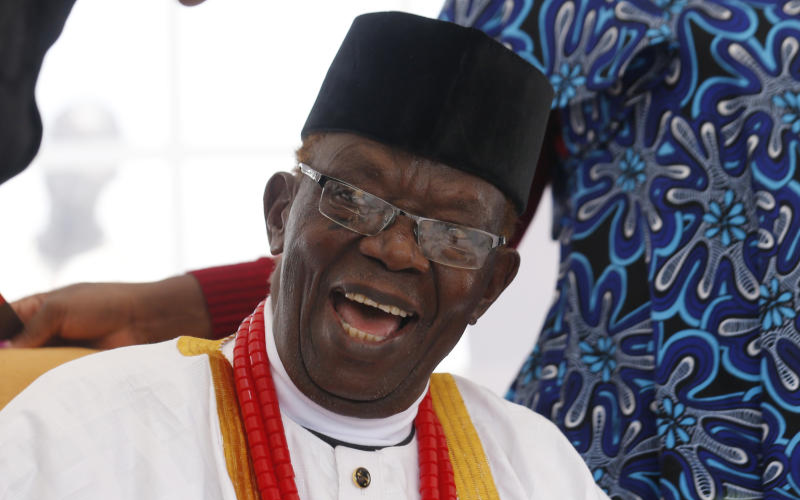
On December 5, Prof David Mulwa laid down his pen after a life dedicated to theatre, television, education, and film. His career, spanning more than five decades, influenced generations of artists.
Mulwa is fondly remembered by the theatre arts fraternity as an amiable and disciplined man.
His widow, Janet Mulwa, recalled that they met for the first time in 2010. Mulwa was acting in Tabasamu at the time, a show that she used to watch.
She appealed to the public to help offset the outstanding hospital bill, which remains high. “I am grateful that we are celebrating the love of my life. I would like to appeal for support from people. Maintaining his dialysis treatment has not been easy, and we still have a substantial hospital bill,” she said.
Veteran playwright and actor John Sibi-Okumu recalls Mulwa playing the role of the Divine Drummer in the inaugural production of Muntu by Ghanaian playwright Joe de Graft at the University of Nairobi.
The year was 1975. It was an ensemble of talents; De Graft played Muntu, Sibi-Okumu was the First Son, Francis Imbuga as the Second Son, and part of the cast had Abel Ndumbu, Jerry Okungu, Edwin Nyutho, and Ghanaian Janet Badjan Young.
He described Mulwa as a good man whom he grew to love.
“Good because he would rather share than receive; give away rather than store away. And talk of love because of his innate generosity of spirit. Our artistic world is often marked by creative jealousies, but David was affirmative and supportive, to a fault,” says Sibi-Okumu.
Dr Shikuku Emmanuel, senior lecturer and theatre artist, believes that Mulwa’s legacy lives in his writing, his students, and the countless theatre-makers he mentored.
He first encountered Mulwa through books long before he met him in person. While reading Buriani in 1997 in high school, little did he know he would one day meet the man behind it. Later came Redemption and Inheritance, both national set books, as well as Mulwa’s first novel, Master and Servant.
As a director, Mulwa guided Dr Shikuku in productions such as Redemption and Aminata by Francis Imbuga. Dr Shikuku later joined the directing team, alongside Kinyanjui Kombani and Collins Shibira, in staging The Merchant of Venice by William Shakespeare, in which Mulwa acted.
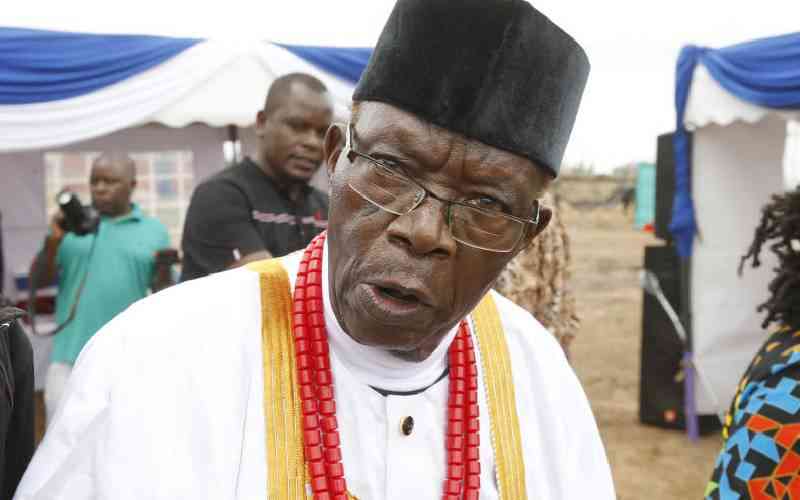
In 2022, they began rehearsing the two-hander, The Island, but Mulwa never got to play Winston, while Dr Shikuku was to play John, but it didn’t come to fruition as Mulwa was undergoing dialysis. “But he didn’t forget his lines. Even in his later years, that discipline never left him,” says Dr Shikuku.
In April, he organised Mulwa’s birthday celebration during the Kenya National Drama and Film Festival held in Nakuru, without knowing that they were giving him his last celebration. He was also brought on stage to speak to the people.
Over the years, Dr Shikuku would visit him nearly every month, and he would always bring two students on these visits. Even when Mulwa’s health declined due to kidney complications, his warmth never dimmed. He was amiable, full of life. He would be in pain, but he would pick up his guitar. In one visit with artist Gabriel Kimani Thuku, Mulwa played the guitar for them.
“Being with him was experiencing greatness. He loved company. If I went to visit him, I knew I would spend the whole day. He loved telling deep stories about theatre and life. When he spoke, you felt it,” he says.
Edwin Nyutho, retired lecturer of broadcast media, first met Mulwa in 1974, when he was a first-year student at KU. Accompanied by friends who were looking for a theatre teacher, Nyutho had gone to Bomas of Kenya, where Mulwa was working at the time.
Soon after, he joined KU and produced one of the greatest plays ever staged there, Wole Soyinka’s Kongi’s Harvest, where Nyutho played the character of Daodu. Since then, he says that Mulwa became his mentor, teacher, and best friend.
“David taught me all elements of theatre arts. He was one of the most amazing men I have ever met. He impacted my life so deeply that I attribute my success solely to him,” he says.
Mulwa’s standards were high, Nyutho recalls, and that discipline became the epitome of his students.
“To relate to David, you had to be disciplined and a good performer. He pushed me to be the very best I could be. My English diction was so poor at the time, and it was through him that I became articulate,” Nyutho says.
Their collaboration continued long after Nyutho left KU. While teaching at Nairobi School, he starred in Clean Hands, one of Mulwa’s best-known works.
“I took one of the leading roles. I also played Archbishop Elton in Redemption. When I performed that role, the audience hated me for my character. That’s how powerful David’s directing was. When he remarried, I was his best man,” he says.
Nyutho also remembers him as a man at the forefront of building the foundation of theatre arts in Kenya. He Kenyanised theatre, and a bulk of theatre artists have passed through his hands.
Author Kinyanjui Kombani remembers meeting Mulwa in 2000, when he arrived at KU as a first-year student. Mulwa was already a celebrated writer and actor, and Kombani immediately enrolled in his creative writing class.
Kombani had a novel manuscript which he gave to him, and within a week, he returned it full of red marks, telling him, “This is a masterpiece. Tighten it and submit it for publication.”
That manuscript developed into The Last Villains of Molo, the novel that launched Kombani’s writing career. As patron of the KU Travelling Theatre, Mulwa was deeply involved in student productions and attended performances.
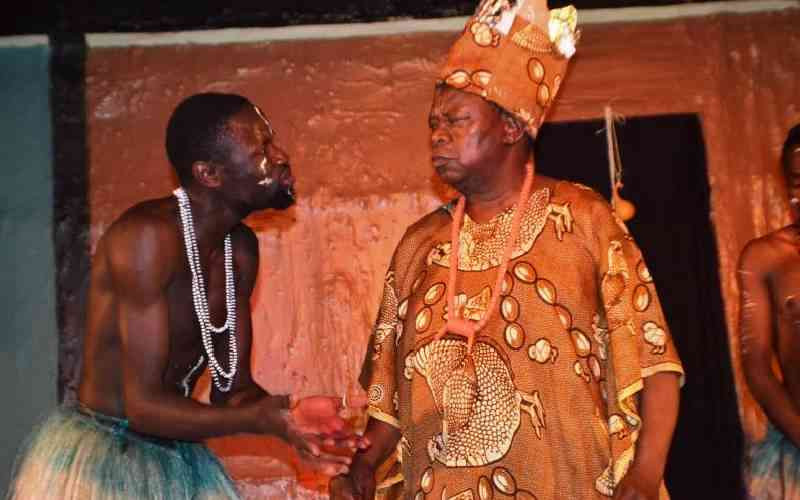
When Kombani became a creative director, this was when he staged The Merchant of Venice in 2005, with Mulwa performing the role of Shylock. He portrayed the role so powerfully that the next actor forgot his lines.
Even in rehearsals, he was disciplined and punctual, and he didn’t believe in doing anything halfway.
As years passed by, their relationship evolved into a close bond. Kombani gifted Mulwa copies of every new book he wrote, and Mulwa, in turn, challenged him constantly.
“He would ask me what I am writing next. He pushed me to keep writing even when one book was still in the publishing process. When Mulwa could not move around easily, Kombani would drive him to watch plays, continuing the tradition of learning from him,” he says.
Prof Mulwa’s play Redemption is slated for a restaging by the Kenya National Theatre in March 2026, showing the relevance of his work. It will star veteran actors Ian Mbugua, Arabron Osanya, and Muthoni Gatheca, alongside Nyakundi Isaboke, award-winning Maryanne Nungo, Anne Kiveli, John Gat Man, Lucarelli Onyango, Cosmas Kirui, and Fischer Maina.
In October, representatives from the Kenya Cultural Centre (KCC) team and the Redemption play committee visited Mulwa at his home to get his blessing to restage the play.
“He looked forward to being involved in the proposed production, however minimal. He genuinely looked forward to seeing it come to life. Even though he is no longer with us, we remain committed to this production,” says KCC CEO Michael Pundo.
Born in 1945, Mulwa was one of the longest-serving theatre practitioners and most published authors.
He also held a Fulbright Scholarship and a Rockefeller Foundation Scholarship. His academic training included an MA in Theatre Arts from UCLA, studies at Ohio University, and a BA Honours from the University of East Africa.
His early career included a stint at Bomas of Kenya, where he served as director and producer of the Harambee Dancers from 1973 to 1974. In 1974, he joined Kenyatta University (KU) as a lecturer, a role he would hold for 52 years.
He taught creative writing, theatre arts, drama, oral literature, and African and European literature, and later served as a senior lecturer in the Department of Theatre Arts and Film Technology. He also produced more than 200 educational programmes for the Kenya Institute of Education, now the Kenya Institute of Curriculum Development.
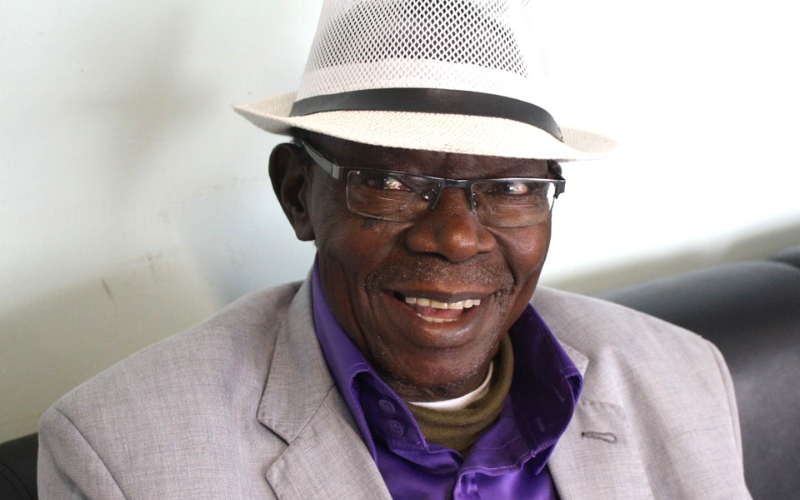
On stage, Mulwa acted in productions such as The Good Samaritan, Treasure Island, Wole Soyinka’s Kongi’s Harvest, Joe de Graft’s Muntu, Mzalendo Kimathi by Ngũgĩ wa Thiong’o and Micere Mugo, Athol Fugard’s The Island, Shakespeare’s Romeo and Juliet, and many others.
He also performed in his own plays, including Redemption and Clean Hands, works that are critically acclaimed as a playwright and performer.
As a director, he staged several productions, among them Muntu, Kongi’s Harvest, Kinjekitile, Animal Farm, Man of Kafira, The Bride, The Successor, and The Island. His directorial choices leaned towards discipline.
Mulwa’s screen career began in 1967 with Joe de Graft’s Through a Film Darkly. He went on to write and act in more than 50 television plays in programmes such as Play of the Week, Theatre Special, and Family Affairs.
Some of the titles of the plays are The Search, About Turn, Lunch Time, The Union, The Past Speaks Again, Deadwood, We Live Again, and The Last Truant Goes to School.
His film repertoire is equally endless; he appeared in The Great Elephant Escape, The Baisikol, To Walk with Lions, 100 Days, Behind Closed Doors, The Knife Grinder’s Tale, Shuga, Born Free, Eye of the Witness, and Kolor Mask, the first locally produced feature film. Audiences also remember him in major TV series, including Makutano Junction, Higher Learning, Tahidi High, Reflections, and Men of Office.
As an author, Mulwa published more than 20 books, such as Inheritance, Buriani, Terrible Times, The Girl with a Vision, The Crocodile’s Jaw, Flee, Mama Flee, Kabasha Says No, Master and Servant, Champion, and Love Lasts Forever.
Remembered as one of the fathers of Kenyan theatre, he was also part of the drama festivals; since 1975, he served as a drama adjudicator for teacher training colleges, primary and secondary schools, and at district, provincial, and national levels.
His honours reflect the measure of his contribution, as he received the Head of State Commendation twice, a Lifetime Achievement Award from the Sanaa Theatre Awards, a Lifetime Achievement Award from the Kalasha TV & Film Awards, the Kenya @ 50 Heroes Award, and recognition from the East Africa Theatre Institute.
As they reflected on Mulwa’s legacy, Kombani and Dr Shikuku said to each other that Mulwa is not dead.
“We are his product. As long as we are alive, he lives in us.”
This echoes poet and storyteller Ngartia’s sentiments that “Mulwa’s greatest legacy is his students and mentees.”