

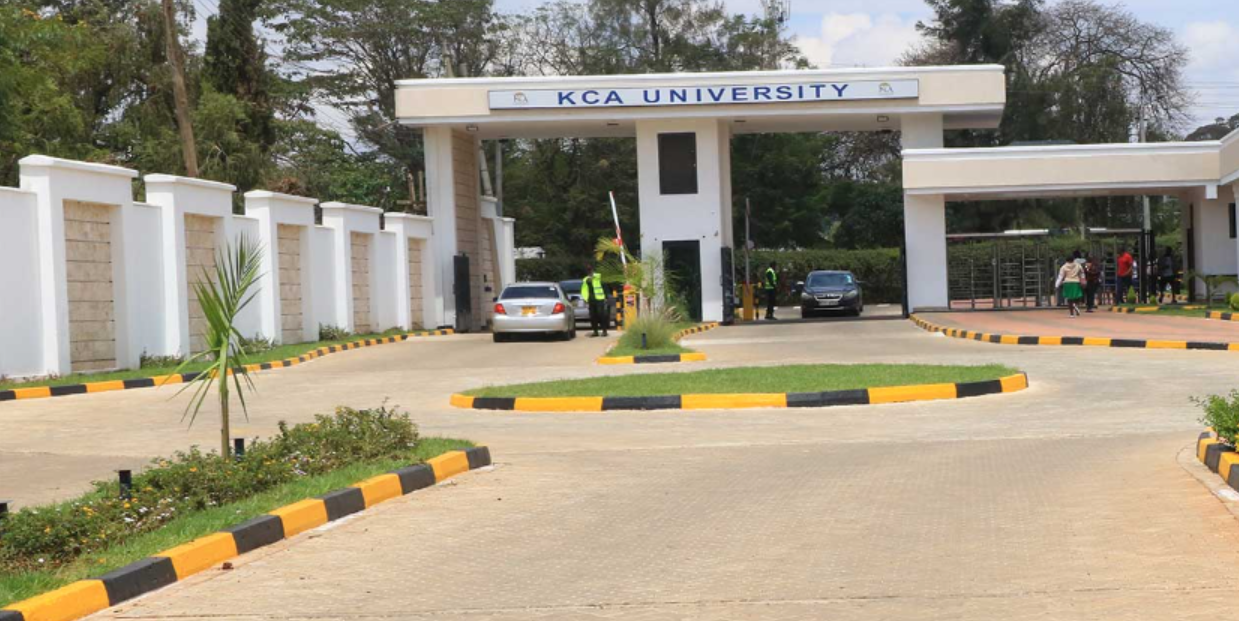
When KCA
University Vice Chancellor Professor Isaiah I.C Wakindiki addressed graduands
during the institution’s 19th graduation ceremony, his message was
unmistakably forward-looking.
As the university conferred degrees to 3,286 graduates, he framed their
achievement within the realities of a rapidly evolving global knowledge
economy.
“This is the
era of Artificial Intelligence, and anybody who does not embrace AI will very
soon be obsolete,” Professor Wakindiki said.
“At KCA University, we are ahead.
We have embraced AI and are embedding it into our curriculum, teaching, and
research. AI is now part of how we train, innovate, and generate knowledge.”
That
statement encapsulates the strategic direction KCA University is taking, one
where technology, research, and innovation are not optional add-ons, but core
academic drivers.
This vision was further unpacked in an in-depth interview
with Professor Vincent O. Onywera, the Deputy Vice Chancellor in charge
of Research, Innovation and Outreach, whose portfolio sits at the centre of the
university’s transformation agenda.
In an era
where universities are increasingly judged not only by the degrees they award
but by the solutions they generate, KCA University is deliberately positioning
itself as a hub of applied knowledge, innovation, and enterprise.
According to
Professor Onywera, this shift is intentional and systemic.
“What we’ve
done at KCA University is to create an enabling ecosystem that does not only
support teaching and learning, but also supports research, innovation,
incubation, and commercialisation of research outputs,” he said.
This
ecosystem is built on robust systems, clear policies, and deliberate investment
in infrastructure. Research, innovation, incubation, and enterprise development
are not treated as parallel activities operating in silos.
Instead, they are
designed as interconnected pillars within a single institutional framework
aimed at translating ideas into impact.
KCA
University has established business incubation hubs, common entrepreneurship
units, and dedicated directorates focused on research support, innovation, and
partnerships.
These structures ensure that both students and faculty receive
guidance from the earliest stages of ideation through to product development,
intellectual property protection, and eventual commercialisation.
Entrepreneurship
is not reserved for a select group of students.
“We ensure that all our
students take a university common unit on entrepreneurship,” Professor Onywera
noted. This approach embeds entrepreneurial thinking across disciplines,
ensuring that innovation becomes part of the institutional culture rather than
an extracurricular activity.
Crucially,
the university provides internal financial support for promising research
ideas, recognising that innovation must often be nurtured locally before it can
attract external or international funding.
Equally important is the protection
of student ideas. “We make sure that the student ideas are protected,”
Professor Onywera emphasised, pointing to the use of non-disclosure agreements
and formal filings with the Kenya Industrial Property Institute (KIPI) and the
Kenya Copyright Board (KECOBO).
From Classrooms to Boardrooms: Student-Led
Innovation
The strength
of KCA University’s research and innovation agenda is perhaps best illustrated
by its student outputs. In the current academic year alone, students developed 22 prototypes, 17 of which have been formally filed, with 3 already commercialised.
These
innovations cut across sectors that are central to Kenya’s socio-economic
development, including artificial intelligence, agribusiness, fintech, sports
technology, education, mental health, non-communicable diseases, and medical
solutions, among others.
Professor Onywera was keen to point out that these
outcomes are not accidental.
They are the
result of close collaboration between students and faculty mentors, who guide
learners through research design, product development, validation, and market
positioning.
This mentorship culture reinforces the university’s philosophy
that students should graduate not only with academic credentials but with
tangible products, intellectual property, and entrepreneurial confidence.
In one
standout example, a student-led mental health innovation impressed the DVC so
much that it became a reference point for what is possible when research meets
real-world need.
The student behind the innovation later secured employment at
Microsoft as a software engineer, underscoring the link between innovation,
employability, and global competitiveness.
Supporting Research Beyond the Campus
Research
support at KCA University extends well beyond the classroom and laboratory.
Through VC and CEO Research and Innovation Grants, support for international
funding applications, and facilitation of conference travel, students and
faculty are encouraged to engage with global research communities.
According to
Professor Onywera, this exposure is essential in building confidence, academic
maturity, and competitiveness. It also reinforces the university’s emphasis on
collaboration rather than competition as the true driver of innovation.
Equally
important is the institution’s emphasis on inclusivity and care. The research
environment at KCA is deliberately designed to be supportive rather than
intimidating, fostering a sense of belonging that encourages young researchers
to take intellectual risks.
Challenge-Based Learning: Changing How
Students Learn
At the core
of KCA University’s pedagogy is Challenge-Based
Learning (CBL). Rather than relying solely on traditional lectures and
examinations, students are immersed in real-world problems and guided by
lecturers as they design solutions.
This approach
ensures that learning is experiential, interdisciplinary, and outcome-driven.
Students learn by doing, testing ideas, failing, refining, and ultimately
delivering solutions that respond to real societal and industry challenges.
The results
are already visible. Professor Onywera noted that KCA University students
ranked top in a recent British Council study on job readiness, reinforcing the
institution’s claim that its graduates are better prepared for the demands of
the modern economy.
Partnerships, Industry Linkages and Community
Impact
Research and
innovation at KCA University are deliberately outward-facing. A dedicated
directorate focuses on partnerships, collaboration, and industry linkages,
ensuring that academic work translates into real-world impact.
Through
strong industry relationships, the university provides platforms for testing
research outputs, solving sector-specific challenges, and offering students
meaningful internship and attachment opportunities. These partnerships also
ensure that curricula remain responsive to industry needs.
Professor
Onywera stressed that partnerships must move beyond signed Memoranda of
Understanding. Implementation, shared ownership, and co-creation are essential
if collaborations are to deliver lasting value to both industry and society.
Strategic Vision: Scaling Innovation for the
Future
Looking
ahead, KCA University’s 2024–2028
strategic plan places research and innovation at the centre of
institutional growth.
Following a recent Industry Summit, the university
outlined plans to scale up innovation outputs, strengthen business incubation
hubs, and increase patent filings.
Among the
innovations highlighted was the development of AI-enabled spectacles designed to assist visually impaired individuals,
a powerful example of how technology, empathy, and research can converge to
solve human challenges.
It is also a reflection of the university’s alignment
with the Vice Chancellor’s vision of embedding AI into learning and research.
Professor
Onywera emphasised that scaling innovation requires more than funding alone. It
demands a fully integrated ecosystem that brings together people, policies,
infrastructure, and institutional culture.
Insights from the Quick-Fire Session
In a
rapid-fire exchange, Professor Onywera offered candid reflections on research
and innovation at KCA University:
Research at
KCA was described in one word as dynamic.
Internal funding was identified as more impactful than external grants because
“you have to start from somewhere.”
The biggest barrier to student research remains culture, the outdated
perception that universities exist only for teaching.
Challenge-based learning was identified as the antidote to passive education.
Collaboration, rather than competition, was cited as the true driver of
innovation.
Communication was highlighted as the most important skill for young
researchers.
Patents were ranked above publications in terms of impact.
Policies were cited as the strongest form of support for innovators.
With unlimited funding, Professor Onywera would invest first in building a
fully inclusive innovation ecosystem.
A Scholar Beyond Administration
Beyond his
administrative role, Professor Onywera is an accomplished scholar in exercise
and sports science. He offered clarity on the distinctions between exercise,
physical activity, and play, reflecting his passion for physical education and
holistic human development.
This balance
between academic scholarship and institutional leadership reflects the ethos he
champions at KCA University, knowledge that informs practice, and leadership
grounded in research.
Redefining the Purpose of the University
The
conversation with Professor Vincent Onywera reveals a university deeply
intentional about its role in society.
KCA University is not merely responding
to changes in higher education; it is actively redefining what it means to be a
research-led institution in Kenya and beyond.
By embedding
AI into learning, protecting and commercialising ideas, supporting innovation
through structured ecosystems, and prioritising real-world impact, KCA
University is shaping graduates equipped to lead, create, and transform.
In a global
knowledge economy where relevance is measured by impact, KCA University’s model
offers a compelling blueprint for the future of higher education.