

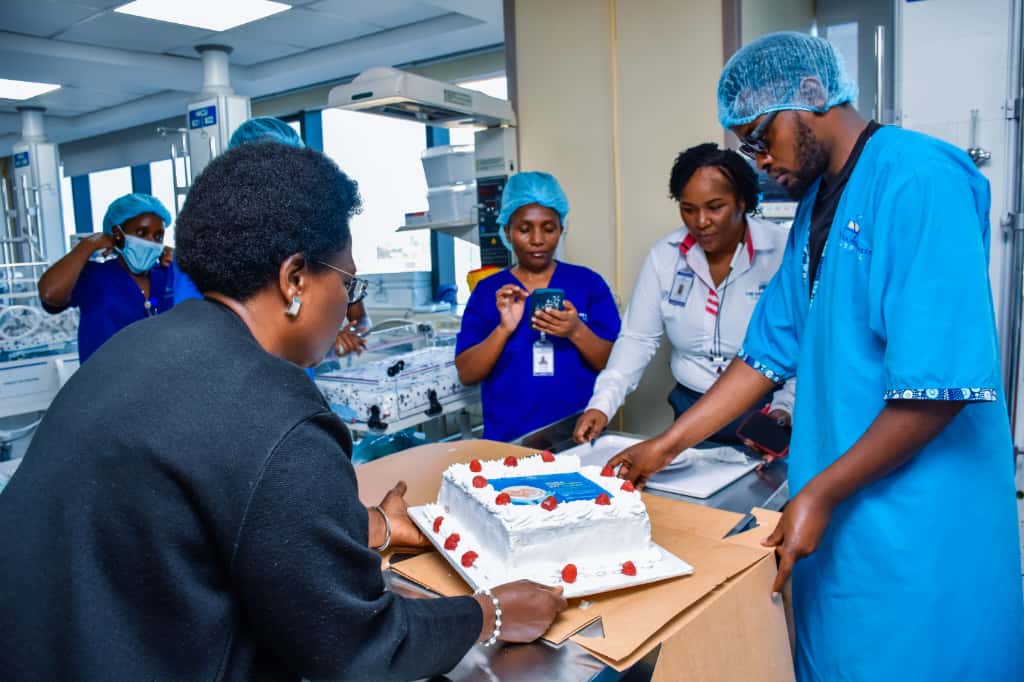
The
Nairobi West Hospital performed a minimally
invasive closure of a complex atrial septal defect
The year 2025 will
be remembered as a watershed year for Kenyan medicine, a period when local
surgeons not only expanded access to complex care at home but also etched Kenya
into the global medical map with pioneering procedures.
From restoring
sensation in amputees to complex cardiac repairs and organ transplants, Kenyan
doctors and hospitals delivered breakthroughs that resonated far beyond
hospital wards.
In May 2025,
Kenyatta National Hospital (KNH) captured global attention when its surgical
team performed the world’s first Transhumeral Targeted Sensory Reinnervation
(TSR) surgery, a groundbreaking procedure that enabled an amputee to regain
sensation in his missing arm for the first time since amputation.
The seven-hour
microsurgical operation was carried out on 22-year-old software engineering
student Moses Mwendwa, who lost his left arm earlier in the year due to
compartment syndrome following a tragic fall.
The TSR technique
reroutes nerves from the amputated limb to adjacent skin, creating a new
“sensory map” that allows the brain to interpret touch, temperature, and
pressure as if the limb were still present – a feat previously unachieved at
this level worldwide.
“We have performed
the World’s First Transhumeral Targeted Sensory Reinnervation (TSR) surgery on
Moses Mwendwa, 22, restoring sensation in his missing left hand! This
groundbreaking 7-hour procedure reroutes nerves to create a ‘sensory map,’
enabling touch perception and better prosthetic control,” KNH said in a
statement.
Led by Prof.
Ferdinand Nang’ole and Dr. Benjamin Wabwire, alongside international
collaborators and a multidisciplinary team, the operation stands not only as a
surgical breakthrough but also a symbol of hope for amputees and prosthetic
integration globally.
“Feeling my hand
again after believing it was gone forever — that’s not just medicine, that’s
magic,” Mwendwa told reporters.
Beyond its
technical brilliance, the success of the TSR camp
at KNH highlights Kenya’s
rising role in cutting-edge neural surgery and rehabilitation, pointing to new
horizons in prosthetic control and pain management.
Later in 2025, The
Nairobi West Hospital created waves in cardiovascular care with a minimally
invasive closure of a complex atrial septal defect – a challenging “hole in the
heart” procedure performed under the leadership of interventional cardiologist Dr.
Vijaysinh Patil.
Using advanced imaging and catheter-based device deployment,
the team successfully sealed the defect in a patient who would otherwise have
required open-heart surgery or foreign referral. This milestone not only
advanced cardiac care locally but demonstrated Kenyan proficiency in high-risk
structural heart interventions.
In May 2025,
Kitui-based KUTRRH (KUTRRH – Kitui County Referral & Teaching Hospital)
marked its entry into renal transplantation, successfully performing its first
kidney transplant.
The achievement was hailed as a major expansion of
life-saving services outside Nairobi’s referral centers, bringing organ
transplant care closer to communities in eastern Kenya and widening equitable
access to complex care.
Moi Teaching and
Referral Hospital (MTRH) in Eldoret earned national acclaim with Kenya’s first
renal artery bypass surgery, a complex vascular reconstruction to treat severe
renovascular hypertension.
The procedure helped reduce reliance on overseas referrals
for advanced vascular care and underscored the depth of surgical expertise
emerging in Kenya’s second-tier referral hospitals.
Western Kenya also
celebrated a milestone when Jaramogi Oginga Odinga Teaching and Referral
Hospital (JOOTRH) successfully completed its first cardiothoracic surgery.
The
operation, a much-needed addition to regional health services, signals a new
era of decentralised specialist care for patients in Western Kenya – reducing
travel burdens and improving outcomes in critical surgical cases.
This year’s
portfolio of procedures – from global firsts to regional breakthroughs –
reflects a growing mastery of high-complexity medicine inside Kenya.
Scholarly
collaboration, cross-disciplinary teamwork, and practical innovation are
enabling clinicians to tackle previously insurmountable conditions without
leaving the continent.
As the healthcare
sector builds on these successes, Kenyans can look forward to more home-grown
solutions that combine local ingenuity with international standards – a trend
that promises better care, more scientific leadership, and greater health
equity.