

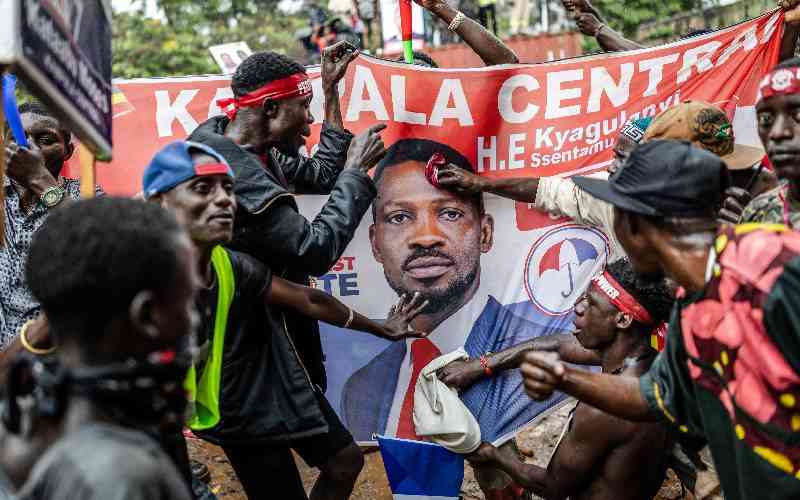
Supporters of Uganda opposition leader and NUP presidential candidate Robert Kyagulanyi Ssentamu, during the party’s final campaign rally ahead of the 2026 general elections, in Kampala on January 12, 2026. [AFP]
Uganda’s presidential election, that will take place on Thursday, is shaping up as a high-stakes test of whether a country can renew itself politically without violence, fear, or manipulation. On the one side stands President Yoweri Museveni, now 81 and in power since 1986, seeking another term that would deepen an already long era of rule. On the other is Robert Kyagulanyi Ssentamu, better known as Bobi Wine, a 43-year-old musician-turned-politician whose rise has fused youth culture with opposition politics, and who has been formally cleared to contest the 2026 race. For many Ugandans, the contest is not just about two candidates; it is about two political futures: A familiar system built around a powerful state, and a restless generation demanding a different social contract.
Wine’s influence did not begin in Parliament. It grew first through music that spoke to daily survival, inequality, and the dignity of ordinary people, especially in urban communities that often feel unseen. Over time, his public voice became openly political, and with that visibility came confrontation: Blocked events, pressure on organisers, arrests, and a tightening security presence around opposition activity. These experiences helped transform him, from entertainer to activist into a symbol of resistance for supporters who view state control as the main obstacle to freedom and opportunity.
His entry into electoral politics accelerated that transformation. In 2017, he won a parliamentary by-election in Kyadondo East, and his “People Power” message spread rapidly, particularly among young Ugandans who see unemployment, corruption, and shrinking civic space as personal, and political crises. That movement fed into the National Unity Platform (NUP), now the most prominent opposition vehicle behind his presidential campaigns.
Follow The Standard
channel
on WhatsApp
The 2021 election showed both his reach and the barriers he faces. Official results declared Museveni the winner with about 59 per cent, while Wine placed second with roughly 35 per cent, results Bobi Wine rejected amid allegations of intimidation and irregularities. This reality frames the central question for 2026: Can Wine convert massive crowds and online mobilisation into votes that are cast, protected, and credibly counted, and if he can, what political and policy shift might follow for Uganda and the wider region?
Wine’s strongest political asset is his ability to turn a demographic reality into a political force. Uganda is one of the world’s youngest countries; UNICEF figures cited by Afrobarometer note that more than three out of four Ugandans are under 35. Wine and his allies often frame this as a generational mandate, arguing that a country so young cannot remain locked into old political habits. In interviews reported widely (and repeated through local outlets), Bobi Wine has described the youth share as roughly 80 per cent under 35, making the “youth vote” not a niche constituency but the national mainstream.
He reaches this constituency in ways traditional politicians rarely do. His political message still travels through the channels that first made him famous, music, street culture, and storytelling that feels personal rather than institutional. And where state pressure has tried to narrow his access to public venues and mainstream broadcasting, the effect has often been to push his supporters further online. Index on Censorship reports that his live shows have effectively been blocked since 2018 and that broadcasters often hesitate to play his music, while Wine himself argues that censorship sometimes amplifies his message because people actively seek it out on digital platforms. This dynamic matters: It helps explain why his popularity persists even when formal campaigning is restricted, and why his support is so visible on social media and among first-time or young voters.
What began as “People Power” evolved into the National Unity Platform (NUP), but the movement’s logic remains grassroots: Neighbourhood organisers, volunteer mobilisers, diaspora networks, and “everyday” activists who treat politics as lived experience rather than elite negotiation. That structure has proven resilient in a hostile environment.
Wine’s influence is no longer speculative; it has measurable electoral weight. In the 2021 presidential race, he secured about 35 per cent of the vote, placing second behind Museveni and delivering the strongest opposition showing in years. NUP also became the largest opposition bloc in Parliament, winning 57 seats in 2021, which gave Wine’s camp a national platform beyond rallies and online engagement.
Wine’s central influence is that he has made the election feel like a referendum on whether Uganda’s youth can finally translate numbers, energy, and mobilisation into political power.
If elected, Wine would likely try to “rebrand” Uganda from the outside in starting with democratic legitimacy at home. In a public discussion hosted by the Council on Foreign Relations, he argued that Ugandans “don’t want to be a laughingstock among nations” and linked Uganda’s image problem to repression, forced exile, and weak accountability. A presidency built on freer competition, credible courts, and fewer political prisoners could quickly improve how Uganda is perceived by multilateral lenders, investors, and democratic partners.
On Western relations, Bobi Wine’s rhetoric aligns more closely with the language Western governments use, rule of law, transparency, human rights, at a time when some partners have shown discomfort with Uganda’s direction. Regionally, a peaceful democratic transition in Uganda could energise youth movements elsewhere, though it could also trigger push back from leaders who fear contagion. Economically, better governance could lower “political risk,” which is a real factor investors cite as Uganda heads toward elections.
Wine’s significance goes beyond whether he wins in the 2026 elections. He has already reshaped Uganda’s opposition politics, turning youth culture, digital mobilisation, and accountability language into a durable national force.
Dr Kaze is lecturer, Xiangtan University, School of Law. Ms Kakuru is a PhD student, Xiangtan University, School of Law.
Follow The Standard
channel
on WhatsApp
By Kaze Armel and Dassy Kakuru