



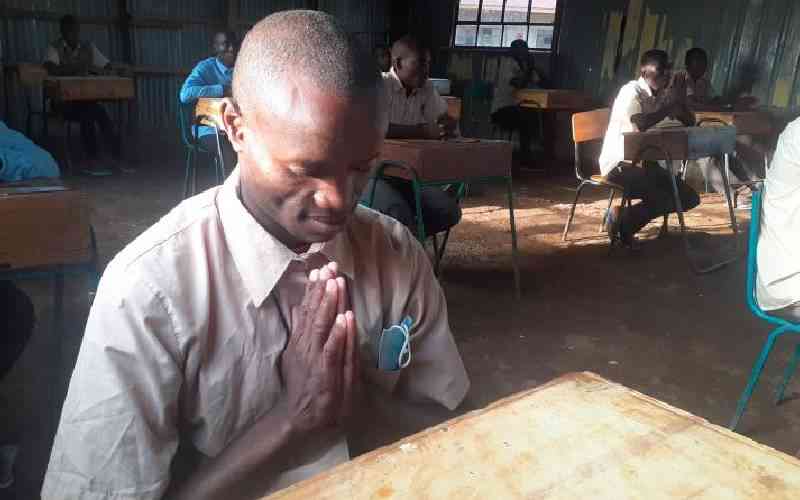
A candidate at Riooga SDA Mixed Secondary School meditates a prayer before the start of KCSE examinations. [Stanley Ongwae, Standard]
Pressure today is often imagined as something loud and dramatic. People recognise it only when it looks like panic, tears, or a complete breakdown. Anything quieter is brushed aside as overreacting or making excuses. But from my experience, pressure is rarely visible. It is silent, constant, and carried privately. It sits in the back of your mind during class, at home, late at night, and even in moments when you are supposed to be resting.
Follow The Standard
channel
on WhatsApp
Many young people avoid talking about it, not because it does not exist, but because they feel that no one will truly listen or try to understand.
My name is Noni Caitlin, and I am sixteen years old. I am not the most outgoing person, and speaking in front of people makes me nervous, especially when I feel like everyone is watching and judging. Changing schools was one of the hardest experiences for me because it forced me to adapt while already feeling unsure of myself. Walking into a new environment where everyone seemed confident and settled made me feel behind, both socially and academically.
At the same time, my parents’ divorce added another layer of emotional pressure that I did not always know how to talk about. It affected my sense of stability and made it harder to focus at school. I worried constantly about fitting in, keeping up, and proving that I deserved to be there. Even though my grades were not always the best, the stress surrounding them felt overwhelming. I often compared myself to others, which slowly made me doubt my own abilities and added to the quiet pressure I carried every day.
This pressure does not come from nowhere. It is shaped by what young people are constantly told success looks like. We are taught that life follows a clear path. First good grades, then top results, then achievements outside the classroom, leadership roles, awards, and recognition. There is little space left for mistakes, rest, or self-discovery. We are encouraged to prioritise performance over balance, often without realising what we are giving up in the process. Over time, this creates a fear of not doing enough or not being enough. When worth becomes tied only to achievement, it becomes difficult to separate who you are from what you produce.
For many young people, including myself, this pressure leads to anxiety. Anxiety is not always dramatic. Sometimes it looks like overthinking simple tasks, struggling to ask for help, or feeling sick before presentations. Sometimes it feels like constantly being on edge, waiting for something to go wrong. Depression can be even quieter. It can look like exhaustion, loss of motivation, or feeling disconnected from things you once cared about. These experiences are often misunderstood, especially by older generations who grew up in very different circumstances.
There is a common phrase that says pressure builds diamonds. It is often used to justify high expectations and intense environments. But what happens when the diamond starts to crack? From what I have seen and felt, constant pressure does not always lead to strength. Sometimes it leads to withdrawal, fear, and burnout. Instead of motivation, it creates paralysis. Instead of confidence, it creates doubt. When young people feel like they are constantly being measured, comparison becomes unavoidable.
Comparison is one of the most damaging effects of modern pressure. With social media and competitive academic environments, it becomes easy to measure your worth against others. Someone always seems to be doing better, achieving more, or coping more easily. Over time, this erodes self-confidence and replaces it with jealousy and self-doubt. In a world that rewards visibility and success, comparison quietly shapes how young people see themselves and how they believe they are seen by others.
What makes this even harder is that stories of struggle are often overlooked or dismissed. When young people express stress or anxiety, they are sometimes told that they are too young to feel this way or that others have it worse. While this may be true in some cases, it does not make our experiences any less real. As the world becomes more complex, the expectations placed on young people grow alongside it. We are preparing for futures that are uncertain, competitive, and constantly changing, yet we are rarely given the emotional tools to cope with that reality.
For me, caring about mental health is deeply personal. Anxiety and depression are topics that matter to me because I see how they affect people my age every day, including myself. I want to create awareness not for attention, but for understanding. I want older generations to recognise that the pressure placed on young people today is different from what they experienced. Technology, social comparison, academic competition, and global uncertainty all play a role in shaping how we grow up. Acknowledging this does not mean lowering standards. It means adjusting expectations to allow young people to grow without losing themselves in the process.
What young people need most is not constant praise or lowered expectations, but balance. We need environments where effort is valued alongside results, where curiosity matters as much as output, and where rest is not seen as laziness. We need spaces where it is safe to speak openly about pressure without fear of judgment. When young people feel heard and supported, they are more likely to develop resilience, motivation, and a genuine desire to contribute.
Success should not come at the cost of identity. Education and achievement should help young people discover who they are, not force them into narrow definitions of worth. If we want future generations to thrive, we must allow them to be human first and performers second. Recognising the invisible weight that young people carry is the first step toward change.
I do not want a world where people are only valued for their results. I want a world where people feel comfortable being themselves, where mental health is taken seriously, and where pressure does not define our worth. By creating a culture that values understanding, balance, and empathy, we can help young people grow into capable and confident individuals. Not perfect, but whole.
The writer is a student at Nairobi Academy
Follow The Standard
channel
on WhatsApp
A candidate at Riooga SDA Mixed Secondary School meditates a prayer before the start of KCSE examinations. [Stanley Ongwae, Standard]
[Stanley Ongwae, Standard]
Pressure today is often imagined as something loud and dramatic. People recognise it only when it looks like panic, tears, or a complete breakdown. Anything quieter is brushed aside as overreacting or making excuses. But from my experience, pressure is rarely visible. It is silent, constant, and carried privately. It sits in the back of your mind during class, at home, late at night, and even in moments when you are supposed to be resting.
Follow The Standard
channel
on WhatsApp
Many young people avoid talking about it, not because it does not exist, but because they feel that no one will truly listen or try to understand.
My name is Noni Caitlin, and I am sixteen years old. I am not the most outgoing person, and speaking in front of people makes me nervous, especially when I feel like everyone is watching and judging. Changing schools was one of the hardest experiences for me because it forced me to adapt while already feeling unsure of myself. Walking into a new environment where everyone seemed confident and settled made me feel behind, both socially and academically.
At the same time, my parents’ divorce added another layer of emotional pressure that I did not always know how to talk about. It affected my sense of stability and made it harder to focus at school. I worried constantly about fitting in, keeping up, and proving that I deserved to be there. Even though my grades were not always the best, the stress surrounding them felt overwhelming. I often compared myself to others, which slowly made me doubt my own abilities and added to the quiet pressure I carried every day.
This pressure does not come from nowhere. It is shaped by what young people are constantly told success looks like. We are taught that life follows a clear path. First good grades, then top results, then achievements outside the classroom, leadership roles, awards, and recognition. There is little space left for mistakes, rest, or self-discovery. We are encouraged to prioritise performance over balance, often without realising what we are giving up in the process. Over time, this creates a fear of not doing enough or not being enough. When worth becomes tied only to achievement, it becomes difficult to separate who you are from what you produce.
For many young people, including myself, this pressure leads to anxiety. Anxiety is not always dramatic. Sometimes it looks like overthinking simple tasks, struggling to ask for help, or feeling sick before presentations. Sometimes it feels like constantly being on edge, waiting for something to go wrong. Depression can be even quieter. It can look like exhaustion, loss of motivation, or feeling disconnected from things you once cared about. These experiences are often misunderstood, especially by older generations who grew up in very different circumstances.
There is a common phrase that says pressure builds diamonds. It is often used to justify high expectations and intense environments. But what happens when the diamond starts to crack? From what I have seen and felt, constant pressure does not always lead to strength. Sometimes it leads to withdrawal, fear, and burnout. Instead of motivation, it creates paralysis. Instead of confidence, it creates doubt. When young people feel like they are constantly being measured, comparison becomes unavoidable.
Comparison is one of the most damaging effects of modern pressure. With social media and competitive academic environments, it becomes easy to measure your worth against others. Someone always seems to be doing better, achieving more, or coping more easily. Over time, this erodes self-confidence and replaces it with jealousy and self-doubt. In a world that rewards visibility and success, comparison quietly shapes how young people see themselves and how they believe they are seen by others.
What makes this even harder is that stories of struggle are often overlooked or dismissed. When young people express stress or anxiety, they are sometimes told that they are too young to feel this way or that others have it worse. While this may be true in some cases, it does not make our experiences any less real. As the world becomes more complex, the expectations placed on young people grow alongside it. We are preparing for futures that are uncertain, competitive, and constantly changing, yet we are rarely given the emotional tools to cope with that reality.
For me, caring about mental health is deeply personal. Anxiety and depression are topics that matter to me because I see how they affect people my age every day, including myself. I want to create awareness not for attention, but for understanding. I want older generations to recognise that the pressure placed on young people today is different from what they experienced. Technology, social comparison, academic competition, and global uncertainty all play a role in shaping how we grow up. Acknowledging this does not mean lowering standards. It means adjusting expectations to allow young people to grow without losing themselves in the process.
What young people need most is not constant praise or lowered expectations, but balance. We need environments where effort is valued alongside results, where curiosity matters as much as output, and where rest is not seen as laziness. We need spaces where it is safe to speak openly about pressure without fear of judgment. When young people feel heard and supported, they are more likely to develop resilience, motivation, and a genuine desire to contribute.
Success should not come at the cost of identity. Education and achievement should help young people discover who they are, not force them into narrow definitions of worth. If we want future generations to thrive, we must allow them to be human first and performers second. Recognising the invisible weight that young people carry is the first step toward change.
Stay informed. Subscribe to our newsletter
I do not want a world where people are only valued for their results. I want a world where people feel comfortable being themselves, where mental health is taken seriously, and where pressure does not define our worth. By creating a culture that values understanding, balance, and empathy, we can help young people grow into capable and confident individuals. Not perfect, but whole.
The writer is a student at Nairobi Academy
Follow The Standard
channel
on WhatsApp
By Noni Njuguna