

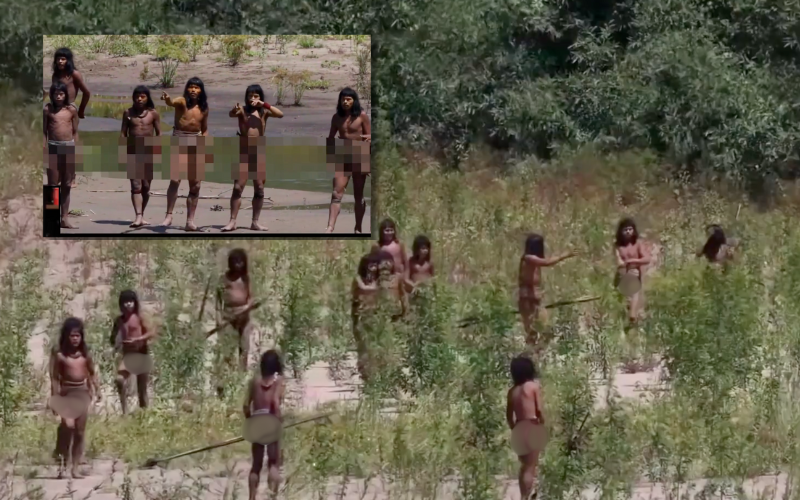
Never-before-seen high-definition footage of an uncontacted Amazonian tribe has captivated the world, revealing a tense yet mesmerising encounter deep in Peru’s rainforest.
The footage, shared by conservationist Paul Rosolie during a January 2026 interview on the Lex Fridman Podcast, shows an unprecedented clarity of a group so reclusive and seemingly isolated from modern society.
Now viral, the video highlights the fragility of these communities amid mounting threats, capturing what appears to be members of the Mashco Piro, one of the largest uncontacted groups in the Amazon.
The tribe is seen emerging from the forest, laying down their bows and arrows on a riverbank beach, while pointing and staring at a canoe carrying plantains and bananas, brought by one of the visitors, anthropologist Ignacio, who accompanied Rosolie.
“The tribe moved closer to Ignacio and asked for his shirt and pants. At some point, Ignacio warmed up and started dancing a bit, and the tribe danced back, waving. We had a great moment where we gave them what they wanted,” Rosolie explained to Lex Fridman.
With over 20 years of experience in the Amazon, Rosolie filmed using an 800mm lens with a 2x teleconverter—producing far sharper images than previous blurry shots taken from over 100 meters away.
Initially, the ‘warriors’ moved in a tight defensive formation, bows at the ready, eyes scanning for potential threats. Their body language gradually shifted from tension to cautious curiosity.
Unlike grainy aerial or distant photos, this up-close view humanises the tribe, revealing their deliberate, warrior-like grace against the lush greenery of their environment.
The encounter also underscored a crisis: as Rosolie noted, “they were starving,” which explains their acceptance of the plantains and bananas.
Uncontacted Amazonian tribes face growing threats from illegal logging, mining, and drug trafficking that encroach on their ancestral lands.
These pressures have pushed some groups, like the Mashco Piro, closer to modern settlements.
In 2024, over 50 members were spotted near logging concessions along 200 km of new roads, leaving them “nowhere else to go,” according to Survival International and FENAMAD.
Globally, there are around 200 uncontacted groups, mostly in the Amazon across Brazil and Peru, monitored via satellite to avoid deadly contact and prevent disease exposure.