

Most parents with Grade 10 children are running from one school to another, one county to another, looking for a “good school.”
One parent visited more than 10 schools before finally securing a place for their child in one of them.
A mysterious “approval” is causing more anxiety as parents wait. What exactly is a “good school” that parents are looking for?
Before answering that, some digression: it’s curious how we easily imported the American political system with governors but not other institutional frameworks like schooling.
Follow The Standard
channel
on WhatsApp
In that country, children go to school where they live, and parents pay taxes in well-demarcated school districts. Boarding schools are rare.
The Canadian and German systems are even more attractive, with the class system muted. Up to high school, there are no school fees; taxes do the work.
And there is a great effort to ensure no school district is left behind. Federal money tries to uplift any district left behind. That is the purpose of Federal Title I funding, which “provides supplemental financial assistance to school districts for children from low-income families.
Its purpose is to provide all children a significant opportunity to receive a fair, equitable, and high-quality education and to close educational achievement gaps by allocating federal funds for education programmes and services.”
We should emulate that by pooling all the bursaries and scattered funds. What is the equalisation fund used for?
Back to good schools. I asked a few Kenyans what they consider to be a good school. Sample responses include “a history of good academic performance.”
“A school that grows a teenage mind into an all-round confident and ambitious young person, coupled with respect and a yearning to impact society positively.”
Performance is at the back of every parent’s mind. But how do we get good schools if we don’t want competition and ranking? Let me start by sharing my own experience. I went through two diametrically opposite schools. One for four years, the other two. But that was enough time to know what a good school is.
The first school was on the outskirts of the city. The school started in 1924 as a technical school. Its objective, unknown to me, was to produce manpower as soon as possible.
And true it did; many of my classmates left after Form Two and started working. The second school focused on making you go up the corporate or public ladder. It had a strong culture, a strong religious foundation, and a global outlook.
Students even went for an exchange programme in the US. There was a lot of interaction with other schools, including girls’ schools. We loved Kotet.
In my earlier life, I taught high school physics and maths and got deep insight into good schools. I also have interacted enough with private schools.
I have also visited schools in the US Deep South and Germany, and here is my list of indicators of a good school. You can enrich the list.
Great schools have a heritage. That is why the most prestigious schools are old, like Mang’u, Maseno, or Kenya High.
They have built a name and reputation perpetuated by successful alumni. This heritage includes rituals, a language, some mannerisms, and even jokes. A good example: by declaring that I never “dissolved anyone or lifted,” you can guess the school I went through.
Sadly, modernism is spoiling that heritage and those traditions. Old architecture often defines the physical heritage. That heritage is enriched if generations of families go through the school.
Good schools inspire the students. They use the alumni, teachers, guest speakers, and the history of the school.
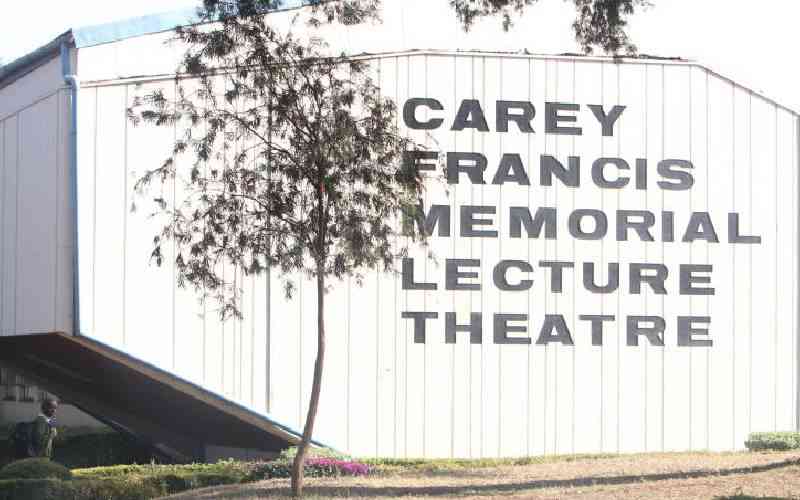
Inspired teachers inspire students. Alliance has Carey Francis. What about your school? The inspiration goes beyond good grades to careers, public service, philanthropy, and legacies.
Which school would allow its former headmaster to be buried there like Geoffrey Griffin at Starehe?
Good schools have sports and other facilities. Facilities are not overstretched. Curiously, one of the selling points of American universities is the percentage of classes with fewer than 20 students or the student-faculty ratio.
I know of schools in Kenya where students can’t take a break at the same time; they can’t fit in the field!
Did I see a school with over 1,000 Kenya Certificate of Secondary Education (KCSE) candidates? How do students get their “identity” and a sense of belonging in such a school?
Clearly, Kenya boasts of mega schools! In good schools, the facilities should be commensurate with the number of students.
I wonder how principals handle these numbers. Management experts have good case studies. Can we define the optimal size of a school?
Good schools have an enriched curriculum. Beyond the mandatory subjects, what else does the school offer? Think of foreign languages, sports, music, clubs, travelling, and exchanges with other countries.
Location matters too. Does it surprise you that most of the original national schools are near Nairobi? And the emerging private schools are also nearby. Do you remember the fate of Garba Tula? Would its location have made a difference? The new far-flung national schools are not as popular as the nearer ones. Alumni matter, more so if they are influential and philanthropic. Which schools have benefited from their alumni, like the American universities whose endowment funds rival our national budgets?
When did you last visit your high school after picking up the certificate? Any donation?
Good schools are well managed. That used to be easy when headmasters were let to run schools and meritocracy gave them jobs.
Today, there is too much interference in the running of schools. Why are board members not elected? Do the key stakeholders, like parents, students, government, and religious organisations, check each other?
Good schools have a reputation; it could be academic performance, sports, discipline, drama, or music. Alumni are proud to be associated with their alma mater. How about the name? A school’s name should be inspiring, not Mung’etho, Mbitini, or Mbari ya Hiti!
Good schools offer a lifetime experience. A good example is multiculturalism. Is that what we are “forcing” by admitting children far away from home? That sounds like “busing” after American schools were desegregated. That would work if we exorcised the ghosts of post-election violence and tribalism. Finally, good schools charge fees commensurate with quality. That is where the government comes in to subsidise education as a public good.
Are the fees charged by our schools fair? Just examine the quality of facilities and services. However, in the West, schools are free from primary school to high school.
What other indicators of a good school have I missed? Did you attend a good school?
Follow The Standard
channel
on WhatsApp
By XN Iraki