



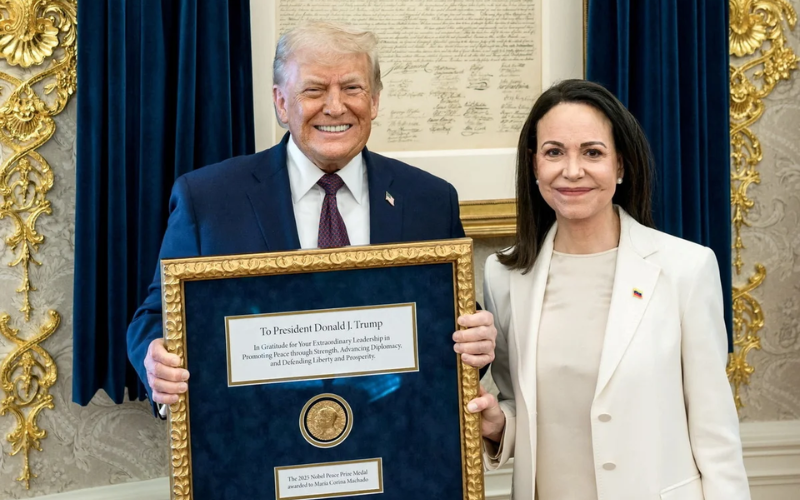
The Nobel Foundation has made it clear that a Nobel Prize cannot be transferred to another person, even symbolically, after controversy erupted over the 2025 Nobel Peace Prize awarded to Venezuelan opposition leader María Corina Machado.
The clarification followed Machado’s decision to present her physical Nobel Peace Prize medal to U.S. President Donald Trump during a meeting at the White House on January 15.
Although Trump accepted the medal, the Nobel Foundation emphasised that the honour and official award remain Machado’s and cannot legally be reassigned.
Statement from the Nobel Foundation
One of the core missions of the Nobel Foundation is to safeguard the dignity of the Nobel Prizes and their administration. The Foundation upholds Alfred Nobel’s will and its stipulations. It states that the prizes shall be awarded to those who… pic.twitter.com/WIadOBLtpD
— The Nobel Prize (@NobelPrize) January 18, 2026
In a statement released on January 16, the foundation said Machado’s gesture does not change the committee’s original decision, stressing that its mandate is to protect the integrity of the Nobel Prizes and strictly follow the conditions of Alfred Nobel’s will.
“The prizes are awarded to individuals who have conferred the greatest benefit to humankind,” the statement noted, adding that Nobel statutes clearly define who has the authority to grant and retain each prize. “A prize can therefore not, even symbolically, be passed on or further distributed.”
Machado was named the 2025 Nobel Peace Prize laureate in October for her sustained efforts to promote democracy in Venezuela amid growing authoritarianism.
This recognition of the struggle of all Venezuelans is a boost to conclude our task: to conquer Freedom.
We are on the threshold of victory and today, more than ever, we count on President Trump, the people of the United States, the peoples of Latin America, and the democratic…
— María Corina Machado (@MariaCorinaYA) October 10, 2025
The Nobel Committee highlighted her leadership and resilience, especially after she was barred from running in Venezuela’s 2024 presidential election by the government of President Nicolás Maduro.
Unable to run, Machado supported opposition candidate Edmundo González Urrutia.
The July 2024 election ended in dispute, with both Maduro and González claiming victory; several international leaders, including Trump, rejected the legitimacy of Maduro’s claimed win.
Since then, Venezuela has seen dramatic political developments.
On January 3, U.S. forces arrested Maduro and his wife, Cilia Flores, on charges related to narcotrafficking and corruption.
Vice President Delcy Rodríguez was sworn in as interim president and has expressed a willingness to work with the U.S.—a development Trump publicly welcomed as American companies resumed Venezuelan oil purchases.
Observers interpreted Machado’s decision to present the medal to Trump as a strategic gesture aimed at strengthening ties with his administration during Venezuela’s transition.
She had earlier dedicated the award to Trump shortly after her win.
Machado characterised the moment as Venezuelans symbolically honouring “the heir of Washington” for his support of their freedom and compared it to a historical gesture where the French hero Marquis de Lafayette honoured Simón Bolívar with a medal depicting George Washington.
Nonetheless, the Nobel Institute reiterated that Nobel Prizes are permanent and irreversible.
“A Nobel Prize cannot be revoked, shared, or transferred. Once announced, the decision stands forever,” the institute stated.
Despite this, Trump intends to keep the medal.
On X, White House Deputy Secretary Anna Kelly criticised the Nobel committee, calling their position “some pretentious nonsense” and accusing them of choosing “criticism over recognition” of Trump’s efforts toward peace.
White House Director of Communications Steven Cheung also accused the Nobel Foundation of “playing politics” and said it should highlight the president’s “unprecedented accomplishments.”