

Sea time training of cadets continues to pose a challenge for the country because of a lack of a training vessel.
The country will have to sign agreements with ship-owning countries to train its cadets to become qualified officers in its quest for the lucrative seafaring jobs.
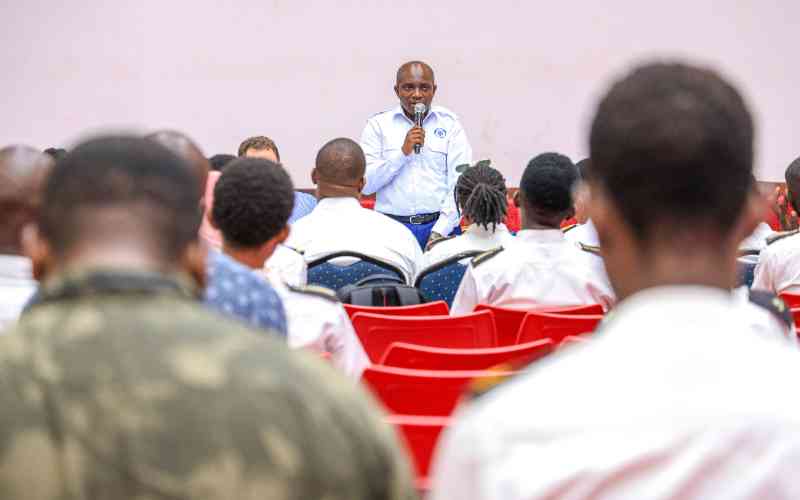
Yesterday, Bandari Maritime Academy Dr Eric Katana said the institution recently signed pacts with Saudi Arabia and Dominican Republic and was set to ink another deal with Singapore in the next two weeks to get training opportunities for cadets who have completed coursework at the academy.
Follow The Standard
channel
on WhatsApp
Katana reaffirmed the academy’s commitment to addressing the long-standing challenge of sea time placement for maritime students pursuing marine and engineering and nautical science, noting that the collaboration with Danica was a major milestone in BMA’s efforts to produce competent and globally competitive seafarers by ensuring that the cadets acquire mandatory practical sea time required for certification and career progression.
“This partnership goes beyond training; it is about securing the future of our young maritime professionals. Sea time remains a critical component of maritime, and we are grateful to Danica for opening doors for our cadets to gain invaluable on-board experience on internationally trading vessels,” Katana stated.
At the BMA during the flag off of 10 nautical science and marine engineering cadets who were recruited by Danica Crewing Specialists for sea time training, Katana and other countries in the world are still struggling to get training opportunities on a ship because of the lack of their own vessels.
“Sea time training for cadets is not a challenge for only Kenya. It is a global issue. This is because Kenya has no training ship at the moment. But we are signing MOUs with a number of countries to get the mandatory training opportunities,” he explained.
Kenyan marine cadets have to go for six months training on board vessels to qualify as ship officers recognised by the Kenya Maritime Authority (KMA) and the United Nations’ International Maritime Organisation (IMO) under the Standard of Training, Certification and Watchkeeping STCW) 1995 convention.
Katana said there are 120 cadets on the waiting list for sea time training from the academy while 43 are onboard various ships.
He said Kenya and Africa have a huge opportunity for seafaring jobs because many countries in Europe and elsewhere have ageing populations.
He commended Mining, Blue Economy and Maritime Affairs Cabinet Secretary Hassan Joho for pushing for the signing of more MOUs to ensure local cadets get training opportunity onboard foreign going vessels.
Danica Crewing Specialists’ chief executive officer Mr Henrik Jensen said Kenya, with a youthful population, has potential in the labour market. “In Africa, we have started with Kenya in the recruitment of cadets for training opportunities,” Jensen said.
Jensen lauded BMA for its dedication to quality maritime education and expressed Danica’s commitment to nurturing the next generation of seafarers.
He noted that the cadets will be exposed to real-world ship operations, international safety standards and professional shipboard culture, which are essential in in shaping disciplined and skilled maritime officers.
KMA assistant director, maritime labour, Josephine Nthia, underscored the authority’s support for structured sea time training programme, including the STCW.
BMA’s principal nautical science trainer Major (Rtd) Frankline Toniok encouraged the cadets to uphold professionalism, discipline and integrity while at se, reminding them that they are the ambassadors of the academy and the country.
Engine cadet Franklin Kagechu and deck cadet Marion Madzo expressed gratitude for the opportunity and pledged to be disciplined as they embarked on the next phase of their career.
Maritime recruitment specialists across the world have sounded alarm bells about a deepening crew shortage and Africa is seen as the next source of labour.
Jensen recently gave his warning at the Global Crew Connect event that African governments and training institutions should seize the opportunity and train for the viable career pathways.
Global shipping depends on approximately 1.89 million seafarers to keep vessels moving, yet traditional maritime nations like the Philippines, Indonesia, and China cannot meet growing demand despite their dominance in crew supply.
Companies like Danica Crewing Specialists, which manages up to 1,700 crew members, are actively expanding recruitment into Kenya and other African markets to address the maritime labour demand.
An able-bodied seafarer (the lowest rank) can earn between US$3000 (Sh387,000) and US$5000 (Sh645,000) dollars per month and officers fetch higher perks.
Follow The Standard
channel
on WhatsApp
Sea time training of cadets continues to pose a challenge for the country because of a lack of a training vessel.
The country will have to sign agreements with ship-owning countries to train its cadets to become qualified officers in its quest for the lucrative seafaring jobs.
Yesterday, Bandari Maritime Academy Dr Eric Katana said the institution recently signed pacts with Saudi Arabia and Dominican Republic and was set to ink another deal with Singapore in the next two weeks to get training opportunities for cadets who have completed coursework at the academy.
Follow The Standard
channel
on WhatsApp
Katana reaffirmed the academy’s commitment to addressing the long-standing challenge of sea time placement for maritime students pursuing marine and engineering and nautical science, noting that the collaboration with Danica was a major milestone in BMA’s efforts to produce competent and globally competitive seafarers by ensuring that the cadets acquire mandatory practical sea time required for certification and career progression.
“This partnership goes beyond training; it is about securing the future of our young maritime professionals. Sea time remains a critical component of maritime, and we are grateful to Danica for opening doors for our cadets to gain invaluable on-board experience on internationally trading vessels,” Katana stated.
At the BMA during the flag off of 10 nautical science and marine engineering cadets who were recruited by Danica Crewing Specialists for sea time training, Katana and other countries in the world are still struggling to get training opportunities on a ship because of the lack of their own vessels.
“Sea time training for cadets is not a challenge for only Kenya. It is a global issue. This is because Kenya has no training ship at the moment. But we are signing MOUs with a number of countries to get the mandatory training opportunities,” he explained.
Kenyan marine cadets have to go for six months training on board vessels to qualify as ship officers recognised by the Kenya Maritime Authority (KMA) and the United Nations’ International Maritime Organisation (IMO) under the Standard of Training, Certification and Watchkeeping STCW) 1995 convention.
Katana said there are 120 cadets on the waiting list for sea time training from the academy while 43 are onboard various ships.
He said Kenya and Africa have a huge opportunity for seafaring jobs because many countries in Europe and elsewhere have ageing populations.
He commended Mining, Blue Economy and Maritime Affairs Cabinet Secretary Hassan Joho for pushing for the signing of more MOUs to ensure local cadets get training opportunity onboard foreign going vessels.
Danica Crewing Specialists’ chief executive officer Mr Henrik Jensen said Kenya, with a youthful population, has potential in the labour market. “In Africa, we have started with Kenya in the recruitment of cadets for training opportunities,” Jensen said.
Jensen lauded BMA for its dedication to quality maritime education and expressed Danica’s commitment to nurturing the next generation of seafarers.
He noted that the cadets will be exposed to real-world ship operations, international safety standards and professional shipboard culture, which are essential in in shaping disciplined and skilled maritime officers.
Stay informed. Subscribe to our newsletter
KMA assistant director, maritime labour, Josephine Nthia, underscored the authority’s support for structured sea time training programme, including the STCW.
BMA’s principal nautical science trainer Major (Rtd) Frankline Toniok encouraged the cadets to uphold professionalism, discipline and integrity while at se, reminding them that they are the ambassadors of the academy and the country.
Engine cadet Franklin Kagechu and deck cadet Marion Madzo expressed gratitude for the opportunity and pledged to be disciplined as they embarked on the next phase of their career.
Maritime recruitment specialists across the world have sounded alarm bells about a deepening crew shortage and Africa is seen as the next source of labour.
Jensen recently gave his warning at the Global Crew Connect event that African governments and training institutions should seize the opportunity and train for the viable career pathways.
Global shipping depends on approximately 1.89 million seafarers to keep vessels moving, yet traditional maritime nations like the Philippines, Indonesia, and China cannot meet growing demand despite their dominance in crew supply.
Companies like Danica Crewing Specialists, which manages up to 1,700 crew members, are actively expanding recruitment into Kenya and other African markets to address the maritime labour demand.
An able-bodied seafarer (the lowest rank) can earn between US$3000 (Sh387,000) and US$5000 (Sh645,000) dollars per month and officers fetch higher perks.
Follow The Standard
channel
on WhatsApp
By Patrick Beja