

Africa has been urged to tap into domestic resources to finance climate action, instead of relying on external funding which is limiting the continent’s ability to respond to escalating climate risks.
Speaking during the IGAD Summit for the 72nd Greater Horn of Africa Climate Outlook Forum (GHACOF 72), Environment and Climate Change Principal Secretary Festus Ng’eno said Africa must be self-reliant in securing climate funding to build resilience across communities.
“We must utilise our own resources to source climate funding. We need to be self-sufficient,” Ng’eno said. He urged leaders from IGAD member states to invest in domestic mechanisms for climate financing, rather than depend on external donors.
Follow The Standard
channel
on WhatsApp
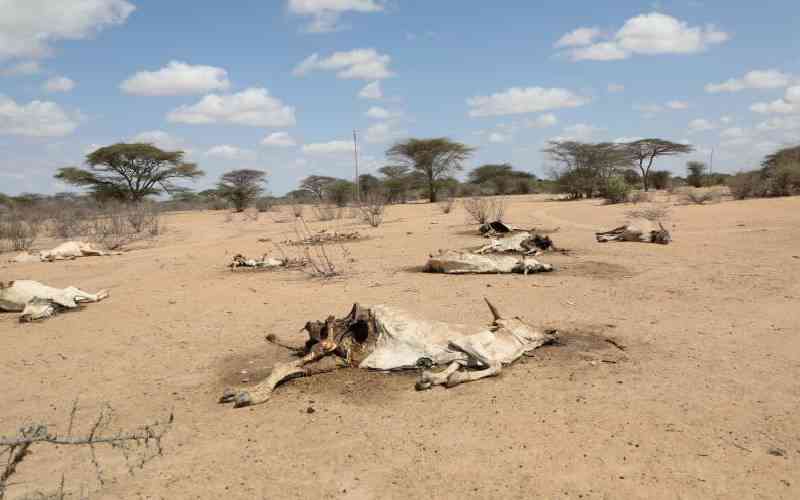
The call comes as Kenya and the greater Horn of Africa face one of the driest rainy seasons on record, with the October–December 2025 rains delivering 30 to 60 per cent of normal rainfall in many areas, according to climate assessments. This has deepened drought conditions, especially in the arid and semi-arid lands (ASALs) in the Northern and Eastern Kenya, with Mandera being ranked in the “alarm” drought phase and nine other counties in the “alert” zone as of late 2025.
Experts warn that poor rainfall will persist into early 2026, worsening water scarcity, pasture loss and food insecurity. Across the Greater Horn of Africa, the failure of the short rains has driven a sharp rise in drought vulnerability, with as many as 20 to 25 million people in Kenya, Somalia and Ethiopia in need of food assistance due to climate stresses.
At the summit, participants stressed that early warning systems are critical, providing timely and effective information to communities and decision-makers ahead of climate disasters.
But gaps in data collection and forecasting remain a major impediment to effective response.
“We have to collect data from the ground and from satellite. At a time of digital age, we need to improve our technical capacity,” said Dr Abdi Fidar, director of the IGAD Climate Prediction and Applications Centre (ICPAC), underlining the need for better climate science tools across the region.
Follow The Standard
channel
on WhatsApp
Africa has been urged to tap into domestic resources to finance climate action, instead of relying on external funding which is limiting the continent’s ability to respond to escalating climate risks.
Speaking during the IGAD Summit for the 72nd Greater Horn of Africa Climate Outlook Forum (GHACOF 72), Environment and Climate Change Principal Secretary Festus Ng’eno said Africa must be self-reliant in securing climate funding to build resilience across communities.
“We must utilise our own resources to source climate funding. We need to be self-sufficient,” Ng’eno said. He urged leaders from IGAD member states to invest in domestic mechanisms for climate financing, rather than depend on external donors.
Follow The Standard
channel
on WhatsApp
The call comes as Kenya and the greater Horn of Africa face one of the driest rainy seasons on record, with the October–December 2025 rains delivering 30 to 60 per cent of normal rainfall in many areas, according to climate assessments. This has deepened drought conditions, especially in the arid and semi-arid lands (ASALs) in the Northern and Eastern Kenya, with Mandera being ranked in the “alarm” drought phase and nine other counties in the “alert” zone as of late 2025.
Experts warn that poor rainfall will persist into early 2026, worsening water scarcity, pasture loss and food insecurity. Across the Greater Horn of Africa, the failure of the short rains has driven a sharp rise in drought vulnerability, with as many as 20 to 25 million people in Kenya, Somalia and Ethiopia in need of food assistance due to climate stresses.
At the summit, participants stressed that early warning systems are critical, providing timely and
effective information to communities
and decision-makers ahead of climate disasters.
But gaps in data collection and forecasting remain a major impediment to effective response.
“We have to collect data from the ground and from satellite. At a time of digital age, we need to improve our technical capacity,” said Dr Abdi Fidar, director of the IGAD Climate Prediction and Applications Centre (ICPAC), underlining the need for better climate science tools across the region.
Follow The Standard
channel
on WhatsApp
By Sofia Ali