

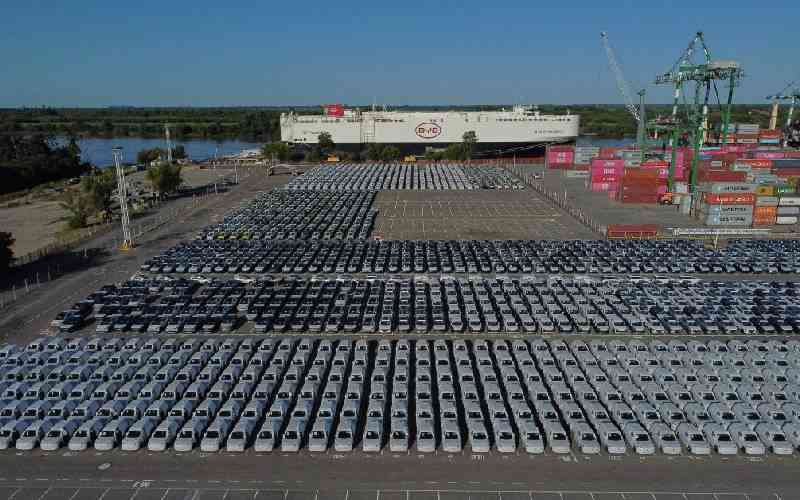
Electric Vehicles unloaded from the BYD Changzhou at the Port Terminal of Zarate after the vessel arrived from Singapore carrying a record shipment of 7,000 electric cars, on January 20, 2026. [AFP]
The first TV set in your home was likely a black-and-white Great Wall.
Later, it was enhanced with a colour screen! That was the most popular TV set in the 1980s and 1990s, particularly in the countryside.
Through the Great Wall, cheap and affordable TVs became a household item in Kenya. Long aerials on rooftops signalled that the home had a TV, and it was prestigious, especially during World Cup tournaments.
Follow The Standard
channel
on WhatsApp
The Great Wall TVs used cathode ray tubes, not liquid crystal displays, which now allow us to hang the TV on the wall.
It’s the same technology used in your watch and phone screens. With artificial intelligence (AI), we have no time for the basics, to know where we came from.
Luckily, traditional watches remind us of the analogue age. Curiously, some of the most expensive watches are analogue. How did watchmakers convince us that being old-fashioned is cool and expensive?
It’s probably the failure to shift to the new technology that doomed Great Wall TV, just as the BlackBerry phones failed to quickly shift to touch screens.
Colour TV, just like colour photographs, became widespread.
Cathode ray tube TVs, like printed photos, ran out of fashion.
Why did the Great Wall not bring us the next generation of TVs?
The Chinese penetrated the Kenyan TV market through pricing. They have used that strategy with other products.
Traders who frequent China are driven by low prices.
And they go one step further, matching price to quality.
What attracts Kenyans to China Square and China City on the Chinese-built superhighway?
Prices. China Square now has locations beyond Nairobi.
Why the obsession with Great Wall TV? We also have Great Wall Motors (GWM); they come in all sizes from SUVs to pickups.
Have you seen them on the Kenyan roads?
It’s more than the name; China’s most famous landmark, the Great Wall, was built from 770 BC onwards.
The Great Wall TV moment is likely to be replicated with electric cars. Chinese carmaker BYD (Beyond Your Dream) surpassed Tesla in the production of electric cars last year. That was a milestone.
The fear now is that China will slowly kill the internal combustion engine by mass-producing cheaper electric cars.
And it had a head start on such cars through Research and Development (R&D) and less legacy technology.
Many know the future of cars is electric, even the big and old Western firms. But how to wean off old engines, technology, and jobs thereof is the problem.
The auto industry creates lots of jobs and is a source of national prestige. Remember the US government rescuing Chrysler and GM from bankruptcy?
Remember President Moi and the Nyayo Car?
Why has no one tried after him? How far did Nderitu Mureithi go with BJ-50 in Laikipia? I was ready to buy one.
Will the auto industry follow the steel industry, which was once the pride of Western countries?
New technology and cheaper labour brought new players into the sector.
That led to the closure of once-famous steel mills like Bethlehem in the US.
Remember the Rust Belt? British Steel is now Chinese-owned. Many steel mills in the West are struggling.
China suffers less from legacy technology, best espoused by the internal combustion engine. Remember the Kodak trap in the old film technology as digital cameras became the norm?
China has another “advantage”: state control, which can distort the market easily, riding on nationalism and pride.
In China, the visible hand of the government can override the invisible hand of the market. Is our government trying to be “Chinese” in its economic projects?
Where do we go from here? Have you noted the small cars on the Kenyan road, recently imported from Japan, called “Keijidosha,” or “light automobile” in Japanese?
They originally had engines of a maximum of 660 cc.
There are many nowadays, and they slow down the traffic on many highways.
But their fuel efficiency and prices make them attractive.
After Keijidosha, we can predict without the hindsight of a prophet that electric cars will follow; no worry over fuel, only charging.
And there is already a working model with motorbikes, where you exchange the battery. We can do the same with car batteries.
The breakthrough is almost here; we shall soon start charging our cars at home like phones.
Imagine calling someone: “Ngojea kidogo gari injae moto”—wait, the car is not fully charged.
Anyone with basic science and technology knowledge can confirm that making an electric car is easy. Do you recall electric toy cars?
The battery is the key bottleneck, just like the transmission (gearbox) in an internal combustion engine.
The battery improvement is showing a lot of promise, and the price has been going down.
Whoever wins the race in making longer-lasting and more reliable batteries will win the electric car race. One focus of R&D is making batteries that do not use rare earth metals or critical minerals.
Just like Keijidosha made cars more affordable, electric cars will make cars more affordable, just like Great Wall TVs.
Kenyans dislike small cars; they prefer big cars to make statements! The economic reality will humble us.
Check the size of the car ahead of you on the road today.
The reality is there for all to see: the predominance of electric motorcycles in the city.
I expect cars to follow soon, and China may be the major source.
Curiously, India has been a leader in the growth of motorcycles in Kenya and Eastern Africa.
In Uganda, a motorcycle is called a “Bajaj,” which is very Indian. Why have Indian cars not made Kenya their home?
They tried Mahindra through the Kenya Police. It was not a very successful experiment.
Interestingly, Mahindra is doing well in South Africa. How will India fare in the race to electric cars?
A closing and solemn question is whether we shall still be spectators in this technological revolution, just as we were with the internal combustion engine.
Was the Nyayo Pioneer Car project our last shot at making cars?
Follow The Standard
channel
on WhatsApp
Electric Vehicles unloaded from the BYD Changzhou at the Port Terminal of Zarate after the vessel arrived from Singapore carrying a record shipment of 7,000 electric cars, on January 20, 2026.
[AFP]
The first TV set in your home was likely a black-and-white Great Wall.
Later, it was enhanced with a colour screen! That was the most popular TV set in the 1980s and 1990s, particularly in the countryside.
Through the Great Wall, cheap and affordable TVs became a household item in Kenya. Long aerials on rooftops signalled that the home had a TV, and it was prestigious, especially during World Cup tournaments.
Follow The Standard
channel
on WhatsApp
The Great Wall TVs used cathode ray tubes, not liquid crystal displays, which now allow us to hang the TV on the wall.
It’s the same technology used in your watch and phone screens. With artificial intelligence (AI), we have no time for the basics, to know where we came from.
Luckily, traditional watches remind us of the analogue age. Curiously, some of the most expensive watches are analogue. How did watchmakers convince us that being old-fashioned is cool and expensive?
It’s probably the failure to shift to the new technology that doomed Great Wall TV, just as the BlackBerry phones failed to quickly shift to touch screens.
Colour TV, just like colour photographs, became widespread.
Cathode ray tube TVs, like printed photos, ran out of fashion.
Why did the Great Wall not bring us the next generation of TVs?
The Chinese penetrated the Kenyan TV market through pricing. They have used that strategy with other products.
Traders who frequent China are driven by low prices.
And they go one step further, matching price to quality.
What attracts Kenyans to China Square and China City on the Chinese-built superhighway?
Stay informed. Subscribe to our newsletter
Prices. China Square now has locations beyond Nairobi.
Why the obsession with Great Wall TV? We also have Great Wall Motors (GWM); they come in all sizes from SUVs to pickups.
Have you seen them on the Kenyan roads?
It’s more than the name; China’s most famous landmark, the Great Wall, was built from 770 BC onwards.
The Great Wall TV moment is likely to be replicated with electric cars. Chinese carmaker BYD (Beyond Your Dream) surpassed Tesla in the production of electric cars last year. That was a milestone.
The fear now is that China will slowly kill the internal combustion engine by mass-producing cheaper electric cars.
And it had a head start on such cars through Research and Development (R&D) and less legacy technology.
Many know the future of cars is electric, even the big and old Western firms. But how to wean off old engines, technology, and jobs thereof is the problem.
The auto industry creates lots of jobs and is a source of national prestige. Remember the US government rescuing Chrysler and GM from bankruptcy?
Remember President Moi and the Nyayo Car?
Why has no one tried after him? How far did Nderitu Mureithi go with BJ-50 in Laikipia? I was ready to buy one.
Will the auto industry follow the steel industry, which was once the pride of Western countries?
New technology and cheaper labour brought new players into the sector.
That led to the closure of once-famous steel mills like Bethlehem in the US.
Remember the Rust Belt? British Steel is now Chinese-owned. Many steel mills in the West are struggling.
China suffers less from legacy technology, best espoused by the internal combustion engine. Remember the Kodak trap in the old film technology as digital cameras became the norm?
China has another “advantage”: state control, which can distort the market easily, riding on nationalism and pride.
In China, the visible hand of the government can override the invisible hand of the market. Is our government trying to be “Chinese” in its economic projects?
Where do we go from here? Have you noted the small cars on the Kenyan road, recently imported from Japan, called “Keijidosha,” or “light automobile” in Japanese?
They originally had engines of a maximum of 660 cc.
There are many nowadays, and they slow down the traffic on many highways.
But their fuel efficiency and prices make them attractive.
After Keijidosha, we can predict without the hindsight of a prophet that electric cars will follow; no worry over fuel, only charging.
And there is already a working model with motorbikes, where you exchange the battery. We can do the same with car batteries.
The breakthrough is almost here; we shall soon start charging our cars at home like phones.
Imagine calling someone: “Ngojea kidogo gari injae moto”—wait, the car is not fully charged.
Anyone with basic science and technology knowledge can confirm that making an electric car is easy. Do you recall electric toy cars?
The battery is the key bottleneck, just like the transmission (gearbox) in an internal combustion engine.
The battery improvement is showing a lot of promise, and the price has been going down.
Whoever wins the race in making longer-lasting and more reliable batteries will win the electric car race. One focus of R&D is making batteries that do not use rare earth metals or critical minerals.
Just like Keijidosha made cars more affordable, electric cars will make cars more affordable, just like Great Wall TVs.
Kenyans dislike small cars; they prefer big cars to make statements! The economic reality will humble us.
Check the size of the car ahead of you on the road today.
The reality is there for all to see: the predominance of electric motorcycles in the city.
I expect cars to follow soon, and China may be the major source.
Curiously, India has been a leader in the growth of motorcycles in Kenya and Eastern Africa.
In Uganda, a motorcycle is called a “Bajaj,” which is very Indian. Why have Indian cars not made Kenya their home?
They tried Mahindra through the Kenya Police. It was not a very successful experiment.
Interestingly, Mahindra is doing well in South Africa. How will India fare in the race to electric cars?
A closing and solemn question is whether we shall still be spectators in this technological revolution, just as we were with the internal combustion engine.
Was the Nyayo Pioneer Car project our last shot at making cars?
Follow The Standard
channel
on WhatsApp
By XN Iraki