



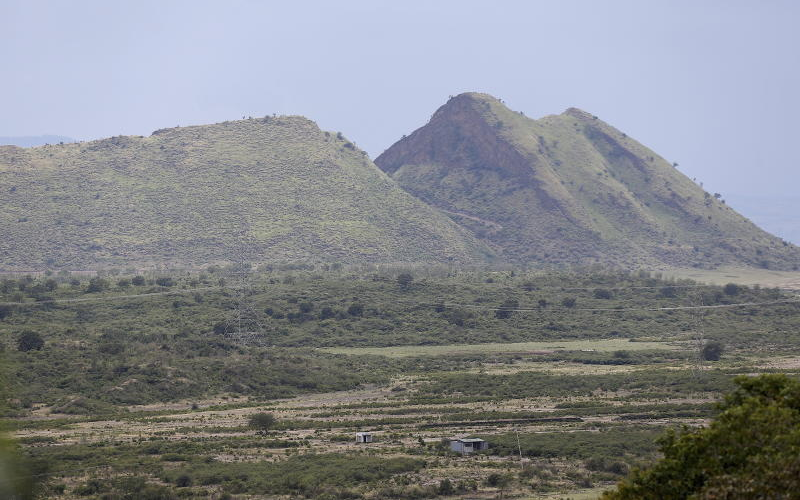
The sleeping Warrior hill at the Lake Elementaita. [Wilberforce Okwiri, Standard]
My travel itinerary has, in recent years, leaned heavily towards adventure: Camping, road trips, hiking trails, walking excursions, conservation tourism, and Airbnbs tucked away in unlikely places.
After chasing waterfalls, navigating road trips, pitching tents, and exploring conservancies, I decided to start 2026 with a hiking challenge closer to home – a return to the shores of Lake Elementaita to conquer the Sleeping Warrior, nestled within the vast Soysambu Conservancy.
This was my second attempt. My first endeavour, in 2024 did not quite go as planned.
I have driven along the Nairobi–Naivasha Road countless times, yet each journey feels like a first encounter. For anyone passionate about travel, familiar routes always reveal something new.
On this particular morning, I was seeking communion with nature, losing myself to music as the Rift Valley unfolded in dramatic backdrops.
I made my first stop at Kikopey, where I picked up Joseph Mochoge, my guide for the day. Before heading to the lake, he insisted I sample Kikopey’s signature muteta soup, a ritual that marks the beginning of many journeys through this landscape.
Over the brief stop, Mochoge explained that Kikopey lies along an ancient route once used by ivory and slave traders on their way to the coast. Today, the area forms part of the UNESCO-listed Kenya Lake System, recognised as a World Heritage Site.
“This landscape carries history,” he said. “Lake Elementaita is not just scenic, it is globally significant and deserving of protection.”
We left the main road and took a rough detour towards the lake. Fresh air, deep stillness, and the narration of a gifted storyteller elevated the drive into an experience.
Mochoge mentioned that hiking the Sleeping Warrior is best enjoyed in a group, but I opted for a more intimate experience, one that allowed space for questions, pauses and reflection.
Elementaita
“Elementaita,” he explained, “comes from the Maasai word Muteita, meaning dusty place, a reference to the dry, powdery conditions, especially between January and March.”
Our journey took us into the 48,000-acre Soysambu Conservancy, an expansive and relatively less-visited wilderness that offers rare solitude.
Acacia woodlands stretched endlessly, grassy plains dotted with euphorbia candelabra and warburgia fever trees. I was so immersed in Mochoge’s stories that I barely noticed when the vehicle stopped.
Less than 100 metres away lay Lake Elementaita, a modest 18-square-kilometre soda lake on the eastern arm of the Great Rift Valley. The conservancy hosts over 450 bird species, 350 of them migratory, alongside a rich variety of wildlife. During my visit, we encountered zebras, giraffes, gazelles, eland, and warthogs.
As we set out on foot, Mochoge explained that Elementaita’s landscape is shaped by volcanic history – craters, lava flows, and plugs etched into geometric patterns by erosion.
Every turn revealed beauty. Lake, hills, ranges, and sky blended into a canvas so striking I wished I could paint. Words, for once, felt insufficient.
Three hills captured my attention – the Sleeping Warrior, Ugali Hill and Saucer Hill, named for their uncanny resemblance to everyday forms.
The Sleeping Warrior, the most iconic, resembles a human face lying on its back in deep rest. Some locals believe it depicts Oloibon, a revered Maasai spiritual leader, while others claim it mirrors the likeness of Lord Delamere. Ugali Hill resembles a mound of maize meal, while Saucer Hill curves gently like its namesake.
Hiking all three hills in a single stretch is physically demanding and requires more than a day. We agreed instead to “awaken the Sleeping Warrior,” tackling part of the trail using a 4×4 before continuing on foot.
We drove along the lake’s pink-hued shoreline, pausing at hot springs where locals and visitors bathed in mineral-rich waters believed to soothe skin ailments.
A young couple from Maragwa, Murang’a, shared that they had travelled to the springs as a pre-wedding adventure, a memory in the making.
Awakening the Warrior
At the base of the Sleeping Warrior, we left the vehicle and began the ascent along a rocky, thorny, well-trodden path. The trail wound through camphor bushes, their minty aroma invigorating as the climb intensified. The snaking path felt like an embrace — as though the hill itself was guiding each step.
After a sharp ascent, we reached the “nose,” the Warrior’s peak. I paused, breathless, before pressing on to the highest point.
The reward was immediate.
Below me unfolded a sweeping panorama, Lake Elementaita, the caldera, horseshoe crater, Ugali Hill, the Eburru and Gilgil Hills, the Mau ranges and scattered villages beyond.
We lingered, absorbing the view, until it was time to descend towards the southern end of the lake. The downward trail offered its own spectacle, salt pans and pelican breeding grounds glistening in the fading light. It took approximately seven hours to conquer the Sleeping Warrior.
Few experiences rival a Kenyan sunset, especially when framed by a lake and an amphitheater of hills. I know I will return, because an Elementaita escapade is never truly complete without conquering Ugali and Saucer hills as well.