



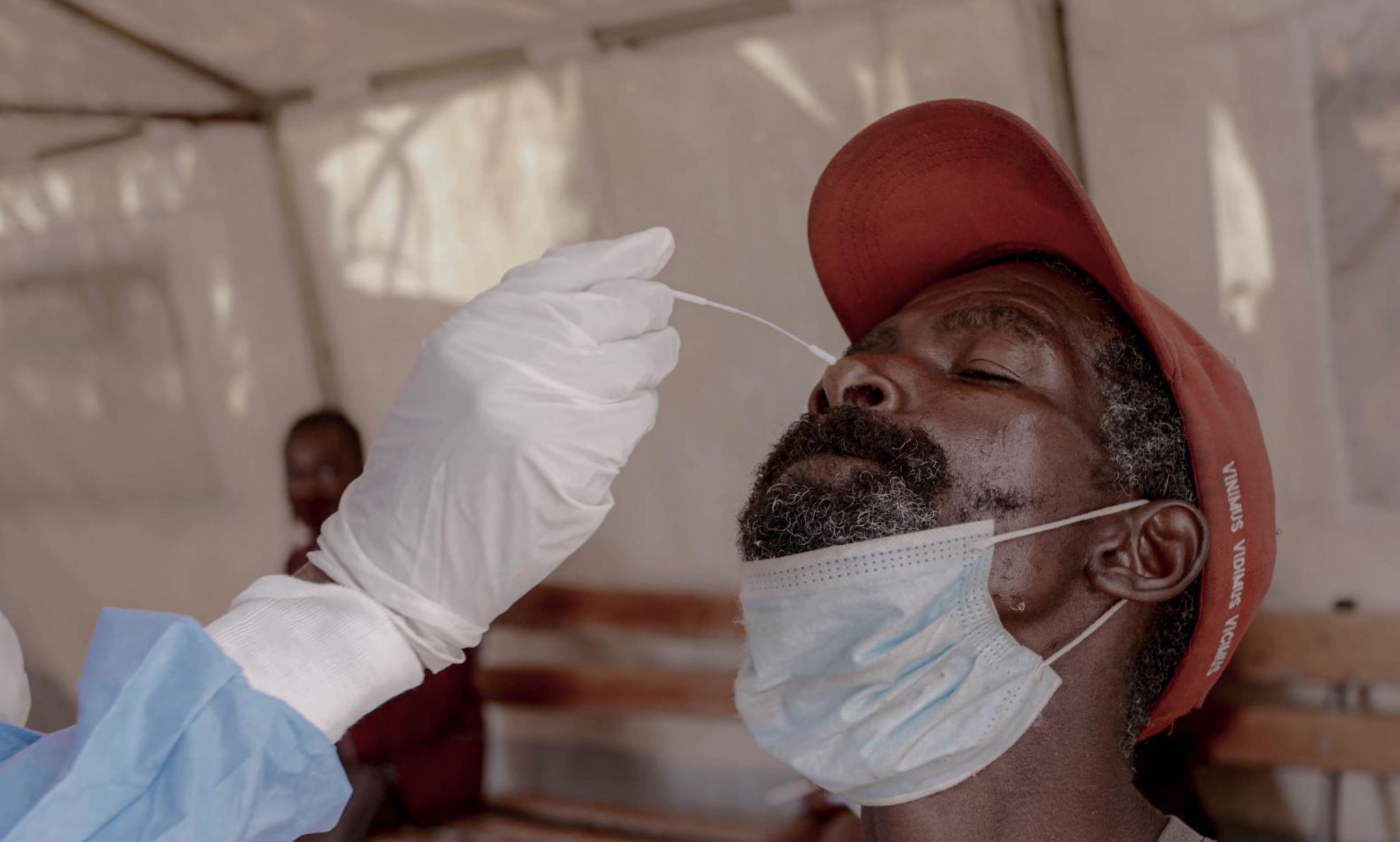
Covid-19 testing in 2021. The researchers said Kenyan truck drivers were exempted from the country’s strict lockdown rules and are likely to have taken the virus to Uganda.
Ugandan researchers say the Covid-19 virus that went on to kill at least 3,620 people in their country likely originated from Kenya, before spreading throughout their country.
The finding is contained in a new genetic study that traces how the virus moved across East Africa during the first two years of the pandemic, from 2020.
The study, titled Genetic diversity and transmission dynamics of SARS-CoV-2 in East Africa, was conducted by scientists from Makerere University and was published in Scientific Reports last month.
The researchers analysed thousands of viral genome sequences collected between 2020 and 2022, concluding that Kenya played a central role in seeding Covid-19 infections across neighbouring countries, including Uganda.
The authors state, “The first case of Covid-19 in Uganda likely originated from Kenya. The virus spread from Kenya to other East African countries.” They added: “Cross-border movements, especially by truck drivers and refugees, played a significant role in the spread.”
Kenya’s first case of Covid-19 was announced on March 12, 2020. Uganda later confirmed its first Covid-19 case on March 21, 2020. A separate analysis of stored blood later confirmed that SARS-CoV-2, the virus that causes Covid-19, was in Kenya as early as December 2019.
“Our integrated genomic and spatial analysis reveals that Kenya was the principal conduit for regional SARS-CoV-2 transmission, with Uganda, DRC, and Rwanda acting as secondary node,” the Ugandan researchers said.
By the end of the acute phase of the pandemic, the country had recorded 3,620 deaths attributed to the virus. The virus killed about 5,000 Kenyans.
The researchers said Kenyan truck drivers were exempted from the country’s strict lockdown rules and are likely to have taken the virus to Uganda.
“Long-distance truck drivers and cargo handlers, often exempted from strict curfews, served as conduits of SARS-CoV-2 between Kenya and its landlocked neighbours,” the authors said. They also noted that “porous land borders, especially among Uganda, Rwanda, South Sudan, and the DRC, played a critical role in sustaining viral flow.”
The researchers caution that the findings should be read as a lesson, not an accusation. “These realities challenge the efficacy of unilateral lockdowns and call for harmonised regional approaches to border health management,” the paper says. It continues, “Our findings underscore the importance of coordinated regional responses, especially in border surveillance, data sharing, and sequencing investment.”
Kenyan scientists have not responded to the study.
The study set out to understand how Covid-19 moved within Uganda and between countries in East Africa to help inform better public health strategies and preparedness for future pandemics.
The researchers used genetic data rather than relying on case reports or border records alone.
In total, 11,865 high-quality viral genome sequences from East Africa were analysed. Kenya contributed the largest share. “Kenya had the highest number of sequences, followed by the DRC,” the paper notes. Tanzania had no data, while Burundi and South Sudan had few sequences.
Ugandan sequences appeared in clusters dominated by Kenyan samples, “indicating either shared lineage ancestry or cross-border transmission events,” the researchers said.
The statistical confidence behind the study findings is high. According to the study, “Those with a posterior probability of 0.5 or higher are statistically significant,” and the Kenya-to-Uganda transmission link had a posterior probability of 1.0, the highest possible level of support in the model used.
Many other infectious diseases, such as Mpox, are thought to originate from DR Congo and Uganda because they have weaker health systems. But Covid-19 appears to have broken that pattern.
Separately, Dr Kamene Kimenye, acting Director General of the National Public Health Institute of Kenya, highlighted the region’s vulnerability to both endemic and emerging diseases, noting that health threats in one Partner State quickly become regional concerns in a shared economic and social space of more than 300 million people.
“The Covid-19 pandemic exposed critical gaps in surveillance, diagnostics, supply chains, and vaccine access,” she said. “This Policy Framework offers a comprehensive blueprint to strengthen resilience through cross-border coordination, digital innovation, sustainable financing, and meaningful community engagement,” she said.
Dr Kimenye spoke in Nairobi when the East African Community (EAC) launched its inaugural Regional Pandemic Prevention, Preparedness, and Response (PPPR) Policy Framework.
This is an instrument designed to strengthen collective action against public health emergencies across the eight EAC Partner States.
The Policy Framework, approved by the 25th EAC Sectoral Council of Ministers of Health in May 2025, provides a harmonised roadmap that reflects EAC’s commitment to strengthening surveillance systems through collaboration with partner states.
The World Health Oerganization, which did not comment on the study, separately said it is committed to working with all countries to strengthen preparedness. “The pandemic taught all of us many lessons – especially that global threats demand a global response,” WHO Director-General Dr Tedros Adhanom Ghebreyesus said at the opening of the 158th session of the Executive Board. “Solidarity is the best immunity.”