

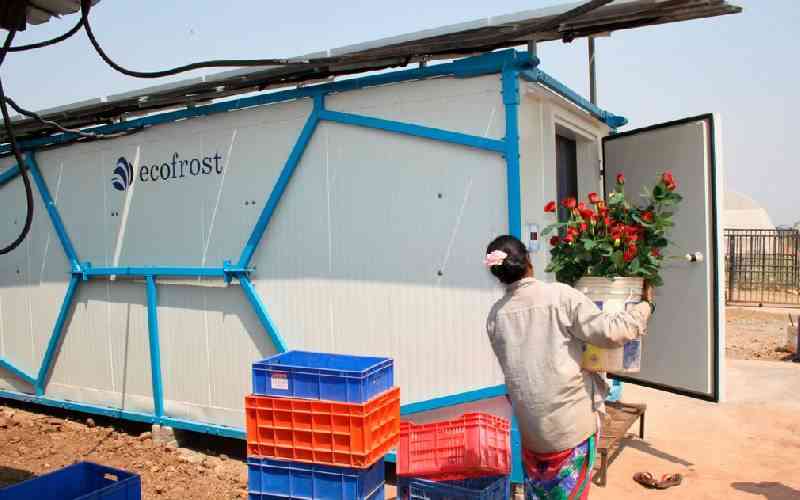
A woman takes flowers for storage in a cold room. [Courtesy]
Kenya loses an estimated 40 per cent of all harvested crops annually, translating into financial losses of up to $500 million (Sh65 billion), according to the World Food Programme (WFP).
These losses highly affect small-scale farmers, who account for 80 per cent of the farming community in the country.
With low income, limited access to both knowledge and technology, most farmers, especially small-scale, lack access to affordable and efficient cold storage systems.
Follow The Standard
channel
on WhatsApp
Agriculture experts have now raised alarm over the high level of post- harvest losses and are calling for sustainable measures to curb the same.
According to Bathseba Ratemo, an environmental scientist and agroecology expert, the country must sustainably address post-harvest challenges as part of the strategies towards curbing food insecurity.
In October 2025, the first Your Virtual Cold Chain Assistant (Your VCCA) e-Summit was held, bringing together global stakeholders to explore innovative, sustainable, and renewable energy–driven cooling solutions for the agriculture sector.
The summit focused on addressing post-harvest losses, reducing emissions, and improving the economic viability of farmers.
The global event attracted 450 participants from 48 countries, including representatives from cooling technology companies, financial institutions, and government entities.
“Post-harvest loss is one of the biggest hidden drains on farmer income. We must embrace technologies and partnerships that preserve produce and guarantee farmers better returns,” said Ms Ratemo, who was among the organizers of the Your VCCA e-Summit. A digitalised cold room in Guinea Bissau. [Courtesy]
Amid this challenge, a new wave of digital cold storage technology is helping farmers to reduce losses.
According to the BASE Foundation, a Swiss non-profit organisation and a specialised partner of the UN Environment Program (UNEP) digitally managed cold chain solutions have cut post-harvest losses by up to 60 per cent and increased farmer revenues by 43 per cent in Nigeria and India, where they have been piloted.
The organisation now seeks to replicate the model in Kenya. The technology allows farmers to store any horticultural produce in decentralised, solar-powered cold rooms and pay only for usage, such as a small fee per crate per day.
“In 2021, BASE and Empa launched the Your Virtual Cold Chain Assistant Initiative (‘Your VCCA’), currently active in India, Nigeria, Iraq, and Guinea-Bissau. Central to this initiative is the ‘Coldtivate’ software, a free-to-use mobile app which digitalizes all cold room operations from check-in and check-out of produce to payments and revenue tracking,” said Simran Singh, a sustainable finance specialist at BASE.
The digital cold room model has been piloted in 38 decentralised cold rooms across the four countries, supported by community engagement, feasibility assessments, capacity building, and the development of “cold room champions” for peer learning.
In Nigeria, the Cold-tivate Marketplace, integrated into the app, allows consumers to view produce stored in the cold room, including updated shelf-life and purchase directly.
The app uses digital twins of 26 crop varieties to track real-time shelf-life based on temperature and harvest data.
Farmers using smartphones can monitor their produce remotely, reducing uncertainty and safeguarding against spoilage.
“This supports decision-making, reduces losses, and brings transparency to the value chain,” said Singh, adding that the model removes the burden of high upfront capital and maintenance costs.
BASE, he added, is now seeking strategic partnerships in Kenya and Uganda in a move geared towards curbing post-harvest losses and enhance economic empowerment.
As climate pressures intensify and food waste continues to undermine farmer livelihoods, experts believe that affordable, digital cold chain technology could be a mitigation measure for Kenya’s smallholder farmers thus protecting harvests, boosting incomes, and strengthening national food security.
Follow The Standard
channel
on WhatsApp
A woman takes flowers for storage in a cold room.
[Courtesy]
Kenya loses an estimated 40 per cent of all harvested crops annually, translating into financial losses of up to $500 million (Sh65 billion), according to the World Food Programme (WFP).
These losses highly affect small-scale farmers, who account for 80 per cent of the farming community in the country.
With low income, limited access to both knowledge and technology, most farmers, especially small-scale, lack access to affordable and efficient cold storage systems.
Follow The Standard
channel
on WhatsApp
Agriculture experts have now raised alarm over the high level of post- harvest losses and are calling for sustainable measures to curb the same.
According to Bathseba Ratemo, an environmental scientist and agroecology expert, the country must sustainably address post-harvest challenges as part of the strategies towards curbing food insecurity.
In October 2025, the first Your Virtual Cold Chain Assistant (Your VCCA) e-Summit was held, bringing together global stakeholders to explore innovative, sustainable, and renewable energy–driven cooling solutions for the agriculture sector.
The summit focused on addressing post-harvest losses, reducing emissions, and improving the
economic viability of farmers.
The global event attracted 450 participants from 48 countries, including representatives from cooling technology companies, financial institutions, and government entities. A digitalised cold room in Guinea Bissau. [Courtesy]
“Post-harvest loss is one of the biggest hidden drains on farmer income. We must embrace technologies and partnerships that preserve produce and guarantee farmers better returns,” said Ms Ratemo, who was among the organizers of the Your VCCA e-Summit.
[Courtesy]
Amid this challenge, a new wave of digital cold storage technology is helping farmers to reduce losses.
According to the BASE Foundation, a Swiss non-profit organisation and a specialised partner of the UN Environment Program (UNEP) digitally managed cold chain solutions have cut post-harvest losses by up to 60 per cent and increased farmer revenues by 43 per cent in Nigeria and India, where they have been piloted.
The organisation now seeks to replicate the model in Kenya. The technology allows farmers to store any horticultural produce in decentralised, solar-powered cold rooms and pay only for usage, such as a small fee per crate per day.
Stay informed. Subscribe to our newsletter
“In 2021, BASE and Empa launched the Your Virtual Cold Chain Assistant Initiative (‘Your VCCA’), currently active in India, Nigeria, Iraq, and Guinea-Bissau. Central to this initiative is the ‘Coldtivate’ software, a free-to-use mobile app which digitalizes all cold room operations from check-in and check-out of produce to payments and revenue tracking,” said Simran Singh, a sustainable finance specialist at BASE.
The digital cold room model has been piloted in 38 decentralised cold rooms across the four countries, supported by community engagement, feasibility assessments, capacity building, and the development of “cold room champions” for peer learning.
In Nigeria, the Cold-tivate Marketplace, integrated into the app, allows consumers to view produce stored in the cold room, including updated shelf-life and purchase directly.
The app uses digital twins of 26 crop varieties to
track real-time shelf-life
based on temperature and harvest data.
Farmers using smartphones can monitor their produce remotely, reducing uncertainty and safeguarding against spoilage.
“This supports decision-making, reduces losses, and brings transparency to the value chain,” said Singh, adding that the model removes the burden of high upfront capital and maintenance costs.
BASE, he added, is now seeking strategic partnerships in Kenya and Uganda in a move geared towards curbing post-harvest losses and enhance economic empowerment.
As climate pressures intensify and food waste continues to undermine farmer livelihoods, experts believe that affordable, digital cold chain technology could be a mitigation measure for Kenya’s smallholder farmers thus protecting harvests, boosting incomes, and strengthening national food security.
Follow The Standard
channel
on WhatsApp
By Rachael Kibui