



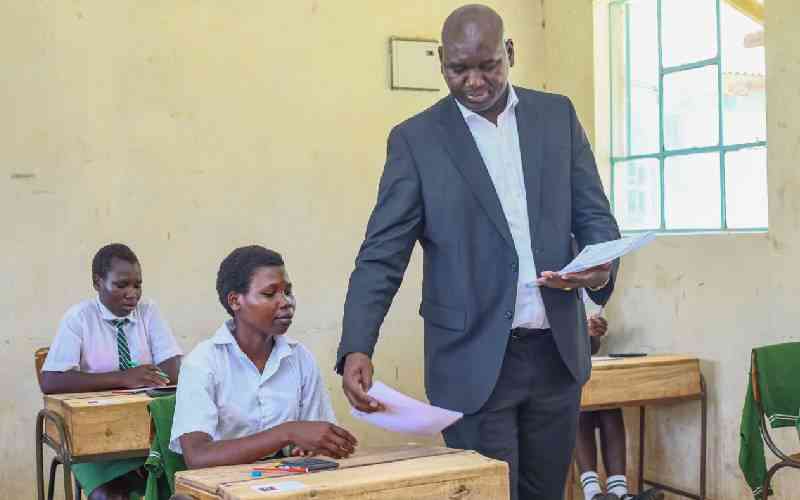
Half of Grade Six learners cannot read and comprehend a Grade Three English storybook! This should alarm and indeed shock all of us in the education sector. This is not just bad news; it is a sobering signal that something fundamental is not working as it should. Literacy is the foundation upon which all other learning rests. When that foundation is weak, the entire structure of education becomes unstable.
Every once in a while, a statistic emerges that should make a nation pause, fall silent, and look at itself in the mirror. I think we are at such a moment. Recent research findings by Usawa Agenda have unmasked the truth that we have been avoiding confronting. The Foundational Literacy and Numeracy Assessment (FLANA 2025), released by the organisation’s Executive Director, Dr Emmanuel Manyasi, reveals a deeply disturbing reality. The question is; what does this truly mean for our learners and for the future of education?
These are not abstract numbers of children. These are children in our classrooms and are the future workers, leaders, innovators, and citizens of this country. If a learner reaches Grade 6 without the ability to read and understand a Grade 3 text, then we must ask ourselves a hard question: What exactly has been happening in our classrooms at the foundational level? I will tell you where the problem is shortly.

Follow The Standard
channel
on WhatsApp
But first things first. Let us first state the philosophical basis of my argument. Literacy is not just another school outcome. It is the doorway to all learning. When reading collapses, every other subject limps. Science becomes guesswork. Mathematics becomes mechanical. Social studies becomes memorization without meaning. Language is the tool through which knowledge is accessed, processed, questioned, and applied. At the moment, this tool is blunt and the entire system has to underperform.
For me, this report should be treated as a national wake-up call, not a technical document to be shelved after a press conference. We must resist the temptation to shift blame quickly. I know that it is easy to shift blame to teachers, policy, curriculum, parents, technology, or to children themselves. That is a good example of being lazy.
The truth is that literacy failure is usually systemic. It accumulates slowly through neglect of reading culture, inadequate exposure to books, exam-driven teaching, overcrowded classrooms, limited access to appropriate reading materials, and the gradual disappearance of structured reading programmes in schools. That is where we should begin.
In my recent engagements with teachers and through my extensive reading programme that I launched last year in Kakamega County, I had already discovered the nerve centre of the problem. In my workshops, I underscored the urgent need for extensive reading programmes in our schools.
My initial concern was with secondary schools, where I discovered that many institutions no longer run structured, extensive reading initiatives. But if Grade 6 learners are struggling with Grade 3 texts, then the intervention point must move even lower, to primary schools, and indeed to the earliest grades. We have to go back to the basics.
Extensive reading is not a luxury. It is not an optional enrichment activity. It is the backbone of literacy development. Children learn to read by reading widely, regularly, and enjoyably. Not only textbooks. Not only examination passages. They must read stories, short books, graded readers, folktales, biographies, science readers, and age-appropriate informational texts. Reading must move from being a test requirement to becoming a habit.
This means deliberate investment. Schools must be supported to build classroom and school libraries. Reading materials must be varied, culturally relevant, and level-appropriate. Local language materials should be included alongside English and Kiswahili resources, because early literacy grows best when rooted in familiar linguistic environments. Counties, publishers, NGOs, and communities must partner to make books physically present where children are.
But books alone are not enough. Every teacher, not just language teachers, must see themselves as a reading teacher. A science teacher who guides learners through a passage is teaching reading. A history teacher who helps learners interpret a text is teaching reading. A mathematics teacher who explains a word problem is teaching reading. Literacy is cross-curricular. It cannot be outsourced to one department.
We must also restore reading time. Yes. We have to protect, structure, and supervise reading time within the school timetable. When everything is urgent, reading quietly disappears. Yet it is the one practice that makes all other learning possible.
I was particularly disturbed when a teacher told me the other day that learning had not started in grade ten because course books had not been supplied to schools. What is happening to our teachers’ creativity? Why not put learners in a reading programme for two weeks of reading and reviewing books if you have a modest library?
A nation that does not read eventually loses the ability to think deeply, argue clearly, innovate responsibly, and govern wisely. This is what is happening to our country. I see this when I read social media posts. Literacy is not merely an education issue; it is a development issue, a democracy issue, and a cultural survival issue.
The FLANA 2025 findings should not depress us; they should mobilize us. They have told us where we are. They have also shown us where we must act. The journey back begins with a simple, powerful act: put a book in a child’s hands, and make sure they read it.
Prof Egara Kabaji is a writer, educationist, and researcher based at Masinde Muliro University. He is also the Vice President of the Pan African Writers Association (PAWA) and the Chancellor of Mt Kigali University, Rwanda.
Follow The Standard
channel
on WhatsApp
By Egara Kabaji