



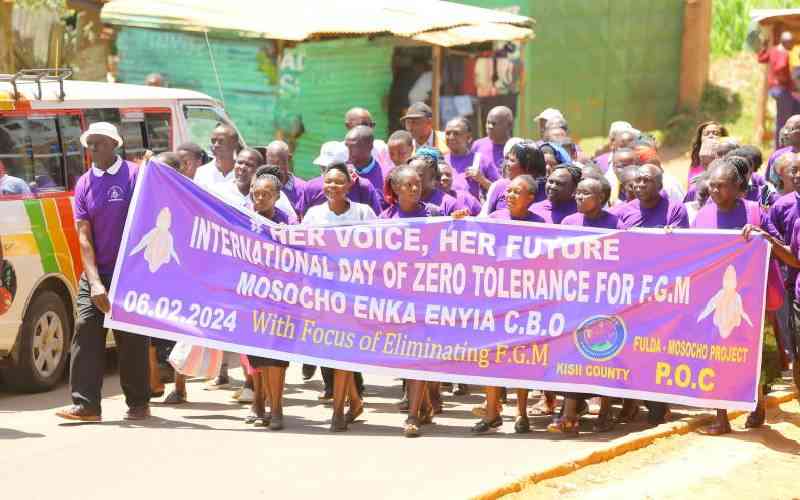
Anti-FGM crusaders and Community-Based Organisations march in Kisii town to mark International Day of Zero Tolerance for FGM. [File, Standard]
Female Genital Mutilation (FGM) remains one of the most challenging human rights violations to eliminate because it is hidden, normalised, and reinforced through deep social expectations. Over the years, awareness campaigns have increased, laws have been enacted, and public conversations have grown louder. Yet millions of girls remain at risk, forcing us to confront a difficult question: Is awareness alone enough?
Kenya has made notable progress in reducing FGM at the national level. According to the 2022 Kenya Demographic and Health Survey, the national prevalence of FGM among women aged 15–49 stands at approximately 15 per cent, a significant decline from previous decades. However, this national average masks stark regional inequalities. In several counties, FGM remains almost universal. Wajir records a prevalence of over 97 per cent, Mandera over 95 per cent, Marsabit above 80 per cent, Garissa above 80 per cent, Kisii at over 77 per cent, Nyamira at nearly 75 per cent, Samburu at over 75 per cent, Isiolo at around 66 per cent, Tana River at over 60 per cent, and Narok at over 50 per cent. These figures reveal a troubling reality: While progress is real, it is uneven, and thousands of girls in specific regions remain unprotected.
Despite growing awareness, FGM continues to be documented. The practice is still widely treated as a women’s issue rather than recognised as a global human rights concern that demands collective responsibility. For many women and girls, banning FGM does not equate to justice. Justice means access to protection, healing, psychosocial support, and accountability for those who perpetuate harm. Too often, these remain inaccessible.
Follow The Standard
channel
on WhatsApp
What is rarely discussed is life after FGM. The harm does not end when the cutting stops. Survivors often live with lifelong physical, emotional, and social consequences. Trauma may resurface years later during relationships, pregnancy, or childbirth. Many women carry fear, shame, and silence because spaces for healing and support are limited, especially in marginalised communities. This silence enables FGM to persist.
Kenya’s ban on FGM has been in place for over a decade, yet enforcement remains uneven. Families continue to find ways around the law by carrying out the practice in secrecy, crossing counties or turning to medicalised forms of cutting. Laws alone cannot dismantle a system where a girl’s social acceptance, marriage prospects, and economic security depend on conformity.
In many communities, refusing FGM is not a realistic option. Girls face immense pressure from families and society, where exclusion can mean loss of protection, belonging, and future stability. When a girl’s survival is tied to being considered marriageable, compliance is often mistaken for consent, yet it is driven by coercion. Under such conditions, awareness messages alone cannot protect girls, and justice remains out of reach.
Men and boys play a critical role in ending FGM. While younger generations may be more open to change, many still feel constrained by cultural expectations and social norms. Transforming attitudes around masculinity, marriage, and women’s autonomy is essential. If a woman’s worth is measured by whether she has been cut, progress will remain fragile. This year’s International Day of Zero Tolerance for FGM theme, ‘Towards 2030: No End to FGM Without Sustained Commitment and Investment’, reflects an urgent truth. Ending FGM requires more than laws and awareness campaigns. It demands sustained political will, long-term investment, community-led approaches, survivor-centred services, and engagement of men and boys.
Ms Damaris is an anti-GBV advocate and communications Coordinator at International Solidarity
Follow The Standard
channel
on WhatsApp
Anti-FGM crusaders and Community-Based Organisations march in Kisii town to mark International Day of Zero Tolerance for FGM.
[File, Standard]
Female Genital Mutilation (FGM) remains one of the most challenging human rights violations to eliminate because it is hidden, normalised, and reinforced through deep social expectations. Over the years, awareness campaigns have increased, laws have been enacted, and public conversations have grown louder. Yet millions of girls remain at risk, forcing us to confront a difficult question: Is awareness alone enough?
Kenya has made notable progress in reducing FGM at the national level. According to the 2022 Kenya Demographic and Health Survey, the national prevalence of FGM among women aged 15–49 stands at approximately 15 per cent, a significant decline from previous decades. However, this national average masks stark regional inequalities. In several counties, FGM remains almost universal. Wajir records a prevalence of over 97 per cent, Mandera over 95 per cent, Marsabit above 80 per cent, Garissa above 80 per cent, Kisii at over 77 per cent, Nyamira at nearly 75 per cent, Samburu at over 75 per cent, Isiolo at around 66 per cent, Tana River at over 60 per cent, and Narok at over 50 per cent. These figures reveal a troubling reality: While progress is real, it is uneven, and thousands of girls in specific regions remain unprotected.
Despite growing awareness, FGM continues to be documented. The practice is still widely treated as a women’s issue rather than recognised as a global human rights concern that demands collective responsibility. For many women and girls, banning FGM does not equate to justice. Justice means access to protection, healing, psychosocial support, and accountability for those who perpetuate harm. Too often, these remain inaccessible.
Follow The Standard
channel
on WhatsApp
What is rarely discussed is life after FGM. The harm does not end when the cutting stops. Survivors often live with lifelong physical, emotional, and social consequences. Trauma may resurface years later during relationships, pregnancy, or childbirth. Many women carry fear, shame, and silence because spaces for healing and support are limited, especially in marginalised communities. This silence enables FGM to persist.
Kenya’s ban on FGM has been in place for over a decade, yet enforcement remains uneven. Families continue to find ways around the law by carrying out the practice in secrecy, crossing counties or turning to medicalised forms of cutting. Laws alone cannot dismantle a system where a girl’s social acceptance, marriage prospects, and economic security depend on conformity.
In many communities, refusing FGM is not a realistic option. Girls face immense pressure from families and society, where exclusion can mean loss of protection, belonging, and future stability. When a girl’s survival is tied to being considered marriageable, compliance is often mistaken for consent, yet it is driven by coercion. Under such conditions, awareness messages alone cannot protect girls, and justice remains out of reach.
Men and boys play a critical role in ending FGM. While younger generations may be more open to change, many still feel constrained by cultural expectations and social norms. Transforming attitudes around masculinity, marriage, and women’s autonomy is essential. If a woman’s worth is measured by whether she has been cut, progress will remain fragile. This year’s International Day of Zero Tolerance for FGM theme, ‘Towards 2030: No End to FGM Without Sustained Commitment and Investment’, reflects an urgent truth. Ending FGM requires more than laws and awareness campaigns. It demands sustained political will, long-term investment, community-led approaches, survivor-centred services, and engagement of men and boys.
Ms Damaris is an anti-GBV advocate and communications Coordinator at International Solidarity
Follow The Standard
channel
on WhatsApp
By Damaris Celestine