

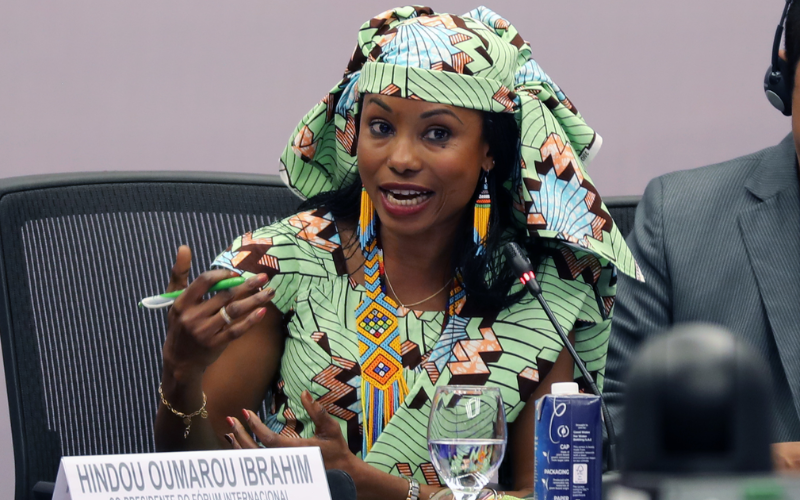
Nairobi has long been a crossroads of diplomacy, development and debate. However, last week, it also became a listening space. In a quiet gathering of activists, policymakers and community leaders, one person stood out: Hindou Oumarou Ibrahim, a woman at work.
The Indigenous rights advocate from Chad was doing what she has done across continents: stitching together ancestral knowledge, community land rights and climate justice into a language the world’s power centres can no longer ignore.
Meet the President of the Indigenous Women and Peoples Association of Chad (AFPAT), whose fruit-salad-like life takes her to some of the world’s most powerful stages, United Nations assemblies, global climate summits, and policy rooms thick with acronyms, urgency and responsibility.
It was on one such powerful stage that I met her at the auditorium of the Kenya Institute of Monetary Studies, where she was co-convening a rare meeting, the African Indigenous and Pastoralists Gathering, alongside the equally outstanding Mali ole Kaunga, executive director and founder of the Indigenous Movement for Peace Advancement and Conflict Transformation (IMPACT), Kenya.
In between brief, hearty conversations, she was juggling the demands of a packed four-day conference, and I began to understand her deep attachment to Indigenous peoples, pastoralists and rangelands.
“No matter what happens in this playground, winning or losing, getting a lead role in an event like this one, or even wearing a unique ballet outfit, I always find myself juggling so many things,” she said, flashing one of her contagious smiles.
Before Hindou began her globe-trotting advocacy for Indigenous peoples, pastoralists and their rangelands, she says the land spoke to her long before the world listened.
She paints her early life vividly. At dawn in the Sahel, when the air still carried the night’s coolness and cattle bells began their low, rhythmic music, she would walk beside her mother, reading signs invisible to outsiders, the bend of a grass blade underfoot, the smell of soil after a rare rain, the circling of birds in the early morning sky.
“This is not poetry; it was survival,” she laughs.

For pastoralist families, she explains, the land is archive, classroom and compass. She learned this language early in life. Born into the Mbororo pastoralist community in Chad, Hindou grew up in motion, following grazing routes shaped by seasons, memory and oral histories rather than fixed borders. Long before climate change became a global headline, her community was already living with its consequences: shrinking water sources, vanishing pasturelands and rising tensions over land that once sustained everyone.
What Hindou absorbed as a child was not just ecological knowledge. It was a responsibility.
Today, she carries that responsibility into some of the world’s most powerful rooms. She is often introduced as an environmental activist, a climate leader or an Indigenous rights advocate.
Hindou prefers a quieter, truer description. “I am a bridge,” she says. “A bridge between knowledge systems, between communities and decision-makers, between the land and the law.”
Climate change reality
For decades, Hindou notes, Indigenous communities across Africa, from the Sahel to northern Kenya, have existed at the margins of national development plans.
“Our voices were often consulted too late, if at all, and our knowledge was dismissed as anecdotal, unscientific or inconvenient, yet it is precisely this knowledge that is now proving indispensable,” she says.
Back in Kenya, host of the first continental gathering of Indigenous peoples and pastoralists, communities across arid and semi-arid lands understand climate variability not as theory, but as lived experience.
“They know when grazing routes must shift, when water points are under threat, and when environmental stress risks tipping into conflict,” she told the audience.

Hindou’s work echoes these realities. Through the Association for Indigenous Women and Peoples of Chad (AFPAT), which she co-founded, she has helped document Indigenous land-use systems, migration routes and water access points, placing women at the centre of this work.
In many pastoralist societies, women are the custodians of intergenerational knowledge, yet they remain the least consulted.
One of Hindou’s most powerful tools is participatory mapping, a process that brings elders, women and herders together to translate oral histories into visual, legal evidence. The resulting maps are not abstract diagrams; they tell stories of survival, movement and belonging. “These maps have helped reduce land-related conflict, influence development projects, and shape national and international climate adaptation strategies,” she explains.
In policy rooms dominated by charts and projections, Hindou introduces another metric: lived reality. She does so as a woman in rooms that were never built for her. There is a quiet audacity in her presence. She does not dilute her identity to fit global expectations. Dressed in traditional attire, she enters spaces that once excluded Indigenous women entirely and stays firmly rooted in who she is.
Being an Indigenous African woman in global climate negotiations comes with layered challenges: language barriers, power imbalances and the constant pressure to simplify complex realities into neat soundbites. Hindou navigates these spaces with steady clarity. “When policies are made without us, they fail, as you cannot protect the land without protecting the people who live on it,” she reminds delegates.
Her advocacy has helped shift climate conversations away from distant targets and timelines towards practical adaptation, including access to water, land tenure, conflict prevention and gender justice. She insists that climate action must begin where impacts are felt first, at the community level.
At global gatherings, climate summits, Indigenous forums and cross-cultural dialogues, Hindou becomes something of a gravitational force.
She speaks of women walking farther for water, of herders losing entire livelihoods to drought, and of children inheriting uncertainty instead of land. Then, calmly, she offers solutions, drawn from the same communities often portrayed only as victims.
During the Nairobi Gathering, she reminded the room that Indigenous peoples protect over 80 per cent of the world’s remaining biodiversity, despite holding legal rights to only a fraction of that land.

“The question is not whether Indigenous knowledge is valuable, but why the world waited so long to listen,” she noted.
For Hindou, climate justice is inseparable from land rights, gender equity and peace. She says in regions where climate stress fuels conflict, recognising traditional land-use systems can mean the difference between coexistence and violence.
Her work underpins a truth often missing from global debates: climate change is not only an environmental crisis; it is a social one.
“Women, especially Indigenous women, bear disproportionate burdens, managing water, food and family survival while remaining excluded from decision-making spaces. I always challenge this imbalance not by asking for permission, but by demonstrating results,” she says.
Recognition has followed her, international awards, global fellowships and advisory roles at the highest levels, yet she remains anchored to home.
“I cannot speak for communities if I am not accountable to them,” she says.
In a world addicted to urgency, Hindou’s leadership is grounded in listening. She listens to elders before drafting proposals, to women before attending negotiations, and to the land before offering solutions. This slow, relational and respectful approach stands in quiet defiance of extractive systems that have failed both people and planet.
“Hindou is not asking the world to romanticise Indigenous life. Rather, she is asking it to respect it, to learn from it, and to protect it, not as a relic, but as a living, evolving system of knowledge,” said Mali ole Kaunga, co-convenor of the Gathering, during a shared platform.
Thousands of kilometres away from the continental stage of the African Indigenous and Pastoralists Gathering, as the sun sets over the Sahel, the land continues to speak. Winds shift, grasses bend, and water remembers its paths.
Hindou calls herself a bridge, between knowledge systems, between communities and power, between the land and the law. And as the climate crisis deepens, it may be bridges like Hindou Oumarou Ibrahim, grounded, patient and rooted in truth, that carry humanity forward.