



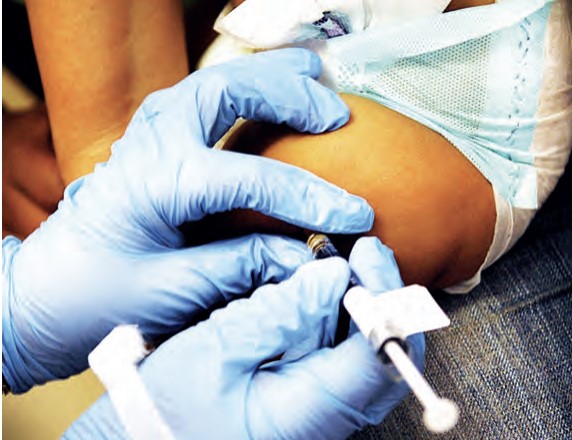
HIV injectable vaccine under trial.
Kenya receives nearly 12 per cent of all vaccine research
and development funding allocated to Africa, according to a new analysis.
This places the country second only to South Africa, which
receives 38 per cent of all vaccine development funding on the continent.
Kenya has also hosted 100 vaccine clinical trials over the
past 16 years, making it Africa’s second-largest trial hub. The data, covering
the period between 2007 and 2024, is drawn from the International Vaccine
Institute (IVI).
However, the IVI warns that Kenya’s leadership in vaccine
development is under threat due to shifting global funding patterns, while the
country has not increased its own domestic contribution.
In a report titled A Landscape Analysis of the Vaccine
Ecosystem in Africa, the IVI notes that 95 per cent of vaccine research funding
in Africa comes from outside the continent, mainly from the United States and
the European Union.
Kenya is largely
absent from the small group of African countries investing domestic resources
in vaccine research.
“Twenty-nine of the 55 African Union member states received
funding for vaccine research and development between 2007 and 2023. South
Africa received the largest share at $266.04 million, followed by Kenya at
$83.43 million. Tanzania accounted for 8.29 per cent ($57.85 million), Burkina
Faso 7.34 per cent ($51.24 million), Ghana 6.61 per cent ($46.13 million) and
Uganda 6.58 per cent ($45.89 million),” the report states.
Africa as a whole receives less than two per cent of global
vaccine research and development funding.
“Reported data shows that Africa received less than two per
cent of global vaccine research and development funding, with most of it
concentrated in South Africa, Kenya and Tanzania,” the report says. The study
was published in The Lancet Global Health journal.
Ondari Mogeni, an IVI public health specialist, and
colleagues assessed clinical trial activity from 2007 to 2024 using data from
multiple sources. Disease burden context was drawn from the Global Burden of
Disease Study 2021, while regulatory maturity levels were obtained from the
World Health Organization’s list of National Regulatory Authorities.
The findings show that Africa accounts for only eight per
cent of global vaccine clinical trials that include African sites. The top five
countries by clinical trial count over the 16-year period were South Africa
(200), Kenya (100), Mali (60), Uganda (56) and Tanzania (46).
These figures show that Kenya is not only a major recipient
of research funding but also a key location for testing new vaccines targeting
diseases that disproportionately affect Africa, including malaria, HIV/Aids,
tuberculosis and Covid-19.
The United States provided 56.28 per cent ($392.56 million)
of all vaccine research and development funding to Africa during the period
under review. The European Union followed with 29.88 per cent ($208.43
million). South Africa contributed 4.34 per cent ($30.26 million), Germany 3.31
per cent ($23.07 million) and the United Kingdom 3.10 per cent ($21.63
million).
Experts say external funding has played an important role in
building Kenya’s research footprint. However, Kenya’s own contribution remains
small, leaving the country vulnerable when donors change priorities.
For instance, Kenya Medical Research Institute (Kemri)
director general Prof Elijah Songok reported last year that US funding cuts
affected about 40 per cent of Kemri’s programmes, placing jobs and research
projects at risk. In one case, foreign support for a five-year HIV vaccine
project funded by USAID was abruptly suspended.
“Our findings highlight the need for better vaccine data in
Africa and the opportunity to build on existing strengths to achieve greater
sovereignty and more resilient health systems,” the IVI researchers said.
They also noted that funding flows unevenly across the
stages of vaccine research, with most resources directed towards early-stage
work. The pre-licensure phase accounted for 47.86 per cent ($333.84 million) of
all vaccine research funding to Africa. Phase two trials received 11.23 per
cent ($78.31 million), while phase three trials received 10.69 per cent ($74.55
million). Post-licensure studies accounted for just 5.63 per cent ($39.24
million).
Overall, the study paints a picture of a continent that
participates in global vaccine research but does not control its own funding
flows or research priorities. This matters because diseases that attract the
most funding, such as malaria, HIV/Aids and Covid-19, often reflect global
interests as much as Africa’s health needs.
Other diseases that impose a heavy health burden in Kenya
and elsewhere, including Rift Valley fever, yellow fever, meningitis, syphilis
and schistosomiasis, receive far less research funding.
Public health experts say the solution lies in greater
domestic investment by African governments, supported by stable and long-term
funding commitments. Kenya has begun taking steps in this direction.
The Kenya BioVax Institute, part of the government’s plan to
build domestic vaccine production capacity, has submitted reports and
feasibility studies aimed at establishing a “smart vaccine manufacturing
facility” in the country. The project, developed with partners including the
International Vaccine Institute and other international firms, seeks to reduce
dependence on imported vaccines and external research funding.
The government is also engaged in discussions with global
partners and is positioning Kenya as a hub for advanced vaccine manufacturing
under its bio-manufacturing strategy.
Plans for a $250 million vaccine manufacturing plant at
Konza Technopolis form part of this effort.