

Audio By Vocalize
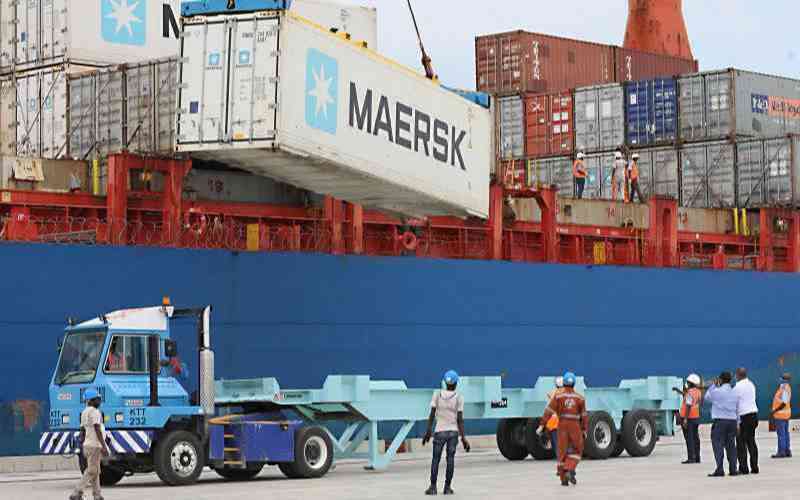
A container being off loaded from a cargo ship at Lamu Port on November 9, 2022. [File, Standard]
As the global push to decarbonise the shipping industry gathers pace, Africa finds itself at a crossroads — whether to fully embrace the proposed framework or resist elements that could raise trade costs.
Despite mounting pressure to adopt the International Maritime Organisation’s (IMO) Net Zero Framework (NZF), maritime officials from Africa warn that the continent risks losing either way — through higher compliance costs if it adopts the rules unprepared, or through reduced competitiveness if it fails to align with emerging global standards.
These concerns emerged during the Regional African Port States Meeting on the IMO Net Zero Framework held in Mombasa.
Kenya’s special envoy for climate change, Ali Mohamed, said Africa must position itself strategically amid shifting geopolitical dynamics and rising pressure within multilateral systems.
The technical meeting, convened under the auspices of the Association of African Maritime Administrations (AAMA), brought together heads of maritime administrations across the continent to deliberate on the implications of the IMO NZF to African economies.
Mohamed noted that over 90 per cent of Africa’s external trade is transported by sea, making any changes to global shipping regulations directly impactful on ports, trade flows and economic competitiveness.
“We meet at an important moment for global shipping and for Africa,” he said, noting that international negotiations are increasingly shaped not only by technical considerations but also by power dynamics and strategic interests.
Geopolitical tensions
He referenced last year’s IMO discussions, which failed to reach consensus on aspects of the Net Zero Framework, reflecting broader geopolitical tensions and differing national circumstances.
In October 2025, IMO postponed the adoption of the NZF for one year following intense opposition from a coalition led by the United States and Saudi Arabia.
While African Union countries were not uniformly opposed, several African nations and developing economies expressed concerns that the proposed levy on high-emitting ships would increase costs for food and goods or that the transition would not be equitable.
IMO is pushing for the full implementation of green industrialisation, where ships use renewable energy as opposed to fossil fuels in their operations and non-compliance would attract a levy.
AAMA Chairman and Kenya Maritime Authority (KMA) Director General Omae Nyarandi described the shipping transition as a defining moment for the continent, saying Africa must convert technical complexity into “African leverage.”
“The rules governing fuels, emission performance, and compliance are becoming the language of markets,” Nyarandi said, warning that if the transition is shaped without Africa’s realities in mind, it could increase logistics costs and erode trade competitiveness.
Prepared negotiation
He emphasised that AAMA would intensify coordination among member states to ensure Africa presents a coherent and prepared negotiating posture ahead of key global decision points.
“Africa must move from the margins and shape the future,” he said.
Mohamed warned that Africa remains highly vulnerable to climate change impacts, citing severe flooding in parts of the continent and devastating drought in the Horn of Africa.
However, he said the transition to low-emission shipping systems also presented significant opportunities, including modernisation of ports, attraction of green finance, development of alternative fuels, skills development and enhanced resilience of coastal infrastructure.
“Ignoring this reality would leave Africa reacting to change rather than shaping it,” he cautioned.
Both Mohamed and Nyarandi stressed that while the decarbonisation of shipping is inevitable, the critical question for Africa is whether it will be adequately prepared, supported, and strategically positioned to benefit from the transition.
Head of transport and mobility division at the African Union Commission Eric Ntagengerwa said the maritime transport was central to Africa’s trade, industrialisation and regional integration and was increasingly shaped by global regulatory shifts such as the IMO framework.
“As Africa advances key continental initiatives including the Revised African Maritime Transport Charter, Africa Continental Free Trade Area and green industrialisation agendas, there is a growing need for coherent continental coordination,” he stated.
He said AUC plays a critical role in providing policy leadership, aligning maritime priorities across sectors, and coordinating Africa’s collective engagement in global maritime governance to ensure the continent speaks with a unified, strategic, and opportunity-driven voice.
Participants are expected to use the meeting to develop shared priorities, identify readiness investments, and craft unified messages to guide Africa’s engagement within the IMO framework.
Follow The Standard
channel
on WhatsApp
A container being off loaded from a cargo ship at Lamu Port on November 9, 2022.
[File, Standard]
As the global push to decarbonise the shipping industry gathers pace, Africa finds itself at a crossroads — whether to fully embrace the proposed framework or resist elements that could raise trade costs.
Despite mounting pressure to adopt the
International Maritime Organisation’s
(IMO) Net Zero Framework (NZF), maritime officials from Africa warn that the continent risks losing either way — through higher compliance costs if it adopts the rules unprepared, or through reduced competitiveness if it fails to align with emerging global standards.
These concerns emerged during the Regional African Port States Meeting on the IMO Net Zero Framework held in Mombasa.
Kenya’s special envoy for climate change, Ali Mohamed, said Africa must position itself strategically amid shifting geopolitical dynamics and rising pressure within multilateral systems.
The technical meeting, convened under the auspices of the Association of African Maritime Administrations (AAMA), brought together heads of maritime administrations across the continent to deliberate on the implications of the IMO NZF to African economies.
Mohamed noted that over 90 per cent of Africa’s external trade is transported by sea, making any changes to global shipping regulations directly impactful on ports, trade flows and economic competitiveness.
“We meet at an important moment for global shipping and for Africa,” he said, noting that international negotiations are increasingly shaped not only by technical considerations but also by power dynamics and strategic interests.
Geopolitical tensions
He referenced last year’s IMO discussions, which failed to reach consensus on aspects of the Net Zero Framework, reflecting broader geopolitical tensions and differing national circumstances.
In October 2025, IMO postponed the adoption of the NZF for one year following intense opposition from a coalition led by the United States and Saudi Arabia.
While African Union countries were not uniformly opposed, several African nations and developing economies expressed concerns that the proposed levy on high-emitting ships would increase costs for food and goods or that the transition would not be equitable.
IMO is pushing for the full implementation of green industrialisation, where ships use renewable energy as opposed to fossil fuels in their operations and non-compliance would attract a levy.
AAMA Chairman and
Kenya Maritime Authority
(KMA) Director General Omae Nyarandi described the shipping transition as a defining moment for the continent, saying Africa must convert technical complexity into “African leverage.”
“The rules governing fuels, emission performance, and compliance are becoming the language of markets,” Nyarandi said, warning that if the transition is shaped without Africa’s realities in mind, it could increase logistics costs and erode trade competitiveness.
Stay informed. Subscribe to our newsletter
Prepared negotiation
He emphasised that AAMA would intensify coordination among member states to ensure Africa presents a coherent and prepared negotiating posture ahead of key global decision points.
“Africa must move from the margins and shape the future,” he said.
Mohamed warned that Africa remains highly vulnerable to climate change impacts, citing severe flooding in parts of the continent and devastating drought in the Horn of Africa.
However, he said the transition to low-emission shipping systems also presented significant opportunities, including modernisation of ports, attraction of green finance, development of alternative fuels, skills development and enhanced resilience of coastal infrastructure.
“Ignoring this reality would leave Africa reacting to change rather than shaping it,” he cautioned.
Both Mohamed and Nyarandi stressed that while the decarbonisation of shipping is inevitable, the critical question for Africa is whether it will be adequately prepared, supported, and strategically positioned to benefit from the transition.
Head of transport and mobility division at the African Union Commission Eric Ntagengerwa said the maritime transport was central to Africa’s trade, industrialisation and regional integration and was increasingly shaped by global regulatory shifts such as the IMO framework.
“As Africa advances key continental initiatives including the Revised African Maritime Transport Charter, Africa Continental Free Trade Area and green industrialisation agendas, there is a growing need for coherent continental coordination,” he stated.
He said AUC plays a critical role in providing policy leadership, aligning maritime priorities across sectors, and coordinating Africa’s collective engagement in global maritime governance to ensure the continent speaks with a unified, strategic, and opportunity-driven voice.
Participants are expected to use the meeting to develop shared priorities, identify readiness investments, and craft unified messages to guide
Africa’s engagement within the IMO framework
.
Follow The Standard
channel
on WhatsApp
By Patrick Beja