

Audio By Vocalize
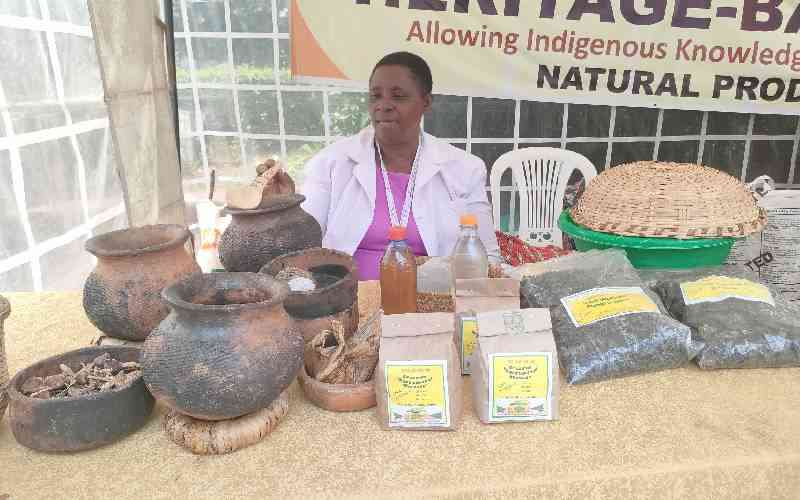
Beatrice Kirundu from Hamisi Sub-County in Vihiga County, with some of her indigenous knowledge–based intellectual assets, during an exhibition in Nairobi. [Nanjinia Wamuswa, Standard]
Beatrice Kirundu is one of millions of Kenyans who have invested in indigenous knowledge–based intellectual assets, commonly referred to as the Natural Products Industry (NPI).
However, she has long struggled to access reliable markets and receive fair value for her products.
She produces and sells a wide range of natural products, including traditional clay pots, table mats, cassava flour, indigenous maize seeds, reed baskets, termites, mushrooms and dried or preserved indigenous vegetables such as cowpeas, saga and managu.
“I depend entirely on this business, but the market has not been good. My high-quality goods do not fetch better prices, despite the effort involved,” she says.
Although she sells her products locally in Hamisi Sub-County, Vihiga County, Beatrice hopes to establish linkages to international markets.
The NPI has significant potential, not only to provide income and livelihoods for many people but also to make a substantial contribution to Kenya’s economy. However, this potential has yet to be fully realised.
Stakeholders say a structured study is currently underway to determine the industry’s exact contribution to the country’s Gross Domestic Product (GDP).
But preliminary estimates place its value at about Sh230 billion annually, an amount comparable to what the national government transfers to counties each year.
Although Kenya has been missing out on this revenue, it is expected to begin benefiting in the future.
This shift is being driven by a government flagship project under Vision 2030, implemented by the Natural Products Industry in the Department of the National Museums of Kenya (NMK). Hillary Kalama from Chivara in Ganze Sub-County, Kilifi County, showcases some of his indigenous knowledge–based intellectual assets, during an exhibition in Nairobi. [Nanjinia Wamuswa, Standard]
The initiative is an indigenous, heritage-based project aimed at harnessing Kenya’s rich cultural and traditional resources, assets that have largely been overlooked over the years.
Stakeholders note that communities have existed for a long time even before Western influence, with their own traditional medicines, foods, dances and technologies, many of which were later discarded.
Categories of the assets
Dr Evans Taracha, the NPI national coordinator and principal researcher at NMK, says the project is founded on the recognition, protection and promotion of indigenous knowledge intellectual assets, as guided by the Constitution and national legislation.
“These assets are God-given and represent birthright wealth belonging to communities. They are wide-ranging and deeply rooted in culture, tradition and identity,” he says.
Taracha says the project has enormous potential to generate substantial revenue for the country.
The assets fall into five categories: Traditional foods and local cuisines, indigenous technologies, traditional medicines and local remedies, performing arts and the creative economy, as well as heritage and historical sites.
Similarly, Hillary Kalama from Chivara area in Ganze Sub-County, Kilifi County, has been in the natural products business for nearly 40 years. He inherited the trade from his great-grandparents.
Kalama produces a variety of traditional items, including Nguvene (a musical instrument similar to a guitar), cups made from baobab trees, drums, Nzele (a traditional wine container), chipawa (a spoon for scooping foodstuffs), rat traps and decorative bulb holders.
“My main challenge is the lack of reliable markets, which makes it difficult to earn a stable livelihood despite having many products,” he says.
He reveals that with access to consistent markets, he could earn about Sh100,000 per month. Currently, his average monthly income stands at approximately Sh10,000.
Taracha confirms that natural product entrepreneurs have historically faced market challenges due to lack of standardisation, weak legal protection and perceptions that foreign products are superior. Charles Saitabou, a herbalist from Narok County, showcases some of his traditional medicine during an exhibition in Nairobi. [Nanjinia Wamuswa, Standard]
There has also been mistrust between asset holders and investors, driven by fears of losing traditional technologies, as happened with the kiondo, which lacked protection and was appropriated and commercialised by Japan. Today, Japan sells kiondos globally.
“Kenya attempted to reclaim ownership through the International Court of Arbitration, but there was no documented proof establishing Kenya’s ownership of the technology,” he explains.
The researcher says the current programme seeks to prevent such losses by establishing clear identity, ownership and legal protection for indigenous knowledge assets, guided by legislative frameworks such as the Protection of Traditional Knowledge and Cultural Expressions Act of 2016.
With protection secured, the next phase focuses on value addition and market entry.
Product standards are being developed in partnership with the Kenya Bureau of Standards (Kebs) to ensure consistency and market acceptance.
The project has now reached a stage where potential investors must be engaged.
As a result, an International Investment Conference and Trade Fair has been organised to bring together indigenous knowledge holders, county governments, national agencies, researchers, policymakers and the business community.
Entrepreneurs will have a chance to showcase products whose standards, intellectual property protection, and commercial viability have been established. The conference will be hosted by Murang’a County in April.
“It is the first investment conference of its kind, focused exclusively on indigenous knowledge intellectual assets,” Taracha says.
Charles Saitabou, a herbalist from Narok County, is looking forward to the conference, where he plans to exhibit his traditional medicines to potential clients.
Traditional healing solutions
He claims his remedies can treat ailments such as headaches, stomach problems, diabetes, obesity, heart disease and also aid general body cleansing.
However, doubts remain around his traditional medicine due to lack of approval from regulatory agencies.
“When people doubt the efficacy, sales drop because they don’t believe the remedies can heal them. The government needs to support us by providing quality and efficacy certification to build public confidence,” he says.
Dr Atunga Nyachieo, Director of Research and Product Development at the Kenya Institute of Primate Research (KIPRE), notes that herbal practitioners have long provided remedies relied upon by generations.
“As custodians of this knowledge, our role is to add value through scientific validation, assessing safety, efficacy and proper usage. This approach has been successful in countries such as India, Brazil, and China,” he explains.
Nyachieo says this is the right time for the government, stakeholders, and communities to work together to ensure these products meet international standards and access global markets.
So far, the project has been rolled out in 13 counties, including Kilifi, Makueni, Tharaka Nithi, Garissa, Marsabit, Murang’a, Narok, Kericho, Kisii, Vihiga, Siaya, Kakamega and Turkana.
Phase two will expand the initiative to all 47 counties, to create sustainable livelihoods, alleviating poverty at the grassroots, diversifying county revenue streams and positioning culture as a key driver of socio-economic growth.
Murang’a Deputy Governor Stephen Munania describes natural products as Kenya’s most abundant yet underutilised resources, with immense potential to create jobs, industries, and sustainable products.
“Too often, indigenous knowledge has been commercialised elsewhere without benefiting the communities that own it. Products like Muratina and traditional crafts generate wealth abroad while local communities gain nothing due to lack of documentation and IP protection,” he says.
Munania says that the investment conference signals a shift from storytelling to strategic investment in indigenous knowledge industries spanning tourism, medicine, food, arts and crafts.
He adds that collaboration among stakeholders is essential to building the infrastructure and policy frameworks needed to make indigenous knowledge a pillar of Kenya’s economy.
NMK Director General Prof Mary Gikungu says she admires how other countries value their heritage, often wondering when Kenya lost that appreciation.
She reveals that communities, counties and national agencies have documented natural assets and established digital repositories in 13 counties, creating secure innovation databanks linked to a national repository at NMK.
This system, known as the Indigenous Knowledge Management System, will evolve into the Indigenous Knowledge Innovation Bank, protecting assets for posterity and enabling future generations to access and understand their heritage.
“Our goal is not just preservation. It is to empower communities to harness this knowledge for socio-economic development and cottage industry creation,” Gikungu says.
Stakeholders emphasise that indigenous knowledge is a bankable asset capable of creating thousands of jobs and transforming communities at the grassroots level.
Follow The Standard
channel
on WhatsApp
Beatrice Kirundu from Hamisi Sub-County in Vihiga County, with some of her indigenous knowledge–based intellectual assets, during an exhibition in Nairobi
. [Nanjinia Wamuswa, Standard]
Beatrice Kirundu is one of millions of Kenyans who have invested in indigenous knowledge–based intellectual assets, commonly referred to as the Natural Products Industry (NPI).
However, she has long struggled to access reliable markets and receive fair value for her products.
She produces and sells a wide range of natural products, including traditional clay pots, table mats, cassava flour, indigenous maize seeds, reed baskets, termites, mushrooms and dried or preserved indigenous vegetables such as cowpeas, saga and managu.
“I depend entirely on this business, but the market has not been good. My high-quality goods do not fetch better prices, despite the effort involved,” she says.
Although she sells her products locally in Hamisi Sub-County, Vihiga County, Beatrice hopes to establish linkages to international markets.
The NPI has significant potential, not only to provide income and livelihoods for many people but also to make a substantial contribution to Kenya’s economy. However, this potential has yet to be fully realised.
Stakeholders say a structured study is currently underway to determine the industry’s exact contribution to the country’s Gross Domestic Product (GDP).
But preliminary estimates place its value at about Sh230 billion annually, an amount comparable to what the national government transfers to counties each year.
Although Kenya has been missing out on this revenue, it is expected to
begin benefiting in the future.
This shift is being driven by a government flagship project under Vision 2030, implemented by the Natural Products Industry in the Department of the National Museums of Kenya (NMK). Hillary Kalama from Chivara in Ganze Sub-County, Kilifi County, showcases some of his indigenous knowledge–based intellectual assets, during an exhibition in Nairobi. [Nanjinia Wamuswa, Standard]
[Nanjinia Wamuswa, Standard]
The initiative is an indigenous, heritage-based project aimed at harnessing Kenya’s rich cultural and traditional resources, assets that have largely been overlooked over the years.
Stakeholders note that communities have existed for a long time even before Western influence, with their own traditional medicines, foods, dances and technologies, many of which were later discarded.
Stay informed. Subscribe to our newsletter
Categories of the assets
Dr Evans Taracha, the NPI national coordinator and principal researcher at NMK, says the project is founded on the recognition, protection and promotion of indigenous knowledge intellectual assets, as guided by the Constitution and national legislation.
“These assets are God-given and represent birthright wealth belonging to communities. They are wide-ranging and deeply rooted in culture, tradition and identity,” he says.
Taracha says the project has enormous potential to generate substantial revenue for the country.
The assets fall into five categories: Traditional foods and local cuisines,
indigenous technologies
, traditional medicines and local remedies, performing arts and the creative economy, as well as heritage and historical sites.
Similarly, Hillary Kalama from Chivara area in Ganze Sub-County, Kilifi County, has been in the natural products business for nearly 40 years. He inherited the trade from his great-grandparents.
Kalama produces a variety of traditional items, including Nguvene (a musical instrument similar to a guitar), cups made from baobab trees, drums, Nzele (a traditional wine container), chipawa (a spoon for scooping foodstuffs), rat traps and decorative bulb holders.
“My main challenge is the lack of reliable markets, which makes it difficult to earn a stable livelihood despite having many products,” he says.
He reveals that with access to consistent markets, he could earn about Sh100,000 per month. Currently, his average monthly income stands at approximately Sh10,000.
Taracha confirms that natural product entrepreneurs have historically faced market challenges due to lack of standardisation, weak legal protection and perceptions that foreign products are superior. Charles Saitabou, a herbalist from Narok County, showcases some of his traditional medicine during an exhibition in Nairobi. [Nanjinia Wamuswa, Standard]
[Nanjinia Wamuswa, Standard]
There has also been mistrust between asset holders and investors, driven by fears of losing traditional technologies, as happened with the kiondo, which lacked protection and was appropriated and commercialised by Japan. Today, Japan sells kiondos globally.
“Kenya attempted to reclaim ownership through the International Court of Arbitration, but there was no documented proof establishing Kenya’s ownership of the technology,” he explains.
The researcher says the current programme seeks to prevent such losses by establishing clear identity, ownership and legal protection for indigenous knowledge assets, guided by legislative frameworks such as the Protection of Traditional Knowledge and Cultural Expressions Act of 2016.
With protection secured, the next phase focuses on value addition and market entry.
Product standards are being developed in partnership with the Kenya Bureau of Standards (Kebs) to ensure consistency and market acceptance.
The project has now reached a stage where potential investors must be engaged.
As a result, an International Investment Conference and Trade Fair has been organised to bring together indigenous knowledge holders, county governments, national agencies, researchers, policymakers and the business community.
Entrepreneurs will have a chance to showcase products whose standards, intellectual property protection, and commercial viability have been established. The conference will be hosted by Murang’a County in April.
“It is the first investment conference of its kind, focused exclusively on indigenous knowledge intellectual assets,” Taracha says.
Charles Saitabou, a herbalist from Narok County, is looking forward to the conference, where he plans to exhibit his traditional medicines to potential clients.
Traditional healing solutions
He claims his remedies can treat ailments such as headaches, stomach problems, diabetes, obesity, heart disease and also aid general body cleansing.
However, doubts remain around his traditional medicine due to lack of approval from regulatory agencies.
“When people doubt the efficacy, sales drop because they don’t believe the remedies can heal them. The government needs to support us by providing quality and efficacy certification to build public confidence,” he says.
Dr Atunga Nyachieo, Director of Research and Product Development at the Kenya Institute of Primate Research (KIPRE), notes that herbal practitioners have long provided remedies relied upon by generations.
“As custodians of this knowledge, our role is to add value through scientific validation, assessing safety, efficacy and proper usage. This approach has been successful in countries such as India, Brazil, and China,” he explains.
Nyachieo says this is the right time for the government, stakeholders, and communities to work together to ensure these products meet international standards and access global markets.
So far, the project has been rolled out in 13 counties, including Kilifi, Makueni, Tharaka Nithi, Garissa, Marsabit, Murang’a, Narok, Kericho, Kisii, Vihiga, Siaya, Kakamega and Turkana.
Phase two will expand the initiative to all 47 counties, to create sustainable livelihoods, alleviating poverty at the grassroots, diversifying county revenue streams and positioning culture as a key driver of socio-economic growth.
Murang’a Deputy Governor Stephen Munania describes natural products as Kenya’s most abundant yet underutilised resources, with immense potential to create jobs, industries, and sustainable products.
“Too often, indigenous knowledge has been commercialised elsewhere without benefiting the communities that own it. Products like Muratina and traditional crafts generate wealth abroad while local communities gain nothing due to lack of documentation and IP protection,” he says.
Munania says that the investment conference signals a shift from storytelling to strategic investment in indigenous knowledge industries spanning tourism, medicine, food, arts and crafts.
He adds that collaboration among stakeholders is essential to building the infrastructure and policy frameworks needed to make indigenous knowledge a pillar of Kenya’s economy.
NMK Director General Prof Mary Gikungu says she admires how other countries value their heritage, often wondering when Kenya lost that appreciation.
She reveals that communities, counties and national agencies have documented natural assets and established digital repositories in 13 counties, creating secure innovation databanks linked to a national repository at NMK.
This system, known as the Indigenous Knowledge Management System, will evolve into the Indigenous Knowledge Innovation Bank, protecting assets for posterity and enabling future generations to access and understand their heritage.
“Our goal is not just preservation. It is to empower communities to harness this knowledge for socio-economic development and cottage industry creation,” Gikungu says.
Stakeholders emphasise that indigenous knowledge is a bankable asset capable of creating thousands of jobs and transforming communities at the grassroots level.
Follow The Standard
channel
on WhatsApp
By Nanjinia Wamuswa