



Audio By Vocalize
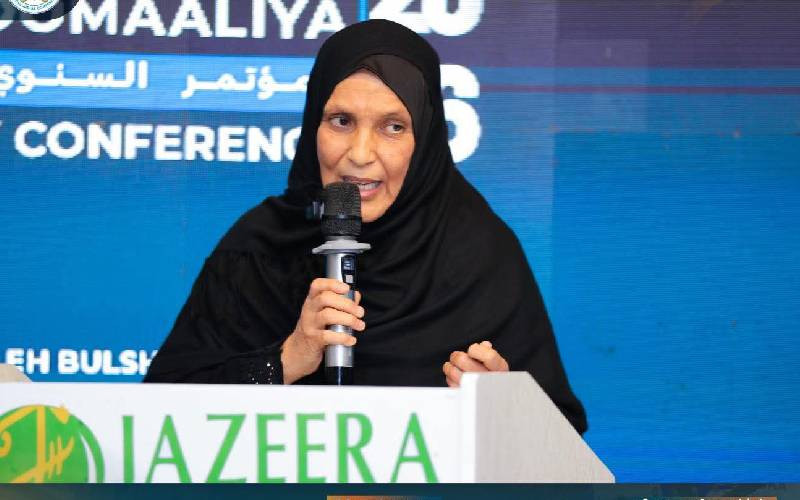
The recent remarks by the Somalia National Independent Human Rights Commissioner, Dr Maryan Kasim, have ignited a measured but significant debate about the philosophical foundations of human rights and their implications for Somalia’s democratic future.
Addressing judges, legal scholars and public officials in Mogadishu, Kasim suggested that human rights are fundamentally rooted in faith and moral tradition rather than primarily in international instruments such as the Universal Declaration of Human Rights (UDHR). Drawing from Islamic history, she cited Umar ibn al-Khattab and Ali ibn Abi Talib as exemplars of equality before the law.
“Human rights are given by God,” she stated, adding that they “should not be viewed solely through international conventions adopted in 1948.”
For some observers, the remarks were a philosophical reflection on the moral underpinnings of justice in Somali society. For others, including segments of civil society and international partners, the comments raised concerns about how Somalia’s human-rights framework will align with global standards at a time when institutional credibility is still consolidating.
The UDHR, adopted by the United Nations General Assembly in the aftermath of World War II, has shaped constitutions, treaties and national legal systems worldwide. While not legally binding on its own, it remains the cornerstone of the modern human-rights system. For national commissions, alignment with their principles is widely viewed as a benchmark of independence and predictability.
Somalia’s context makes the debate particularly sensitive. As the country rebuilds its justice institutions after decades of conflict, public confidence, both domestic and international, depends heavily on clarity. Statements perceived as distancing national institutions from internationally recognised norms may, fairly or not, invite scrutiny regarding commitments to freedom of expression, minority rights and gender equality.
Yet the issue need not be framed as a choice between faith and universality. Across Africa, including Kenya, constitutional democracies have demonstrated that religious and cultural traditions can coexist with international human-rights obligations. Many religious teachings emphasise justice, equality and accountability, values that equally underpin modern democratic systems.
Central to this conversation is universal suffrage. The right of every adult citizen to vote without discrimination is the most tangible expression of universal human rights. It reflects the principle that all individuals possess equal political worth, regardless of clan, creed, gender or status. Universal suffrage transforms abstract rights into practical power, the power to shape governance through the ballot.
Kenya’s constitutional journey affirms that institutional legitimacy flows from equal participation. The vote is not merely procedural; it safeguards dignity. When suffrage is universal, the moral claim that rights are inherent finds concrete democratic expression.
Analysts note that Somalia’s Islamic tradition has historically accommodated diverse interpretations. In that context, national institutions are expected to communicate in ways that reflect pluralism and inclusivity. With Somalia still healing from decades of division, public messaging from key bodies carries particular weight.
Ultimately, Somalia’s progress will depend less on the origin story of rights than on their consistent application. Whether grounded in faith, constitutional law or international consensus, the true test lies in protecting every citizen equally and ensuring each has an equal voice at the ballot box.
Follow The Standard
channel
on WhatsApp
Addressing judges, legal scholars and public officials in Mogadishu, Kasim suggested that human rights are fundamentally rooted in faith and moral tradition rather than primarily in international instruments such as the Universal Declaration of Human Rights (UDHR). Drawing from Islamic history, she cited Umar ibn al-Khattab and Ali ibn Abi Talib as exemplars of equality before the law.
“Human rights are given by God,” she stated, adding that they “should not be viewed solely through international conventions adopted in 1948.”
For some observers, the remarks were a philosophical reflection on the moral underpinnings of justice in Somali society. For others, including segments of civil society and international partners, the comments raised concerns about how Somalia’s human-rights framework will align with global standards at a time when institutional credibility is still consolidating.
The UDHR, adopted by the United Nations General Assembly in the aftermath of World War II, has shaped constitutions, treaties and national legal systems worldwide. While not legally binding on its own, it remains the cornerstone of the modern human-rights system. For national commissions, alignment with their principles is widely viewed as a benchmark of independence and predictability.
Somalia’s context makes the debate particularly sensitive. As the country rebuilds its justice institutions after decades of conflict, public confidence, both domestic and international, depends heavily on clarity. Statements perceived as distancing national institutions from internationally recognised norms may, fairly or not, invite scrutiny regarding commitments to freedom of expression, minority rights and gender equality.
Yet the issue need not be framed as a choice between faith and universality. Across Africa, including Kenya, constitutional democracies have demonstrated that religious and cultural traditions can coexist with international human-rights obligations. Many religious teachings emphasise justice, equality and accountability, values that equally underpin modern democratic systems.
Central to this conversation is universal suffrage. The right of every adult citizen to vote without discrimination is the most tangible expression of universal human rights. It reflects the principle that all individuals possess equal political worth, regardless of clan, creed, gender or status. Universal suffrage transforms abstract rights into practical power, the power to shape governance through the ballot.
Kenya’s constitutional journey affirms that institutional legitimacy flows from equal participation. The vote is not merely procedural; it safeguards dignity. When suffrage is universal, the moral claim that rights are inherent finds concrete democratic expression.
Analysts note that Somalia’s Islamic tradition has historically accommodated diverse interpretations. In that context, national institutions are expected to communicate in ways that reflect pluralism and inclusivity. With Somalia still healing from decades of division, public messaging from key bodies carries particular weight.
Ultimately, Somalia’s progress will depend less on the origin story of rights than on their consistent application. Whether grounded in faith, constitutional law or international consensus, the true test lies in protecting every citizen equally and ensuring each has an equal voice at the ballot box.
Follow The Standard
channel
on WhatsApp
By Ali Kassim