



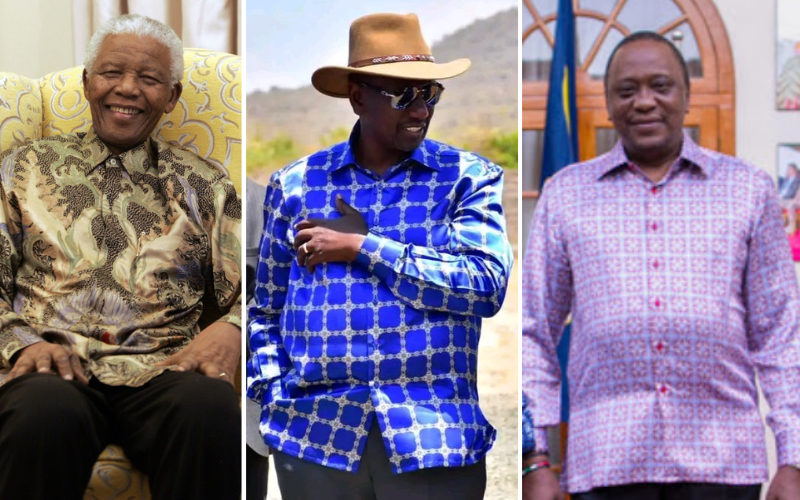
Power dressing, the exclusive domain of political elites and prominent figures, has a powerful ripple effect that extends far beyond boardrooms, statehouses, and international stages.
In many societies, Kenya included, the middle class views refined attire, think silk textures, impeccable tailoring, subtle luxury signals, as more than fashion. It becomes a tool for signalling competence, restraint, and alignment with elite standards.
Before 1994, South African parliamentary sessions might have struck observers as little more than a sombre parade of the darkest suits and broadest hats, a quiet competition in formality. Then came Nelson Mandela, striding through those hallowed halls in what would become globally iconic, the Madiba shirt.
Crafted from silk in bold combinations of yellow and black, white and red, or sometimes all the above, these loose, full-length, untucked garments broke every convention.
Increasingly, there are now many outlets specialising in these eponymous Madiba shirts, even though the original was conceived and designed by Sonwabile Ndamase in the 1990s, the former president’s personal designer.
In essence, power has always had a form, an identifier of sorts. When William Ruto touched down in Beijing for his maiden trip to China on October 14, 2023, he was wearing silk.
When Nelson Mandela took to the stage at the United Nations General Assembly on October 23, 1995, he was wearing silk. When former President Uhuru Kenyatta met Prince William on September 30, 2018, he was wearing silk.
These scenarios are far from isolated. Leaders across time have grasped the subtle language of attire to project authority, whether Winston Churchill’s practical “Siren Suit” during wartime or Kim Jong-un’s structured Mao-style tunics that echo dynastic continuity.
Silk, once the preserve of emperors, has quietly glided into the public foreground, not as spectacle, but as statement, understood and interpreted only by a discerning circle.
Classified among the most expensive fabrics on earth, to wear silk is to exercise appreciation on an entirely uncustomary scale. Sea silk, also known as byssus or the “Diamond of Clothing”, exists as the rarest fabric on earth, fetching an astonishing Sh174,200 per gram, about $1,340.
This costs more than its equivalent weight in gold. Furthermore, silk varieties occupy four of the top ten slots among the world’s most expensive fabrics, maintaining a lead in the exclusive club of fabric heavyweights.
And in Kenya, an elite scion is silently relishing this discovery.
Silk’s association with power dates back centuries, when its rarity underpinned China’s dominance across what later became known as the Silk Road, a commercial corridor stretching more than 6,000 kilometres between Asia and the Western world.
Producing a single kilogram involves thousands of silkworms, carefully raised in monitored conditions and painstakingly fed mulberry leaves multiple times a day. Yields from silk farms are dismal at best, justifying the notion that silk has never truly been for the ordinary.
President William Ruto, who seems to have refined this particular aesthetic, has recently been championing the silk philosophy. Seemingly intentional, his recent adoption of silk as a go-to staple, especially in interactive settings, appears to balance out his renowned fondness for the Kaunda, which he has single-handedly iconised.
His choice of short-sleeved options, rather than the commonly perceived long-sleeved style, also does not seem accidental. This is equally noticeable in his go-to picks for his signature Kaunda style.
This aesthetic is proving influential, with senior leaders, aides, and ministers, including Deputy President Kithure Kindiki, increasingly adopting similar silhouettes and textiles.
Yet this influence carries complexities. Power dressing can heighten status anxiety for the middle class.
The pressure to look the part amid economic constraints leads to stress, as aspirations for refinement clash with realities such as inflation or limited disposable income. What reads as effortless ease among the powerful can feel performative or burdensome when emulated without the same resources.
The renewed prominence of classic African forms, particularly the Kaunda suit and expressive silk shirts, marks a shift away from westernised or borrowed forms. Instead, they hint at intentional self-expression.
In a previous interview about the significance of wielding power through statement dressing, Brian Kisimba, an expert couturier and MD at Barone, explained the concept of “Style as Power”, where the garment, especially in silk, is used as a “Personalised Instrument of Influence”.
Additionally, Niccolò Ricci, son and CEO of the Italian style icon Stefano Ricci, in his interview with Patrick Bet-David, underscored that “Life is made of details”, alluding to the Italian house’s hyper focus on craft and detail as cornerstones of its brand’s success.