

Audio By Vocalize
President William Ruto now says he has no interest in running Nairobi, insisting the cooperation agreement signed at State House between the national government and Nairobi County is a constitutional obligation, not a takeover.
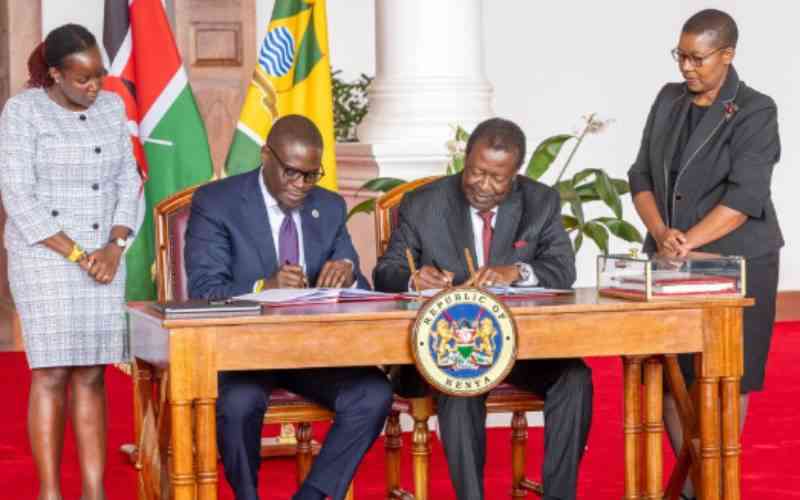
The agreement was signed by Governor Johnson Sakaja and Prime Cabinet Secretary Musalia Mudavadi, whose office will spearhead its implementation, with Sakaja deputising.
“What we are augmenting today is not a transfer of functions. The Nairobi City County Government retains its legal mandate. What is being enhanced is structured national government support where the capital city’s performance affects the entire Republic,” said Ruto on Tuesday.
The deal, backed by an initial capital package of Sh80 billion spread across priority sectors, solidifies earlier agreements between the two levels of government and is rooted in the country’s two-tier governance structure.
It covers four key areas: water and sewerage; roads, bridges, and drainage; housing and related infrastructure, including lighting; and solid waste management alongside the Nairobi Rivers regeneration project.
Ruto anchored the deal in law, citing Article 189(2) of the Constitution, which requires the two levels of government to cooperate, assist and consult each other, as well as the Intergovernmental Relations Act (IRA) and the Urban Areas and Cities Act.
He noted pointedly that since the enactment of the Urban Areas and Cities Act in 2012, the cooperation agreement was 14 years late. “It should have been in place with the advent of devolution,” noted Ruto, adding that Nairobi carries national, regional and global obligations but is funded largely through the same formula as other counties.
“Today’s cooperation agreement is designed to close that gap fully and within the confines of the constitution,” he added.
Street Lighting
On street lighting, Ruto said only 21,000 of Nairobi’s 70,000 lighting points, roughly 30 per cent, are fully operational.
The government will commit Sh3.7 billion towards street lighting modernisation and expansion, completing 10,000 existing points and installing an additional 40,000.
New roads will include lighting by design, and poles will be commercialised so that advertising revenue supports maintenance.
Electricity
On electricity costs in informal settlements, Ruto said families in Nairobi’s nine major informal settlements sometimes pay up to 150 per cent more for illegal electricity connections than residents in formal estates pay legally.
The national government, working with Kenya Power, will invest Sh1.5 billion in transformers and last-mile connections alongside a prepaid bulk framework to lower power costs for low-income households.
A further Sh3.3 billion will go into upgrading programmes covering transformers, prepaid metering and settlement lighting around footpaths, markets, schools and health facilities.
Water Supply
On water, Ruto announced a Sh2.1 billion investment at the Ng’ethu Treatment Plant to stop daily losses of approximately 50,000 cubic litres, and a further Sh3 billion for the Gigiri-Shauri Moyo evacuation corridor to stabilise and extend supply to high-demand zones.
Funding is also being mobilised for the Maragua IV and Northern Collector II projects to secure long-term water stability for Nairobi and neighbouring counties.
On sanitation, the government will commit Sh9 billion to build two parallel 27-kilometre trunk sewer networks along the Nairobi River corridor and Sh6 billion for a new sewer treatment plant capable of treating 60,000 cubic litres of wastewater per day, securing capacity for at least the next 40 years. An additional Sh3 billion will support last-mile sewer connectivity, while Sh15 billion is set aside for long-term sewer expansion across the city.
On roads, the government will spend Sh8.7 billion in total. Sh2 billion has been allocated to complete Phase One Kenya Urban Roads Authority (KURA) roads within two months, with an additional Sh1.7 billion mobilised for a 59-kilometre road package starting in April 2026 under Phase Two.
Phase Three, valued at Sh5 billion, will be procured this financial year. Every ward will benefit from enhanced road networks under a Sh5 billion mobility and safety programme, complemented by Sh3.7 billion from the county government, and a further Sh1 billion dedicated to drainage improvements.
On solid waste, the county will allocate 100 acres for Material Recovery Facilities (MRFs) and four transfer stations, committing Sh4 billion, while the national government will provide Sh2 billion to advance circular waste systems.
Security
On security, Ruto directed Interior Cabinet Secretary Kipchumba Murkomen to prepare a framework for a dedicated Nairobi Metropolitan Police Unit within 60 days, to work alongside the city’s existing security teams. “Security is non-negotiable for a modern capital like Nairobi,” said Ruto.
Mudavadi, whose office takes charge of driving the agreement, framed the deal as a test of political courage, warning that Nairobi risks losing its hub status to rival African cities if leaders remain within their comfort zones.
“It takes a lot of courage for a leader. We have to go beyond the comfort zone that has been there. Nairobi has always had hub status, but we are facing serious competition. For those of you who have been to Addis Ababa, you will see exactly what I am talking about. If you have been to Uganda, you will see what I am talking about, especially at the airport. The same goes for Rwanda and Angola,” said Mudavadi.
Sakaja, who put his signature to the deal alongside Mudavadi, reached for a constitutional metaphor to defend it. “Devolution is like asking a bird which wing it needs to fly.
He is on record last week, denying the transfer of some county roles to the national government.
It needs both wings; it needs the national government and the county government,” noted Sakaja.
Follow The Standard
channel
on WhatsApp
The agreement was signed by Governor Johnson Sakaja and Prime Cabinet Secretary Musalia Mudavadi, whose office will spearhead its implementation, with Sakaja deputising.
“What we are
augmenting today is not a transfer of functions
. The Nairobi City County Government retains its legal mandate. What is being enhanced is structured national government support where the capital city’s performance affects the entire Republic,” said Ruto on Tuesday.
The deal, backed by an initial capital package of Sh80 billion spread across priority sectors, solidifies earlier agreements between the two levels of government and is rooted in the country’s two-tier governance structure.
It covers four key areas: water and sewerage; roads, bridges, and drainage; housing and related infrastructure, including lighting; and solid waste management alongside the Nairobi Rivers regeneration project.
Ruto anchored the deal in law, citing Article 189(2) of the Constitution, which requires the two levels of government to cooperate, assist and consult each other, as well as the Intergovernmental Relations Act (IRA) and the Urban Areas and Cities Act.
He noted pointedly that since the enactment of the
Urban Areas and Cities Act in 2012
, the cooperation agreement was 14 years late. “It should have been in place with the advent of devolution,” noted Ruto, adding that Nairobi carries national, regional and global obligations but is funded largely through the same formula as other counties.
“Today’s cooperation agreement is designed to close that gap fully and within the confines of the constitution,” he added.
Street Lighting
On street lighting, Ruto said only 21,000 of Nairobi’s 70,000 lighting points, roughly 30 per cent, are fully operational.
The government will commit Sh3.7 billion towards street lighting modernisation and expansion, completing 10,000 existing points and installing an additional 40,000.
New roads will include lighting by design, and poles will be commercialised so that advertising revenue supports maintenance.
Electricity
Stay informed. Subscribe to our newsletter
On electricity costs in informal settlements, Ruto said families in Nairobi’s nine major informal settlements sometimes pay up to 150 per cent more for illegal electricity connections than residents in formal estates pay legally.
The national government, working with Kenya Power, will invest Sh1.5 billion in transformers and last-mile connections alongside a prepaid bulk framework to lower power costs for low-income households.
A further Sh3.3 billion will go into upgrading programmes covering transformers, prepaid metering and settlement lighting around footpaths, markets, schools and health facilities.
Water Supply
On water, Ruto announced a Sh2.1 billion investment at the Ng’ethu Treatment Plant to stop daily losses of approximately 50,000 cubic litres, and a further Sh3 billion for the Gigiri-Shauri Moyo evacuation corridor to stabilise and extend supply to high-demand zones.
Funding is also being mobilised for the Maragua IV and Northern Collector II projects to secure long-term water stability for Nairobi and neighbouring counties.
On sanitation, the government will commit Sh9 billion to build two parallel 27-kilometre trunk sewer networks along the Nairobi River corridor and Sh6 billion for a new sewer treatment plant capable of treating 60,000 cubic litres of wastewater per day, securing capacity for at least the next 40 years. An additional Sh3 billion will support last-mile sewer connectivity, while Sh15 billion is set aside for long-term sewer expansion across the city.
On roads, the government will spend Sh8.7 billion in total. Sh2 billion has been allocated to complete Phase One Kenya Urban Roads Authority (KURA) roads within two months, with an additional Sh1.7 billion mobilised for a 59-kilometre road package starting in April 2026 under Phase Two.
Phase Three, valued at Sh5 billion, will be procured this financial year. Every ward will benefit from enhanced road networks under a Sh5 billion mobility and safety programme, complemented by Sh3.7 billion from the county government, and a further Sh1 billion dedicated to drainage improvements.
On solid waste, the county will allocate 100 acres for Material Recovery Facilities (MRFs) and four transfer stations, committing Sh4 billion, while the national government will provide Sh2 billion to advance circular waste systems.
Security
On security, Ruto directed Interior Cabinet Secretary Kipchumba Murkomen to prepare a framework for a dedicated Nairobi Metropolitan Police Unit within 60 days, to work alongside the city’s existing security teams. “Security is non-negotiable for a modern capital like Nairobi,” said Ruto.
Mudavadi, whose office takes charge of driving the agreement, framed the deal as a test of political courage, warning that Nairobi risks losing its hub status to rival African cities if leaders remain within their comfort zones.
“It takes a lot of courage for a leader. We have to go beyond the comfort zone that has been there. Nairobi has always had hub status, but we are facing serious competition. For those of you who have been to Addis Ababa, you will see exactly what I am talking about. If you have been to Uganda, you will see what I am talking about, especially at the airport. The same goes for Rwanda and Angola,” said Mudavadi.
Sakaja, who put his signature to the deal alongside Mudavadi, reached for a constitutional metaphor to defend it. “Devolution is like asking a bird which wing it needs to fly.
He is on record last week, denying the transfer of some county roles to the national government.
It needs both wings; it needs the national government and the county government,” noted Sakaja.
Follow The Standard
channel
on WhatsApp
By David Njaaga