

Audio By Vocalize
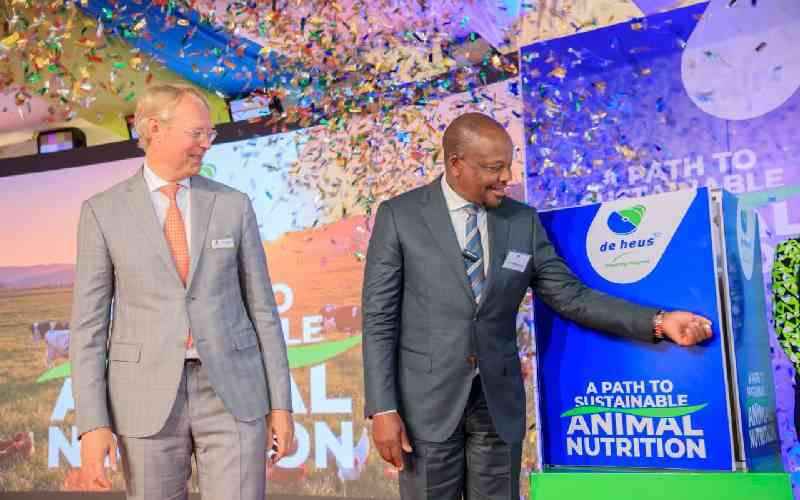
Livestock farmers will now breathe a sigh of relief after a Sh3 billion feed manufacturing plant was commissioned in Athi River, Machakos County.
The plant is deemed central to doubling national milk production, strengthening feed standards, and positioning the country as a regional livestock powerhouse.
Agriculture and Livestock Cabinet Secretary Mutahi Kagwe said the De Heus Animal Nutrition factory is an investment which is part of a broader structural reform in Kenya’s livestock economy.
“Today is not just about commissioning a factory. It is about transforming Kenya’s livestock economy,” said CS Kagwe, adding, “We will not achieve this by merely increasing the number of cows. We will achieve it by increasing productivity per cow.”
Kagwe said the future of Kenya’s dairy and meat sector lies in efficiency, nutrition, genetics, animal health, and most critically, quality feed.
Kenya has set a clear target of doubling annual milk production from 5.2 billion litres to 10 billion litres while also positioning itself to become a net exporter of live animals and meat.
This, Kagwe said, will require a shift from volume-based growth to productivity per animal, underpinned by science-based nutrition and stronger regulatory enforcement.
The commissioning comes at a time when Kenya’s feed industry faces increased scrutiny.
Farmers have raised concerns over inconsistent feed formulations, fluctuating performance from batch to batch, and over-diluted products that compromise productivity.
Feed accounts for up to 60–70 per cent of livestock production costs, making quality and consistency critical to farm profitability.
But Kagwe announced that the government will strengthen enforcement and implement a feed quality index to protect farmers from substandard formulations.
“Over-diluted feed and substandard formulations designed to maximise profits at the expense of productivity will not be tolerated. Farmers must get value for their money,” he said.
He emphasised that export markets demand strict standards and that Kenya’s competitiveness in milk powder, meat, and live animal exports will depend heavily on feed quality and animal health.
The facility, Kagwe said, has an annual production capacity of 240,000 metric tonnes.
It integrates laboratory testing of raw materials, standardised recipe formulation, automated production systems, and batch-to-batch verification to ensure consistency.
In addition, the construction of 50 dams is expected to expand irrigation and reduce dependence on rain-fed agriculture, while structured feed reserves are being planned to cushion farmers during droughts.
“Feed security must be localised. Kenya must reduce dependence on imports of key feed ingredients,” CS Kagwe said.
Co de Heus, Chairman of the Board, said that unlike integrated agribusiness models, De Heus focuses exclusively on animal nutrition, positioning farmers as independent clients supported through knowledge transfer and technical services
“Our investment philosophy is not merely about building factories, but about building capabilities,” he said.
He added, “By working closely with farmers and local partners, we share technical expertise, management insights and practical solutions, helping to unlock the full potential of Kenyan agriculture.”
His sentiments were echoed by Managing Director of De Heus Kenya, Wiehan Visagie, who said the decision to build locally was driven by persistent industry gaps in feed reliability and farmer confidence, especially those dealing with cattle, poultry and pigs.
“For too long, feed has felt like a gamble for many farmers,” he said. “Our commitment is to deliver consistent, batch-to-batch nutrition backed by laboratory testing and strict quality controls. But feed alone is not enough. We pair quality production with technical advisory services, nutrition planning, and on-farm support because real productivity happens when good feed meets good knowledge.”
Visagie said the factory not only represents more than infrastructure but also rebuilding trust.
“Trust that farmers can depend on the quality of what they are buying, and trust that Kenya can build its own food systems using local raw materials,” he said.
The facility creates approximately 280 direct jobs, alongside additional indirect opportunities in logistics and supply chains
Governor Wavinya Ndeti described the plant as a boost to agro-industrial development and youth employment.
“Quality feed is the backbone of productive livestock,” she said. “When our poultry farmers get better feed, they get better yields. When our dairy farmers get better nutrition solutions, milk production increases.”
The Ambassador of the Kingdom of the Netherlands highlighted the broader partnership dimension of the project.
“This new De Heus animal feed facility reflects confidence—confidence in Kenyan farmers, confidence in the future of agriculture, and confidence in the economy of Kenya,” he said.
Follow The Standard
channel
on WhatsApp
The plant is deemed central to doubling national milk production, strengthening feed standards, and positioning the country as a regional livestock powerhouse.
Agriculture and Livestock Cabinet Secretary Mutahi Kagwe said the De Heus Animal Nutrition factory is an investment which is part of a broader structural reform in Kenya’s livestock economy.
“Today is not just about commissioning a factory. It is about transforming Kenya’s livestock economy,” said CS Kagwe, adding, “We will not achieve this by merely increasing the number of cows. We will achieve it by increasing productivity per cow.”
Kagwe said the future of Kenya’s dairy and meat sector lies in efficiency, nutrition, genetics, animal health, and most critically, quality feed.
Kenya has set a clear target of doubling annual milk
production from 5.2 billion litres
to 10 billion litres while also positioning itself to become a net exporter of live animals and meat.
This, Kagwe said, will require a shift from volume-based growth to productivity per animal, underpinned by science-based nutrition and stronger regulatory enforcement.
The commissioning comes at a time when Kenya’s feed industry faces increased scrutiny.
Farmers have raised concerns over inconsistent feed formulations, fluctuating performance from batch to batch, and over-diluted products that compromise productivity.
Feed accounts for up to 60–70 per cent of livestock production costs, making quality and consistency critical to farm profitability.
But Kagwe announced that the government will strengthen enforcement and implement a feed quality index to protect farmers from substandard formulations.
“Over-diluted feed and substandard formulations designed to maximise profits at the expense of productivity will not be tolerated. Farmers must get value for their money,” he said.
He emphasised that export markets demand strict standards and that Kenya’s competitiveness in milk powder, meat, and live animal exports will depend heavily on feed quality and animal health.
Stay informed. Subscribe to our newsletter
The facility, Kagwe said, has an annual production capacity of 240,000 metric tonnes.
It integrates laboratory testing of raw materials, standardised recipe formulation, automated production systems, and batch-to-batch verification to ensure consistency.
In addition, the construction of 50 dams is expected to expand irrigation and reduce dependence on rain-fed agriculture, while structured feed reserves are being planned to cushion farmers during droughts.
“Feed security must be localised. Kenya must reduce dependence on imports of key feed ingredients,” CS Kagwe said.
Co de Heus, Chairman of the Board, said that unlike integrated agribusiness models, De Heus focuses exclusively on animal nutrition, positioning farmers as independent clients supported through knowledge transfer and technical services
“Our investment philosophy is not merely about building factories, but about building capabilities,” he said.
His sentiments were echoed by Managing
Director of De Heus Kenya
, Wiehan Visagie, who said the decision to build locally was driven by persistent industry gaps in feed reliability and farmer confidence, especially those dealing with cattle, poultry and pigs.
“For too long, feed has felt like a gamble for many farmers,” he said. “Our commitment is to deliver consistent, batch-to-batch nutrition backed by laboratory testing and strict quality controls. But feed alone is not enough. We pair quality production with technical advisory services, nutrition planning, and on-farm support because real productivity happens when good feed meets good knowledge.”
Visagie said the factory not only represents more than infrastructure but also rebuilding trust.
“Trust that farmers can depend on the quality of what they are buying, and trust that Kenya can build its own food systems using local raw materials,” he said.
The facility creates approximately 280 direct jobs, alongside additional indirect opportunities in logistics and supply chains
Governor Wavinya Ndeti described the plant as a boost to agro-industrial development and youth employment.
“Quality feed is the backbone of productive livestock,” she said. “When our poultry farmers get better feed, they get better yields. When our dairy farmers get better nutrition solutions, milk production increases.”
The Ambassador of the Kingdom of the Netherlands highlighted the broader partnership dimension of the project.
“This new De Heus animal feed facility reflects confidence—confidence in Kenyan farmers, confidence in the future of agriculture, and confidence in the economy of Kenya,” he said.
Follow The Standard
channel
on WhatsApp
By Selina Mutua