

Audio By Vocalize

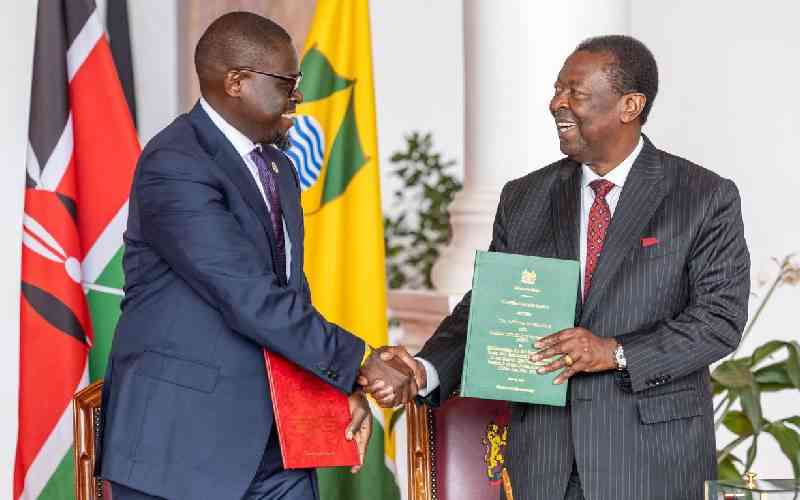
Nairobi Governor Johnson Sakaja has finally signed a cooperation deal with the national government after weeks of blowing hot and cold on the matter.
On the face of it, the Sh80 billion cooperation deal signed by Mr Sakaja and President William Ruto is good for Nairobi. The capital city is on the decline and should not be left to go to the dogs. Street lights must work. Water must flow. Garbage must be collected. Roads must be passable. If the national government has the wherewithal and the money to steady the city, residents would not object to improved services.
But beyond the promise of Sh3.7 billion for lighting, billions more for water infrastructure, sewer lines and informal settlement upgrades, serious questions linger. Did this deal follow the right constitutional procedure that will shield it from litigation? Only days before the signing, Mr Sakaja dismissed reports of the transfer of functions as fake news. Interestingly, before that, he had accused some key figures in government of attempting to take control of key Nairobi city county functions.
Yet, despite denials by Dr Ruto and Sakaja that their deal is not a transfer of functions but a collaboration, what the public sees suggests otherwise. If critical county functions are to be handled by the national government, there should have been a clear deed of transfer approved by the County Assembly, as required by law.
The deal also raises the question: was public participation conducted before the signing of the deal? The Constitution places public participation at the head of any major undertaking that affects the public directly. It is, therefore, a mockery of the Constitution to put this demand at the tail end of the process when the document is already before the assembly for adoption. This arrangement mirrors an earlier one in which some functions of the Nairobi County Government were ceded to the Nairobi Metropolitan Services in March 2020 during Uhuru Kenyatta’s presidency.
At the time, Sakaja was serving as Nairobi Senator and he criticised Uhuru’s regime, blaming it for opaque contracts and ballooning bills. Today, he presides over a deal many see as a return to the same model.
Every governor Nairobi has elected since devolution has left office under a cloud of failure or controversy. From paralysis and scandal to endless turf wars and stalled projects, City Hall has struggled to manage the capital it governs. The impeachment attempt against Sakaja, halted only after intervention by the President and Raila Odinga, underscored the depth of dissatisfaction.
Perhaps it is time for an honest national conversation. Was Nairobi truly suited to function like other counties? Should the capital remain under county administration, or should it be placed fully under national control?
If the current deal succeeds in restoring order and dignity to Nairobi, it will be welcome. However, following the law as laid down is important. We cannot fix our problems through shortcuts.
Follow The Standard
channel
on WhatsApp
By Editorial