



Audio By Vocalize
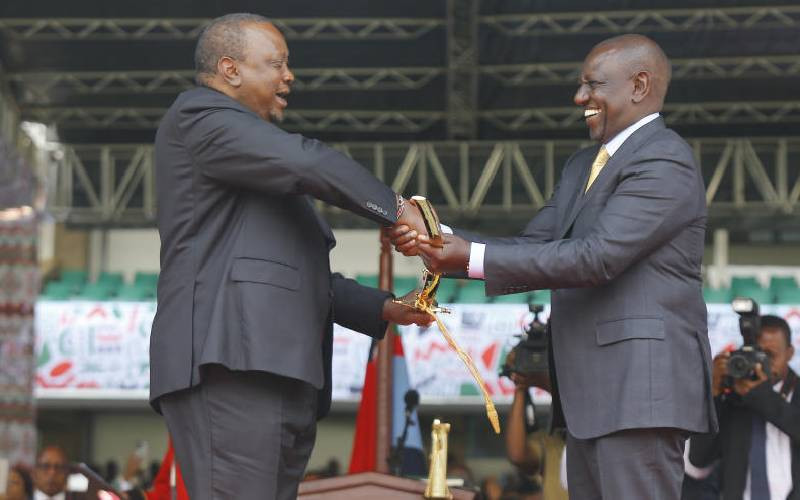
President William Ruto receives instruments of power from his predecessor Uhuru Kenyatta at Kasarani Stadium during inauguration as the 5th President of Kenya at Kasarani Stadium, Nairobi, on September 13, 2022. [File, Standard]
With Kenya’s 2027 presidential election roughly 18 months away, political betting has already begun.
And one wager has quietly gained consensus among seasoned political gamblers: The next presidential contest will pit the incumbent, Dr William Samoei Ruto, against a man whose name shall not appear on the ballot paper-Uhuru Muigai Kenyatta.
In the 2022 election, the outgoing president, Uhuru Kenyatta, openly threw his weight behind his former nemesis-turned-ally Raila Odinga. The State machinery followed suit. Yet Raila lost—narrowly but decisively—after Ruto garnered 7,176,141 votes against Raila’s 6,942,930.
Ruto’s victory stunned many observers, including the victor himself. But it was not accidental. It was largely powered by the Mount Kenya vote, a region that openly defied its most prominent son’s political advice: Despite Uhuru’s endorsement of Raila, voters in Mount Kenya turned out in large numbers to back Ruto, delivering him about 2,364,796 million votes of his total votes.
To Uhuru’s consternation, his own political backyard, Kiambu openly defied him and gave Ruto more than half-a-million votes!
In practical terms, the 2022 election was not simply Ruto versus Raila; it was Ruto versus Uhuru. And despite pouring vast financial resources into the campaign and deploying the full weight of the State, Uhuru lost, especially in Mount Kenya region where voters mutinied against one of their own.
Five years is a short time in politics, but it is long enough for grudges to ferment and rivalries to mature. A new duel is already taking shape. The names on the ballot may differ in 2027, but make no mistake: The next presidential contest will again be a struggle between Ruto and Uhuru.
The rules, however, have changed. Ruto now controls the very State machinery that was once deployed against him. He also commands vast resources with which to mount a formidable defence of his presidency. Yet power has a way of creating its own vulnerabilities. As the saying goes, a pig fries in its own fat—you do not add cooking oil to pork.
Ruto’s fallout with his deputy Rigathi Gachagua, has cost him dearly in Mount Kenya. Crucially, those votes have not migrated to Gachagua; they have drifted back to Uhuru. In a moment of political restraint—some would say genius—Uhuru chose silence, allowing Ruto to unravel on his own.
Gachagua’s ouster only cemented this shift. For voters in Mount Kenya who deeply mistrust Ruto, Gachagua’s protests inspire little confidence. Mistrust, after all, was the central reason Raila failed to crack Mount Kenya in 2022—decades of anti-Luo political narratives compounded by confusion over Uhuru’s sudden change of heart.
That same mistrust now dogs Ruto. And if history is any guide, trust in Mount Kenya politics is like virginity: Once lost, it rarely returns. If Uhuru could not persuade the region to trust Raila, it will take several Uhurus to convince it to trust Ruto again.
By orchestrating Gachagua’s removal, Ruto deepened the wound. Gachagua may have been a political liability, but he has proven a loud and costly one. His public protests resemble those of a spoilt child wailing after a deserved whipping—drawing the attention and anger of other parents. Kenyan politics, it turns out, still believes in the old adage: Spare the rod, spoil the child.
As 2027 approaches, Raila—now politically absent—no longer features as Ruto’s nemesis. Yet Ruto appears to have inherited the mistrust that once defined Raila’s relationship with Mount Kenya. That mistrust was sealed by Gachagua’s ouster.
The chickens are coming home to roost in Central Kenya. Ruto must now confront Uhuru directly—or risk losing millions of votes that once secured his victory.
Uhuru’s name may not appear on the ballot, but his shadow will loom over every polling station in Mount Kenya—and far beyond. Like Hamlet’s ghost, it haunts political conversations from Nyanza to the Coast.
Unless something dramatic happens before August 2027, the race will not truly be Ruto versus an opposition candidate: It will be Ruto versus Uhuru. And unless Ruto pulls off a victory reminiscent of Mwai Kibaki’s controversial 2007 triumph, the odds—at least for now—appear stacked against him.
Mr Muchiri is a journalist
Follow The Standard
channel
on WhatsApp
President William Ruto receives instruments of power from his predecessor Uhuru Kenyatta at Kasarani Stadium during inauguration as the 5th President of Kenya at Kasarani Stadium, Nairobi, on September 13, 2022.
[File, Standard]
With Kenya’s 2027 presidential election roughly 18 months away, political betting has already begun.
And one wager has quietly gained consensus among seasoned political gamblers: The next presidential contest will pit the incumbent, Dr William Samoei Ruto, against a man whose name shall not appear on the ballot paper-Uhuru Muigai Kenyatta.
In the 2022 election, the outgoing president, Uhuru Kenyatta, openly threw his weight behind his former nemesis-turned-ally Raila Odinga. The State machinery followed suit. Yet Raila lost—narrowly but decisively—after Ruto garnered 7,176,141 votes against Raila’s 6,942,930.
Ruto’s victory stunned many observers, including the victor himself. But it was not accidental. It was largely powered by the Mount Kenya vote, a region that openly defied its most prominent son’s political advice: Despite Uhuru’s endorsement of Raila, voters in Mount Kenya turned out in large numbers to back Ruto, delivering him about 2,364,796 million votes of his total votes.
To Uhuru’s consternation, his own political backyard, Kiambu openly defied him and gave Ruto more than half-a-million votes!
In practical terms, the 2022 election was not simply Ruto versus Raila; it was Ruto versus Uhuru. And despite pouring vast financial resources into the campaign and deploying the full weight of the State, Uhuru lost, especially in Mount Kenya region where voters mutinied against one of their own.
Five years is a short time in politics, but it is long enough for grudges to ferment and rivalries to mature. A new duel is already taking shape. The names on the ballot may differ in 2027, but make no mistake: The next presidential contest will again be a struggle between Ruto and Uhuru.
The rules, however, have changed. Ruto now controls the very State machinery that was once deployed against him. He also commands vast resources with which to mount a formidable defence of his presidency. Yet power has a way of creating its own vulnerabilities. As the saying goes, a pig fries in its own fat—you do not add cooking oil to pork.
Ruto’s fallout with his deputy Rigathi Gachagua, has cost him dearly in Mount Kenya. Crucially, those votes have not migrated to Gachagua; they have drifted back to Uhuru. In a moment of political restraint—some would say genius—Uhuru chose silence, allowing Ruto to unravel on his own.
Gachagua’s ouster only cemented this shift. For voters in Mount Kenya who deeply mistrust Ruto, Gachagua’s protests inspire little confidence. Mistrust, after all, was the central reason Raila failed to crack Mount Kenya in 2022—decades of anti-Luo political narratives compounded by confusion over Uhuru’s sudden change of heart.
That same mistrust now dogs Ruto. And if history is any guide, trust in Mount Kenya politics is like virginity: Once lost, it rarely returns. If Uhuru could not persuade the region to trust Raila, it will take several Uhurus to convince it to trust Ruto again.
By orchestrating Gachagua’s removal, Ruto deepened the wound. Gachagua may have been a political liability, but he has proven a loud and costly one. His public protests resemble those of a spoilt child wailing after a deserved whipping—drawing the attention and anger of other parents. Kenyan politics, it turns out, still believes in the old adage: Spare the rod, spoil the child.
As 2027 approaches, Raila—now politically absent—no longer features as Ruto’s nemesis. Yet Ruto appears to have inherited the mistrust that once defined Raila’s relationship with Mount Kenya. That mistrust was sealed by Gachagua’s ouster.
The chickens are coming home to roost in Central Kenya. Ruto must now confront Uhuru directly—or risk losing millions of votes that once secured his victory.
Stay informed. Subscribe to our newsletter
Uhuru’s name may not appear on the ballot, but his shadow will loom over every polling station in Mount Kenya—and far beyond. Like Hamlet’s ghost, it haunts political conversations from Nyanza to the Coast.
Unless something dramatic happens before August 2027, the race will not truly be Ruto versus an opposition candidate: It will be Ruto versus Uhuru. And unless Ruto pulls off a victory reminiscent of Mwai Kibaki’s controversial 2007 triumph, the odds—at least for now—appear stacked against him.
Mr Muchiri is a journalist
Follow The Standard
channel
on WhatsApp
By Muchiri Karanja