

Audio By Vocalize
There is a political firestorm called Edwin Sifuna that is sweeping across Kenya. It is an authentic force, at times appearing like a reincarnation of such past storms as pre-Mau Mau Jomo Kenyatta inspiring anti-colonial speeches, Tom Mboya’s Ndege campaigns, and Kenneth Matiba’s 1992 Githingithia. He has Masinde Muliro’s emotional attraction, Martin Shikuku’s consistency, Mboya’s mental agility, Elijah Mwangale’s abrasiveness, and his uncle’s passion.
He was born in May 1982 when his uncle Lawrence Sifuna and James Orengo were big government critics in Parliament, where Charles Njonjo had dismissed them as ‘bearded sisters’. In Edwin, Orengo probably sees his ‘bearded’ comrade in the struggle against Daniel Arap Moi, but this time the struggle is against Moi’s political protégé, William Ruto. To Orengo, therefore, Edwin is a cultural and ideological ‘nephew’ who deserves full support of the political ‘elders’.
Signs that Sifuna is a force to reckon with were there in his seeming independence of mind as ODM Secretary General (SG). He disagreed with the ‘broad-based’ government philosophy openly and still retained Raila Odinga’s confidence. Raila, a man of political complexity, kept Sifuna and his independence close to him as the most likely linkage to a youth cluster that was increasingly unhappy with Raila’s prominence as a guest in Ruto’s political house.
Since Ruto, probably using Deputy President Rigathi Gachagua as the bait, had successfully ensnared Raila out of ‘opposition’ politics, and the public knew it, Raila needed Sifuna badly. It was not possible, therefore, to hound Sifuna out of the ODM’s SG office the way ‘men in black’ chased Ababu Namwamba. Sifuna also seemed to have the support of such ODM elders as Orengo, Peter Anyang Nyong’o, and Ida Odinga, as well as such youthful players as Babu Owino and Winnie Odinga.
Two rallies, in Kitengela for Sifuna and Tononoka for Oburu Oginga, vividly contrasted the two divisions in ODM. On the one side is the old and desperate Oburu-led group that is hanging on to Ruto’s political pants as a possible saviour. People hardly attended the Tononoko event.
Mimi ni Sifuna
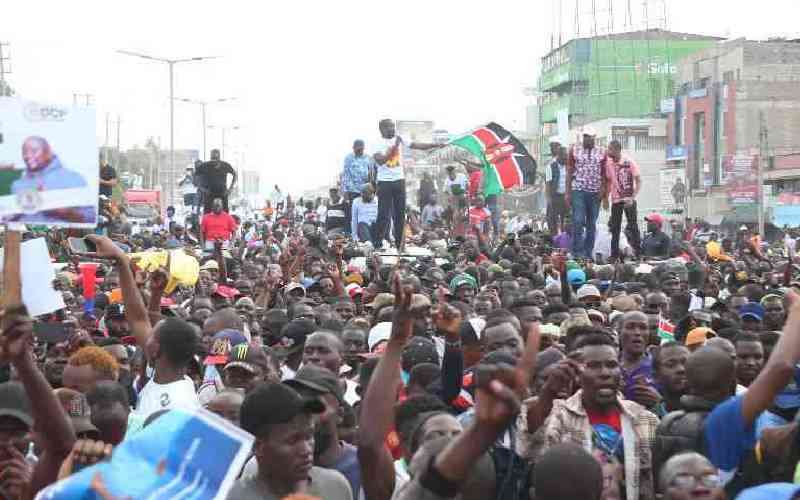
The other is the Sifuna-led, seemingly with a beckoning future, because it is appealing to the youth. Showing his crowd-pulling ability in Kitengela, where the crowd adopted his “Mimi ni Sifuna” slogan as a symbol of defiance against Oburu’s comfort and questionable statements.
Oburu’s promise to take Kenyans to Canaan by way of ‘Singapore’, for instance, sounded odd and was seemingly a declaration of ODM’s fidelity to Ruto. With Ruto warning to use his ODM connections to discipline Sifuna, the Oburu team replaced Sifuna as SG, which implied that ODM had become an instrument of Ruto’s political operation. Gladys Wanga, finding herself cornered, sounded awkward, threatening to abandon Ruto if he does not replace Kithure Kindiki with her or other ODM bigwigs as his deputy in 2027.
The ODM rally at Tononoka was empty compared to the Sifuna rally at Kitengela, which had ‘umati’. Being politically uncontaminated and socio-economically untainted, Sifuna is emerging as a Third Force in the 2027 power game because he seemingly has a large youth following who see him as one of them.
He is intense, focused, and gives the impression of being a man of principles. The perceived quality of being a man of principles is what makes him attractive across the country and a possible unifying force near the Great Lakes or the old Kavirondo, the way that Muliro, Shikuku, or Mwangale could never do.
That said, Sifuna must avoid the curse of the brilliant with their arrogance. Roughly 4,400 years ago, Egyptian Philosopher Ptahhotep advised leaders to consult widely and not to “be arrogant because of your knowledge.” No one, he observed, has all knowledge. Sifuna should also know that other power aspirants would constantly scheme to dislodge him. There is also the magnet of sycophancy in which leaders surround themselves with flatterers who ultimately help to bring them down.
Follow The Standard
channel
on WhatsApp
There is a political firestorm called Edwin Sifuna that is sweeping across Kenya. It is an authentic force, at times appearing like a reincarnation of such past storms as pre-Mau Mau Jomo Kenyatta inspiring anti-colonial speeches, Tom Mboya’s Ndege campaigns, and Kenneth Matiba’s 1992 Githingithia. He has Masinde Muliro’s emotional attraction, Martin Shikuku’s consistency, Mboya’s mental agility, Elijah Mwangale’s abrasiveness, and his uncle’s passion.
He was born in May 1982 when his uncle Lawrence Sifuna and James Orengo were big government critics in Parliament, where Charles Njonjo had dismissed them as ‘bearded sisters’. In Edwin, Orengo probably sees his ‘bearded’ comrade in the struggle against Daniel Arap Moi, but this time the struggle is against Moi’s political protégé, William Ruto. To Orengo, therefore, Edwin is a cultural and ideological ‘nephew’ who deserves full support of the political ‘elders’.
Signs that Sifuna is a force to reckon with were there in his seeming independence of mind as ODM Secretary General (SG). He disagreed with the ‘broad-based’ government philosophy openly and still retained Raila Odinga’s confidence. Raila, a man of political complexity, kept Sifuna and his independence close to him as the most likely linkage to a youth cluster that was increasingly unhappy with Raila’s prominence as a guest in Ruto’s political house.
Since Ruto, probably using Deputy President Rigathi Gachagua as the bait, had successfully ensnared Raila out of ‘opposition’ politics, and the public knew it, Raila needed Sifuna badly. It was not possible, therefore, to hound Sifuna out of the ODM’s SG office the way ‘men in black’ chased Ababu Namwamba. Sifuna also seemed to have the support of such ODM elders as Orengo, Peter Anyang Nyong’o, and Ida Odinga, as well as such youthful players as Babu Owino and Winnie Odinga.
Two rallies, in Kitengela for Sifuna and Tononoka for Oburu Oginga, vividly contrasted the two divisions in ODM. On the one side is the old and desperate Oburu-led group that is hanging on to Ruto’s political pants as a possible saviour. People hardly attended the Tononoko event.
Mimi ni Sifuna
The other is the Sifuna-led, seemingly with a beckoning future, because it is appealing to the youth. Showing his crowd-pulling ability in Kitengela, where the crowd adopted his “Mimi ni Sifuna” slogan as a symbol of defiance against Oburu’s comfort and questionable statements.
Oburu’s promise to take Kenyans to Canaan by way of ‘Singapore’, for instance, sounded odd and was seemingly a declaration of ODM’s fidelity to Ruto. With Ruto warning to use his ODM connections to discipline Sifuna, the Oburu team replaced Sifuna as SG, which implied that ODM had become an instrument of Ruto’s political operation. Gladys Wanga, finding herself cornered, sounded awkward, threatening to abandon Ruto if he does not replace Kithure Kindiki with her or other ODM bigwigs as his deputy in 2027.
The ODM rally at Tononoka was empty compared to the Sifuna rally at Kitengela, which had ‘umati’. Being politically uncontaminated and socio-economically untainted, Sifuna is emerging as a Third Force in the 2027 power game because he seemingly has a large youth following who see him as one of them.
He is intense, focused, and gives the impression of being a man of principles. The perceived quality of being a man of principles is what makes him attractive across the country and a possible unifying force near the Great Lakes or the old Kavirondo, the way that Muliro, Shikuku, or Mwangale could never do.
That said, Sifuna must avoid the curse of the brilliant with their arrogance. Roughly 4,400 years ago, Egyptian Philosopher Ptahhotep advised leaders to consult widely and not to “be arrogant because of your knowledge.” No one, he observed, has all knowledge. Sifuna should also know that other power aspirants would constantly scheme to dislodge him. There is also the magnet of sycophancy in which leaders surround themselves with flatterers who ultimately help to bring them down.
Follow The Standard
channel
on WhatsApp
By Macharia Munene