

Audio By Vocalize
Demystifying the age-old adage “as common as grass” reveals a deeper truth: grass, though ubiquitous, is far more valuable than its familiarity suggests.
In Kenya, where arid and semi-arid lands (ASAL) constitute more than half the country’s land mass, the absence of grass is not merely a botanical concern but a matter of survival.
Grass sustains both ecosystems and livelihoods. Humans depend on herbivorous animals for food, hides, transport, labour and income. Those animals, in turn, depend on pasture. When grass disappears, the entire ecological and economic chain trembles.
Prof Leo Juma Ogalo, an agribusiness scholar at Great Lakes University, attributes grass scarcity in arid regions to poor soils, hardened ground, pests and diseases, low atmospheric humidity, high evapotranspiration, and strong winds and erratic rains that accelerate soil and water erosion. Water scarcity further reduces soil biodiversity, while low organic carbon weakens soil structure, resulting in sparse vegetation.
Grass, he explains, plays a foundational ecological role. It stabilises soil, prevents erosion, regulates water cycles, creates habitat and recycles nutrients. Beyond ecology, grass supports human enterprise. It is used in construction, thatching and craft industries, where artisans fashion furniture, mats and utensils.
Grass also performs a vital atmospheric function. Like other plants, it absorbs carbon dioxide and releases oxygen essential to life. Carbon, though useful in refrigeration and beverage production, becomes dangerous in excess. Elevated carbon dioxide levels increase temperatures and intensify extreme weather patterns.
“Extreme weather ultimately harms vegetation, including grass,” says agriculturist Edwin Omolo Aremo of Ururi Village.
Dr Mohamud Hashir Ali, an Environmental Management lecturer at Garissa University, notes that northern Kenya’s ongoing severe drought has disrupted grass stability and weakened grassland dominance. In drought-prone regions, prolonged dry spells alter grassland productivity and disturb ecological mechanisms.
“Extended drought reduces dominant grass species and retards plant growth,” he explains. Such changes compromise both short- and long-term ecosystem health in ASAL regions.
Although grass covers roughly 40 per cent of the planet’s surface, it plays a disproportionately critical role in maintaining ecological balance and carbon equilibrium. It feeds wildlife and livestock while supporting agricultural systems.
Prof Ogalo warns that long-term drought could reduce grass growing seasons by more than 64.7 per cent in severely affected areas, where temperatures frequently climb to 93 degrees Fahrenheit. The result is sun-baked earth cracked by relentless heat.
Under moderate rainfall, grasslands flourish, delivering consistent ecological output throughout the year. However, ASAL regions rarely enjoy such stability. Instead, they oscillate between prolonged drought and devastating flash floods.
“Both extremes kill grass and retard the growth of what survives,” says Esir Hussein of Garissa. “The resulting pasture shortage harms wildlife, domestic animals and the wider ecosystem.”
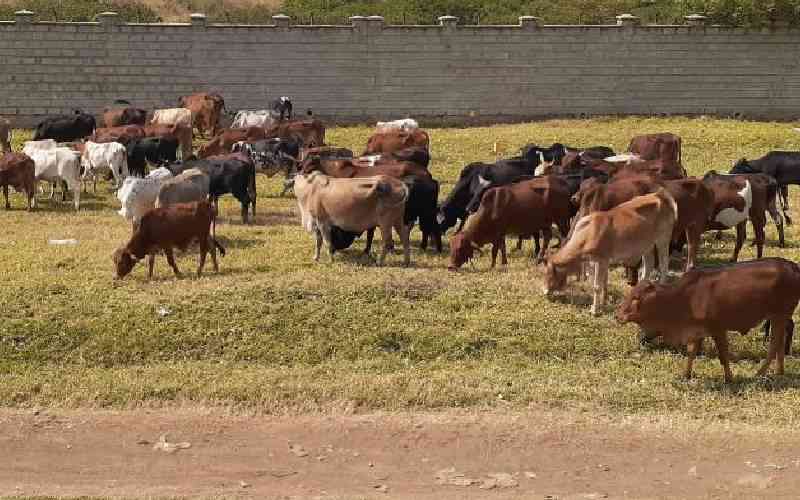
Pasture scarcity exposes livestock and wildlife to disease and starvation. Animal deaths reduce herd sizes and drive up market prices, compounding economic strain. Competition for dwindling grazing land and water often fuels human conflict.
A February 2023 Ministry of Agriculture report revealed that Kenyan pastoralists lost 1.5 million livestock due to pasture and water shortages. The losses included 253,000 cattle, 145,231 sheep and goats, and 43,000 camels.
For ASAL communities, livestock are not merely economic assets; they are social capital. They provide 80 per cent of household livelihoods and underpin pastoralist socio-economic structures. The livestock sector contributes 12 per cent of ASAL Gross Domestic Product and 42 per cent of agricultural output.
“We count livestock as wealth and prestige. Such livestock losses demean our socio-economic status; it is a hit blow below the belt,” says Mohammed Garane, a Mandera County pastoralist.
Solutions exist
Yet experts insist solutions exist.
Prof Ogalo says, “Grass does not always look greener on the yonder. Even the grass on ASAL fields can be greener all year round so long as right steps are taken.”
Defying the adage that grass looks greener where it is watered, the don says, “Many grasses thrive on near waterlessness.” He lists zoysia, Kikuyu, Bermuda, Buffalo, brachiaria, Boma Rhodes, St Augustine, tall fescue and Bahia grass as varieties capable of thriving with minimal water while resisting disease.
He singles out brachiaria as especially promising. The grass can yield up to 19 tonnes of pasture per acre, tolerates drought, resists disease and emits comparatively lower methane levels, making it environmentally advantageous. Brachiaria has already shown success in coastal counties such as Tana River, Kwale and Kilifi. Prof Ogalo questions why northern counties including Isiolo, Garissa, Marsabit, Mandera and Wajir should not adopt similar approaches.
“If such grasses flourish in arid coastal Kenya, northern ASAL counties with comparable terrain should consider them,” he argues.
Dr Tom Ndiewo, a Kericho-based lecturer of English, reflects on the metaphor “the grass is greener where it is watered”. The phrase, he says, simply means that careful management and sustained attention yield results. With appropriate investment and planning, even arid landscapes can be revitalised.
Prof Ogalo outlines practical steps: careful planting, regular weeding, judicious fertilisation, rotational grazing and pasture conservation during favourable seasons to prepare for drought periods.
However, implementing such measures requires coordinated action from county and national governments. Without policy support, funding and extension services, pastoralist communities remain vulnerable to climate extremes.
Grass may appear ordinary, but its significance is profound. It anchors soil, feeds animals, sustains livelihoods and regulates atmospheric balance. Its absence exposes the fragility of interconnected systems. Until meaningful adaptation strategies are implemented, ASAL pastoralists remain at the mercy of an increasingly unpredictable climate.
Follow The Standard
channel
on WhatsApp
Demystifying the age-old adage “as common as grass” reveals a deeper truth: grass, though ubiquitous, is far more valuable than its familiarity suggests.
In Kenya, where arid and semi-arid lands (ASAL) constitute more than half the country’s land mass, the absence of grass is not merely a botanical concern but a matter of survival.
Grass sustains both ecosystems and livelihoods. Humans depend on herbivorous animals for food, hides, transport, labour and income. Those animals, in turn, depend on pasture. When grass disappears, the entire ecological and economic chain trembles.
Prof Leo Juma Ogalo, an agribusiness scholar at Great Lakes University, attributes grass scarcity in arid regions to poor soils, hardened ground, pests and diseases, low atmospheric humidity, high evapotranspiration, and strong winds and erratic rains that accelerate soil and water erosion. Water scarcity further reduces soil biodiversity, while low organic carbon weakens soil structure, resulting in sparse vegetation.
Grass, he explains, plays a foundational ecological role. It stabilises soil, prevents erosion, regulates water cycles, creates habitat and recycles nutrients. Beyond ecology, grass supports human enterprise. It is used in construction, thatching and craft industries, where artisans fashion furniture, mats and utensils.
Grass also performs a vital atmospheric function. Like other plants, it absorbs carbon dioxide and
releases oxygen essential to life
. Carbon, though useful in refrigeration and beverage production, becomes dangerous in excess. Elevated carbon dioxide levels increase temperatures and intensify extreme weather patterns.
“Extreme weather ultimately harms vegetation, including grass,” says agriculturist Edwin Omolo Aremo of Ururi Village.
Dr Mohamud Hashir Ali, an Environmental Management lecturer at Garissa University, notes that northern Kenya’s ongoing severe drought has disrupted grass stability and weakened grassland dominance. In drought-prone regions, prolonged dry spells alter grassland productivity and disturb ecological mechanisms.
“Extended drought reduces dominant grass species and retards plant growth,” he explains. Such changes compromise both short- and long-term ecosystem health in ASAL regions.
Although grass covers roughly 40 per cent of the planet’s surface, it plays a disproportionately critical role in maintaining ecological balance and carbon equilibrium. It feeds wildlife and livestock while supporting agricultural systems.
Prof Ogalo warns that long-term drought could reduce grass growing seasons by more than 64.7 per cent in severely affected areas, where temperatures frequently climb to 93 degrees Fahrenheit. The result is sun-baked earth cracked by relentless heat.
Under moderate rainfall, grasslands flourish, delivering consistent ecological output throughout the year. However, ASAL regions rarely enjoy such stability. Instead, they oscillate between prolonged drought and devastating flash floods.
“Both extremes kill grass and retard the growth of what survives,” says Esir Hussein of Garissa. “The resulting
pasture shortage harms wildlife
, domestic animals and the wider ecosystem.”
Pasture scarcity exposes livestock and wildlife to disease and starvation. Animal deaths reduce herd sizes and drive up market prices, compounding economic strain. Competition for dwindling grazing land and water often fuels human conflict.
Stay informed. Subscribe to our newsletter
A February 2023 Ministry of Agriculture report revealed that Kenyan pastoralists lost 1.5 million livestock due to pasture and water shortages. The losses included 253,000 cattle, 145,231 sheep and goats, and 43,000 camels.
For ASAL communities, livestock are not merely economic assets; they are social capital. They provide 80 per cent of household livelihoods and underpin pastoralist socio-economic structures. The livestock sector contributes 12 per cent of ASAL Gross Domestic Product and 42 per cent of agricultural output.
“We count livestock as wealth and prestige. Such livestock losses demean our socio-economic status; it is a hit blow below the belt,” says Mohammed Garane, a Mandera County pastoralist.
Solutions exist
Yet experts insist solutions exist.
Prof Ogalo says, “Grass does not always look greener on the yonder. Even the grass on ASAL fields can be greener all year round so long as right steps are taken.”
Defying the adage that grass looks greener where it is watered, the don says, “Many grasses thrive on near waterlessness.” He lists zoysia, Kikuyu, Bermuda, Buffalo, brachiaria, Boma Rhodes, St Augustine, tall fescue and Bahia grass as varieties capable of thriving with minimal water while resisting disease.
He singles out brachiaria as especially promising. The grass can yield up to 19 tonnes of pasture per acre, tolerates drought, resists disease and emits comparatively lower methane levels, making it environmentally advantageous. Brachiaria has already shown success in coastal counties such as Tana River, Kwale and Kilifi. Prof Ogalo questions why northern counties including Isiolo, Garissa, Marsabit, Mandera and Wajir should not adopt similar approaches.
“If such grasses flourish in arid coastal Kenya, northern ASAL counties with comparable terrain should consider them,” he argues.
Dr Tom Ndiewo, a Kericho-based lecturer of English, reflects on the metaphor “the grass is greener where it is watered”. The phrase, he says, simply means that careful management and sustained attention yield results. With appropriate investment and planning, even arid landscapes can be revitalised.
Prof Ogalo outlines practical steps: careful planting, regular weeding, judicious fertilisation,
rotational grazing and pasture conservation
during favourable seasons to prepare for drought periods.
However, implementing such measures requires coordinated action from county and national governments. Without policy support, funding and extension services, pastoralist communities remain vulnerable to climate extremes.
Grass may appear ordinary, but its significance is profound. It anchors soil, feeds animals, sustains livelihoods and regulates atmospheric balance. Its absence exposes the fragility of interconnected systems. Until meaningful adaptation strategies are implemented, ASAL pastoralists remain at the mercy of an increasingly unpredictable climate.
Follow The Standard
channel
on WhatsApp
By Dennis Ochieng