

Audio By Vocalize
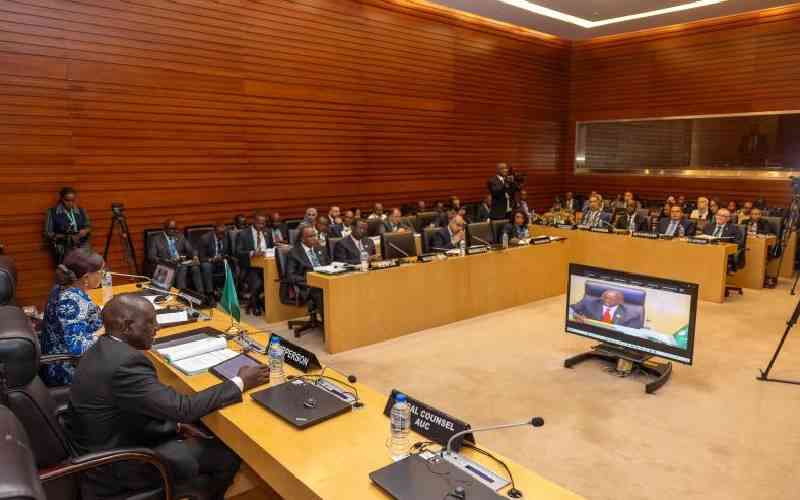
President William Ruto chairs a meeting of the Committee of African Heads of State and Government on Climate Change on the sidelines of the African Union Summit in Addis Ababa, Ethiopia. [File, Standard]
These are times of manufactured world chaos that disrupt accepted international order and place African countries in geopolitical binds arising from colonial conditioning. Among the lingering conditionings was for African potential policymakers to lose self-confidence or confidence in other Africans and thereafter become perpetually dependent on their former colonial authorities for validation or approval. This dependency was most effectively instilled in African minds through adopting European cultural mannerisms as well as the destruction of many African beliefs and values in the name of ‘modernity’ and Euro-Christianity. In the process, losing African identities became a mental condition that empowers the Euros to become the interpreters for African policymakers who thereafter constantly seek validation on how to interpret issues and interests. The tendency for Africans to seek Euro-validation bothers several Africans, like Mwangi Njagi, who would like to ‘de-validate’ the validation mentality.
Mwangi, Director of the American University Study Abroad-Nairobi, thinks that the problem arose from Africans discarding their religions to adopt European Christianity. He is not the first to question the value of Euro-Christianity. Ibn Khaldun, the 14th Century North African writer of Muqqadimah, asserted that European Christians will not go to heaven because all they do is to destroy. ‘Prophet’ Johana Owalo, after getting in and out of various foreign religions, founded his own Nomiya Church in 1912. He also complained about importing the Tuskegee education mentality into Kenya because it tended to turn Africans into tools for European comfort. Kenyan theologian John Mbiti, in accusing Europeans of culturally adulterating the New Testament, translated it from the original Greek version into his Kamba language. Ngugi wa Thiong’o was overly active in calling for ‘decolonising’ the mind through decolonising languages. What these men had in common was the effort to ’de-validate’ assumptions of validity simply because of cultural European-ness.
The need to de-validate the validation mentality is most acute at the top of governments where poor policymaking negatively affects the interests of various countries in two ways. First, the negative effects of the validation mentality are visible in the government’s inability to protect core national interests. Foreign forces tend to bamboozle inept policymakers by offering secondary goods of grandeur and luxuries in exchange for such core national assets as ports, prime land, and strategic institutions. As they wallow in European type ‘aristocratic’ pretensions, policymakers surrender national sovereignty, fail to protect national interests, and occasionally embarrass the country when those privileged foreigners engage in international mischief. Giving national documents such as identification cards and passports to foreigners to do as they please besmirches the national image when those foreigners engage in dubious activities.
Second, the negative effects of the validation mentality display themselves in policy ignorance that leads to loss of comprehensive philosophy on education and what the purpose of education in society should be. Owalo, in the early colonial days, had complained about the stress on the Tuskegee mentality which aimed at stifling thinking. Not very much has changed from the Owalo days as policymakers repeatedly condemn the humanities and the social sciences, especially history and philosophy. They end up plunging their countries into policy quagmires and then seek validation from the same interpreters who misled them. In the process, they destroy not just the educational system but also the fabric of society and such critical services as health.
Since in neglecting national interests policymakers seek validation from London, Paris, Dubai, Washington, or Beijing, de-validating their validation mentality is an act of liberation. This calls for recasting the national education philosophy so as to liberate policymakers from craving for the enslaving external mental validation. This recasting would then stress the totality of Utu in Africa rather than emphasise fragments of technical learning. Policymakers that are free from the Euro-validation mentality would know how to protect and advance collective African interests, not seek external validation.
Follow The Standard
channel
on WhatsApp
President William Ruto chairs a meeting of the Committee of African Heads of State and Government on Climate Change on the sidelines of the African Union Summit in Addis Ababa, Ethiopia.
[File, Standard]
These are times of manufactured world chaos that disrupt accepted international order and place African countries in geopolitical binds arising from colonial conditioning. Among the lingering conditionings was for African potential policymakers to lose self-confidence or confidence in other Africans and thereafter become perpetually dependent on their former colonial authorities for validation or approval. This dependency was most effectively instilled in African minds through adopting European cultural mannerisms as well as the destruction of many African beliefs and values in the name of ‘modernity’ and Euro-Christianity. In the process, losing African identities became a mental condition that empowers the Euros to become the interpreters for African policymakers who thereafter constantly seek validation on how to interpret issues and interests. The tendency for Africans to seek Euro-validation bothers several Africans, like Mwangi Njagi, who would like to ‘de-validate’ the validation mentality.
Mwangi, Director of the American University Study Abroad-Nairobi, thinks that the problem arose from Africans discarding their religions to adopt European Christianity. He is not the first to question the value of Euro-Christianity. Ibn Khaldun, the 14th Century North African writer of
Muqqadimah
, asserted that European Christians will not go to heaven because all they do is to destroy. ‘Prophet’ Johana Owalo, after getting in and out of various foreign religions, founded his own Nomiya Church in 1912. He also complained about importing the Tuskegee education mentality into Kenya because it tended to turn Africans into tools for European comfort. Kenyan theologian John Mbiti, in accusing Europeans of culturally adulterating the New Testament, translated it from the original Greek version into his Kamba language. Ngugi wa Thiong’o was overly active in calling for ‘decolonising’ the mind through decolonising languages. What these men had in common was the effort to ’de-validate’ assumptions of validity simply because of cultural European-ness.
The need to de-validate the validation mentality is most acute at the top of governments where poor policymaking negatively affects the interests of various countries in two ways. First, the negative effects of the validation mentality are visible in the government’s inability to protect core national interests. Foreign forces tend to bamboozle inept policymakers by offering secondary goods of grandeur and luxuries in exchange for such core national assets as ports, prime land, and strategic institutions. As they wallow in European type ‘aristocratic’ pretensions, policymakers surrender national sovereignty, fail to protect national interests, and occasionally embarrass the country when those privileged foreigners engage in international mischief. Giving national documents such as identification cards and passports to foreigners to do as they please besmirches the national image when those foreigners engage in dubious activities.
Second, the negative effects of the validation mentality display themselves in policy ignorance that leads to loss of comprehensive philosophy on education and what the purpose of education in society should be. Owalo, in the early colonial days, had complained about the stress on the Tuskegee mentality which aimed at stifling thinking. Not very much has changed from the Owalo days as policymakers repeatedly condemn the humanities and the social sciences, especially history and philosophy. They end up plunging their countries into policy quagmires and then seek validation from the same interpreters who misled them. In the process, they destroy not just the educational system but also the fabric of society and such critical services as health.
Since in neglecting national interests policymakers seek validation from London, Paris, Dubai, Washington, or Beijing, de-validating their validation mentality is an act of liberation. This calls for recasting the national education philosophy so as to liberate policymakers from craving for the enslaving external mental validation. This recasting would then stress the totality of Utu in Africa rather than emphasise fragments of technical learning. Policymakers that are free from the Euro-validation mentality would know how to protect and advance collective African interests, not seek external validation.
Follow The Standard
channel
on WhatsApp
By Macharia Munene