



Audio By Vocalize
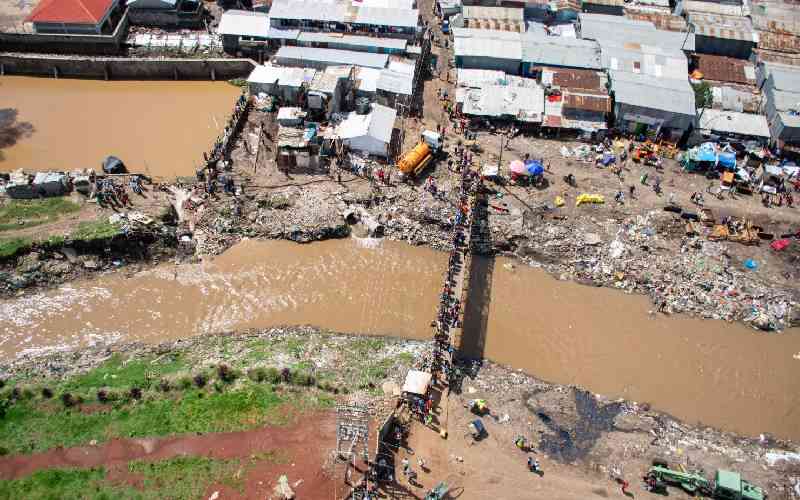
An aerial of areas hit by floods following heavy downpour in Nairobi on March 6, 2026. [KRCS, Standard]
With more than 40 people confirmed dead as a result of the flash flooding, Kenyans are once again forced to reckon with the severe neglect of the population by its leaders. Although it is easy to act as if the floods are an unexpected disaster, the country floods every year. As well, unlike in the past, the weather can now be predicted. Therefore, the death and destruction that we witness from floods every year are completely avoidable or, at worst, can be mitigated through some level of planning and disaster management.
But we know that this is hard to ask of our leaders, especially where cronyism overrides professional experience. Whilst professional climate forecasters warn us months in advance of the coming floods, in Nairobi, which has been particularly affected this time around, our leaders promise to buy us boats to navigate the city, and the head of the disaster management team reportedly has a degree in theology. Perhaps the plan is to pray the rains in and out as in the biblical times, and when this fails, to take off from the city in speed boats.
In reality, however, some easy fixes that have been pointed out by many are being ignored. The first and most important of these is the cleaning of drainage routes to clear them of trash and silt in preparation for the heavy movement of rainwater. Nairobi’s water escape routes, and indeed those of many other parts of the country, are clogged with dirt, and a regular cleaning is needed, but never gets done in anticipation of the rain. Instead, it is done at odd points during the year.
Larger scale mitigation of the flooding problem ought to take the form of preserving our environment. It is well known that tree cover goes a long way in preserving the soil and keeping it hydrated so that when it rains, the ground is not too dry and hardened up to absorb water.
Steady deforestation
In Nairobi, we have witnessed over the years the steady deforestation of a city that was known for being lush and green, in favour of ever-expanding highways and superhighways. Whilst construction and industrialisation lend Nairobi a dazzling look, they do nothing for the wellbeing of the city itself, or of its people.
A leadership is only as good as its people and is in fact a representation of its people. Leaders do not spring out of a vacuum but rise from amongst us. Thus, the slovenly handling of nature and the belligerence towards taking action to prepare for the rains can only reflect our lack of care too. If it is a fact that our drainage system is blocked by trash and is unable to pass rainwater through, then it is also a fact that we are the ones trashing our environment.
One reason for Kenyans throwing trash out into the open, albeit reluctantly, is the lack of proper dumping processes by county governments. In Nairobi, for instance, visitors to the CBD for months on end complained about a lack of trash cans and asked their governor to act.
This simple request went unheeded for far too long, forcing most to dump trash anyhowly, while the more conscientious carried their trash around as they waited for an ideal moment to dispose of it properly.
Perhaps the one location that brings this dilemma into sharp relief due to the magnitude of waste on display is Pipeline Estate. Here, mothers hanging out their clothes to dry must cover them with polythene papers lest trash flying out from the upper floors land on them.
As Kenyans grapple with incompetent leadership that so often leads to losses, we must also remind ourselves that Earth is our home, and we are custodians of it. While individual actions to address government failure – such as planting trees or not littering – are not sufficient, they are nevertheless necessary in building a culture of upright citizens who care for their home. Only in this way will we demand, for our own sake, that our leaders also be upright citizens who show a sense of care.
Ms Njahira is an international lawyer
Follow The Standard
channel
on WhatsApp
An aerial of areas hit by floods following heavy downpour in Nairobi on March 6, 2026.
[KRCS, Standard]
With more than 40 people confirmed dead as a result of the flash flooding, Kenyans are once again forced to reckon with the severe neglect of the population by its leaders. Although it is easy to act as if the floods are an unexpected disaster, the country floods every year. As well, unlike in the past, the weather can now be predicted. Therefore, the death and destruction that we witness from floods every year are completely avoidable or, at worst, can be mitigated through some level of planning and disaster management.
But we know that this is hard to ask of our leaders, especially where cronyism overrides professional experience. Whilst professional climate forecasters warn us months in advance of the coming floods, in Nairobi, which has been particularly affected this time around, our leaders promise to buy us boats to navigate the city, and the head of the disaster management team reportedly has a degree in theology. Perhaps the plan is to pray the rains in and out as in the biblical times, and when this fails, to take off from the city in speed boats.
In reality, however, some easy fixes that have been pointed out by many are being ignored. The first and most important of these is the cleaning of drainage routes to clear them of trash and silt in preparation for the heavy movement of rainwater. Nairobi’s water escape routes, and indeed those of many other parts of the country, are clogged with dirt, and a regular cleaning is needed, but never gets done in anticipation of the rain. Instead, it is done at odd points during the year.
Larger scale mitigation of the flooding problem ought to take the form of preserving our environment. It is well known that tree cover goes a long way in preserving the soil and keeping it hydrated so that when it rains, the ground is not too dry and hardened up to absorb water.
Steady deforestation
In Nairobi, we have witnessed over the years the steady deforestation of a city that was known for being lush and green, in favour of ever-expanding highways and superhighways. Whilst construction and industrialisation lend Nairobi a dazzling look, they do nothing for the wellbeing of the city itself, or of its people.
A leadership is only as good as its people and is in fact a representation of its people. Leaders do not spring out of a vacuum but rise from amongst us. Thus, the slovenly handling of nature and the belligerence towards taking action to prepare for the rains can only reflect our lack of care too. If it is a fact that our drainage system is blocked by trash and is unable to pass rainwater through, then it is also a fact that we are the ones trashing our environment.
One reason for Kenyans throwing trash out into the open, albeit reluctantly, is the lack of proper dumping processes by county governments. In Nairobi, for instance, visitors to the CBD for months on end complained about a lack of trash cans and asked their governor to act.
This simple request went unheeded for far too long, forcing most to dump trash anyhowly, while the more conscientious carried their trash around as they waited for an ideal moment to dispose of it properly.
Perhaps the one location that brings this dilemma into sharp relief due to the magnitude of waste on display is Pipeline Estate. Here, mothers hanging out their clothes to dry must cover them with polythene papers lest trash flying out from the upper floors land on them.
As Kenyans grapple with incompetent leadership that so often leads to losses, we must also remind ourselves that Earth is our home, and we are custodians of it. While individual actions to address government failure – such as planting trees or not littering – are not sufficient, they are nevertheless necessary in building a culture of upright citizens who care for their home. Only in this way will we demand, for our own sake, that our leaders also be upright citizens who show a sense of care.
Ms Njahira is an international lawyer
Follow The Standard
channel
on WhatsApp
By Njahira Gitahi