

Audio By Vocalize
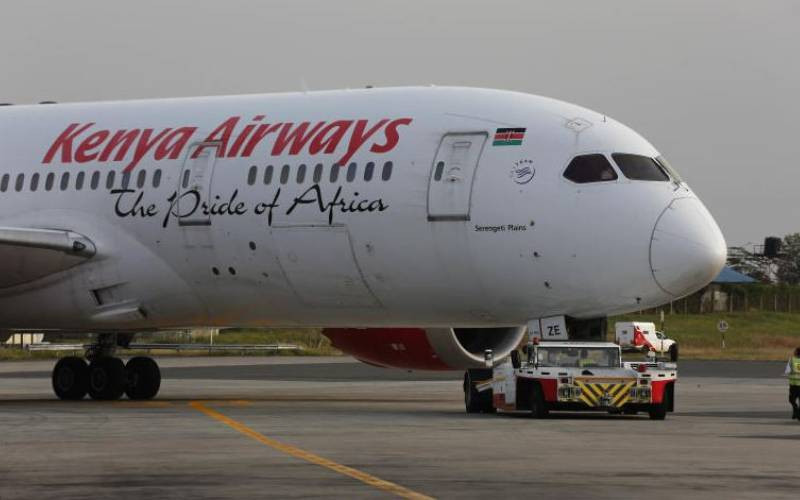
One of Kenya Airways Boeing 787 Dreamliner aircraft at Jomo Kenyatta International Airport, Nairobi, on July 26, 2023. [File, Standard]
The events in the Middle East have once again thrust the global aviation industry into the spotlight. In a manner reminiscent of the disruption wrought by the Covid-19 pandemic in 2020, parts of the sector have grounded to a near halt. The escalation of hostilities between the United States and Israel on one side and Iran on the other has forced the closure of large swathes of Middle Eastern airspace.
According to Euronews, several countries across the region, including Iran, Iraq, Israel and Jordan, have either fully or partially shut their skies, prompting airlines to suspend services, cancel flights and reroute aircraft along longer, costlier corridors. The disruption has rippled through global aviation networks, stranding tens of thousands of passengers and forcing carriers to reconsider routes that ordinarily serve as the principal bridge between Europe, Asia and Africa.
Of the limited flights permitted in extremis last week, the majority departed from Dubai, Doha, Abu Dhabi, Bahrain and Muscat. Nearly all were operated by flag carriers repatriating their nationals from countries that, until recently, had been regarded as major tourist destinations, safe havens for expatriates to live and work, as well as dependable transit hubs. Yet almost overnight, these places became fraught with safety concerns, caught in the collateral fallout of missile exchanges in the escalating conflict involving the United States, Israel and Iran.
Kenya Airways, the national carrier, has repeatedly assumed the role of rescuer when crises have stranded travellers far from home. During the latest disruption, the airline joined other carriers in evacuating passengers. Yet, unlike its peers that restricted seats to their own citizens, it opened its flights to travellers across Africa and beyond.
Such gestures are hardly unprecedented. When civil war erupted in the Central African Republic in 2012, hundreds of African passengers were left stranded after airlines prioritised their own nationals. Kenya Airways stepped in, transporting many who might otherwise have remained trapped. A similar pattern emerged during the upheaval caused by COVID-19. As borders snapped shut and airspace emptied, the airline mounted repatriation flights from distant hubs including India, China and the United States, returning thousands of grateful Kenyans home.
Necessity also spurred innovation. Kenya Airways converted several of its Boeing 787 Dreamliner aircraft into temporary freighters, ensuring that vital exports continued to reach global markets. Tea, coffee, cut flowers, fresh produce and chilled meat were ferried to buyers in Europe, China and the Middle East, a reminder that in adversity, the airline often acted as both lifeline and logistical bridge.
This column has previously lamented the folly of Kenya’s heavy reliance on Middle Eastern airlines at the expense of its national carrier. Policy wonks have granted the former more than 60 weekly frequencies, while Kenya Airways operates fewer than 14 on comparable routes. Such an imbalance sits uneasily with the principle of reciprocity that normally governs aviation agreements. A more even distribution would help even the playing field and give Kenya’s domestic aviation industry a chance not merely to survive but to thrive.
The conflict in the Middle East underlines the strategic wisdom of a robust national carrier and resilient aviation infrastructure. As Kenya Airways’ new board settles in, may it press this case firmly among policymakers.
Support Independent Journalism
Stand With Bold Journalism.
Stand With The Standard.
Continue
→
Pay via
Secure Payment
Kenya’s most trusted newsroom since 1902
Follow The Standard
channel
on WhatsApp
One of Kenya Airways Boeing 787 Dreamliner aircraft at Jomo Kenyatta International Airport, Nairobi, on July 26, 2023.
[File, Standard]
The events in the Middle East have once again thrust the global aviation industry into the spotlight. In a manner reminiscent of the disruption wrought by the Covid-19 pandemic in 2020, parts of the sector have grounded to a near halt. The escalation of hostilities between the United States and Israel on one side and Iran on the other has forced the closure of large swathes of Middle Eastern airspace.
According to Euronews, several countries across the region, including Iran, Iraq, Israel and Jordan, have either fully or partially shut their skies, prompting airlines to suspend services, cancel flights and reroute aircraft along longer, costlier corridors. The disruption has rippled through global aviation networks, stranding tens of thousands of passengers and forcing carriers to reconsider routes that ordinarily serve as the principal bridge between Europe, Asia and Africa.
Of the limited flights permitted in extremis last week, the majority departed from Dubai, Doha, Abu Dhabi, Bahrain and Muscat. Nearly all were operated by flag carriers repatriating their nationals from countries that, until recently, had been regarded as major tourist destinations, safe havens for expatriates to live and work, as well as dependable transit hubs. Yet almost overnight, these places became fraught with safety concerns, caught in the collateral fallout of missile exchanges in the escalating conflict involving the United States, Israel and Iran.
Kenya Airways, the national carrier, has repeatedly assumed the role of rescuer when crises have stranded travellers far from home. During the latest disruption, the airline joined other carriers in evacuating passengers. Yet, unlike its peers that restricted seats to their own citizens, it opened its flights to travellers across Africa and beyond.
Such gestures are hardly unprecedented. When civil war erupted in the Central African Republic in 2012, hundreds of African passengers were left stranded after airlines prioritised their own nationals. Kenya Airways stepped in, transporting many who might otherwise have remained trapped. A similar pattern emerged during the upheaval caused by COVID-19. As borders snapped shut and airspace emptied, the airline mounted repatriation flights from distant hubs including India, China and the United States, returning thousands of grateful Kenyans home.
Necessity also spurred innovation. Kenya Airways converted several of its Boeing 787 Dreamliner aircraft into temporary freighters, ensuring that vital exports continued to reach global markets. Tea, coffee, cut flowers, fresh produce and chilled meat were ferried to buyers in Europe, China and the Middle East, a reminder that in adversity, the airline often acted as both lifeline and logistical bridge.
This column has previously lamented the folly of Kenya’s heavy reliance on Middle Eastern airlines at the expense of its national carrier. Policy wonks have granted the former more than 60 weekly frequencies, while Kenya Airways operates fewer than 14 on comparable routes. Such an imbalance sits uneasily with the principle of reciprocity that normally governs aviation agreements. A more even distribution would help even the playing field and give Kenya’s domestic aviation industry a chance not merely to survive but to thrive.
The conflict in the Middle East underlines the strategic wisdom of a robust national carrier and resilient aviation infrastructure. As Kenya Airways’ new board settles in, may it press this case firmly among policymakers.
Follow The Standard
channel
on WhatsApp
By Leonard Khafafa