

Audio By Vocalize
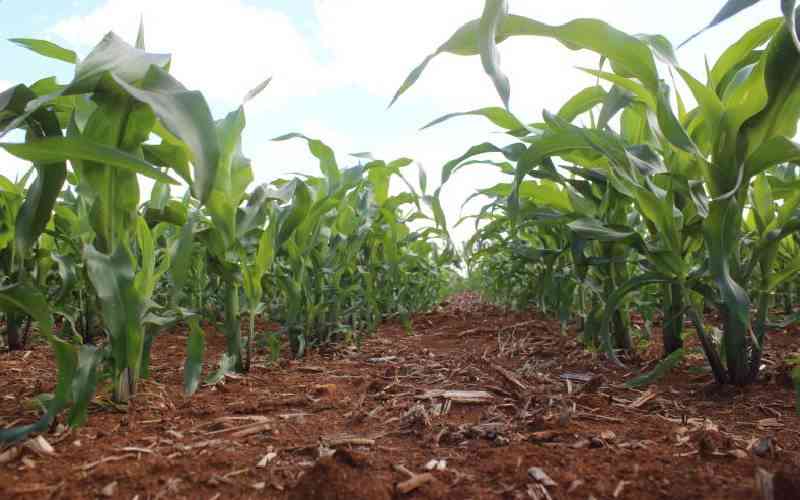
Maize plantation in Uasin Gishu County, on May 31, 2023. [File, Standard]
A push to reduce maize acreage in parts of Uasin Gishu that have produced grain for decades is gaining momentum despite calls for the status quo in Kenya’s breadbasket.
County officials have maintained that acres of land under maize are getting replaced by other cash crops, a move that has sparked fears of less ugali on dinner tables soon.
On Tuesday, Uasin Gishu County rolled out registration of farmers who are seeking to grow one million trees in farms at the onset of the planting season later this month.
Top officials led by Uasin Gishu Deputy Governor Evans Kapkea told agricultural extension officers that the county, which is a leading maize producer in the country, does not have a contract with Kenyans to produce the staple food.
Kapkea said a campaign launched three years ago to introduce cash crops with a target of cushioning maize farmers from unpredictable prices is causing a major reduction of acres under the grain.
“Farmers are now reducing the acreage for maize and wheat. There is a lot of pressure from maize farmers to diversify,” the Deputy Governor said during the launch of Mkulima Portal, a platform for farmers to enroll for cash crop subsidies.
Uasin Gishu Environment Executive Anthony Sitienei, said coffee and other cash crops including avocado, for the local market and export were boosting environmental conservation efforts.
Sitienei said farmers in the bread basket can grow crops of their choice.
“It is not mandatory that we grow maize. Our farmers have learnt that they can have more money in their pockets through coffee and other cash crops,” he said.
He said the bread basket status was a myth that was coined at independence.
The Environment Executive revealed that Uasin Gishu farmers are beginning to taste the returns from cash crops and have been unrelenting in seeking quality seeds in recent years.
“The traditional myth that was being coined from 1963 that Uasin Gishu was the bread basket that feeds the country is long gone,” Sitienei said.
“What people want is to grow cash crops but as the acreage under cereals goes down, we expect the farmer to increase production of maize through proper management. Maize growing is a freelance exercise and farmers have choices,” he added.
Reports at the county’s Agriculture Department indicate that more than 3,000 acres of land is under coffee alone.
The department said the acreage under coffee is expected to double this year as more farmers begin to earn from the crop.
In 2024, a Ministry of Agriculture report indicated that Uasin Gishu was the leading producer of maize, with 483,211 tones followed by Trans Nzoia which produced 423,156t. Other counties are Narok (224,236t) and Kakamega (212,753t).
Support Independent Journalism
Stand With Bold Journalism.
Stand With The Standard.
Continue
→
Pay via
Secure Payment
Kenya’s most trusted newsroom since 1902
Follow The Standard
channel
on WhatsApp
Maize plantation in Uasin Gishu County, on May 31, 2023.
[File, Standard]
A push to reduce maize acreage in parts of Uasin Gishu that have produced grain for decades is gaining momentum despite calls for the status quo in Kenya’s breadbasket.
County officials have maintained that acres of land under maize are getting replaced by other cash crops, a move that has sparked fears of less ugali on dinner tables soon.
On Tuesday, Uasin Gishu County rolled out registration of farmers who are seeking to grow one million trees in farms at the onset of the planting season later this month.
Top officials led by Uasin Gishu Deputy Governor Evans Kapkea told agricultural extension officers that the county, which is a leading maize producer in the country, does not have a contract with Kenyans to produce the staple food.
Kapkea said a campaign launched three years ago to introduce cash crops with a target of cushioning maize farmers from unpredictable prices is causing a major reduction of acres under the grain.
“Farmers are now reducing the acreage for maize and wheat. There is a lot of pressure from
maize farmers to diversify
,” the Deputy Governor said during the launch of Mkulima Portal, a platform for farmers to enroll for cash crop subsidies.
Uasin Gishu Environment Executive Anthony Sitienei, said coffee and other cash crops including avocado, for the local market and export were boosting environmental conservation efforts.
Sitienei said farmers in the bread basket can grow crops of their choice.
“It is not mandatory that we grow maize. Our farmers have learnt that they can have more money in their pockets through coffee and other cash crops,” he said.
He said the bread basket status was a myth that was coined at independence.
The Environment Executive revealed that Uasin Gishu farmers are beginning to taste the returns from cash crops and have been unrelenting in seeking quality seeds in recent years.
“The traditional myth that was being coined from 1963 that Uasin Gishu was the bread basket that feeds the country is long gone,” Sitienei said.
“What people want is to grow cash crops but as the acreage under cereals goes down, we expect the farmer to increase production of maize through proper management. Maize growing is a freelance exercise and farmers have choices,” he added.
Stay informed. Subscribe to our newsletter
Reports at the county’s Agriculture Department indicate that more than 3,000 acres of land is under coffee alone.
The department said the acreage under coffee is expected to double this year as
more farmers begin to earn from the crop.
In 2024, a Ministry of Agriculture report indicated that Uasin Gishu was the leading producer of maize, with 483,211 tones followed by Trans Nzoia which produced 423,156t. Other counties are Narok (224,236t) and Kakamega (212,753t).
Follow The Standard
channel
on WhatsApp
By Stephen Rutto