

Audio By Vocalize
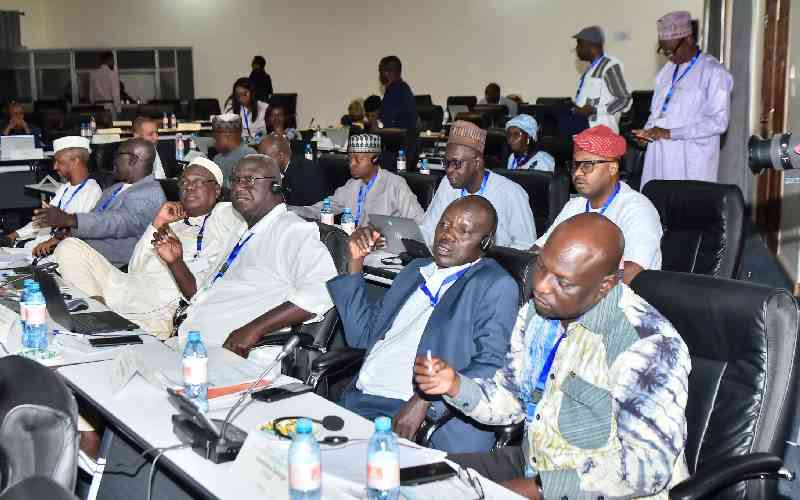
Participants during the regional technical workshop in Naivasha on cross-border livestock trade under AfCTA in the Horn of Africa. [Antony Gitonga, Standard]
Informal livestock trading systems have continued to dominate Africa’s pastoral economies, undermining efforts to unlock the full benefits of the African Continental Free Trade Area (AfCFTA).
Experts say much of the continent’s cross-border livestock movement still operates outside formal regulatory frameworks despite growing demand for regional livestock markets.
This has left pastoral communities unable to fully benefit from the trade opportunities envisioned under the continental agreement while discouraging large-scale private sector investment.
Dr Solomon Munyua, a continental livestock trade expert, said livestock trade was a key economic activity across pastoral regions of the Horn of Africa and the Sahel.
Dr Munyua noted that millions depended on cross-border markets to sell their livestock yet the trade continued to rely heavily on informal networks shaped by fragmented national regulations, inconsistent veterinary certification systems and weak coordination along regional livestock corridors.
“The trade is also shaped by fragmented national regulations, un-harmonized sanitary and phytosanitary standards and weak coordination along livestock trade corridors,” he said.
He noted that although AfCFTA provided a continental framework to expand intra-African trade, effective participation by pastoral economies would depend on predictable and recognized livestock movement governance systems.
Dr Munyua was speaking in Naivasha during regional technical consultations organised by the African Union Inter-African Bureau for Animal Resources (AU-IBAR).
The programme under the African Pastoral Markets Development Platform, aims at strengthening livestock market integration across the continent.
Benjamin Mwongela, Director of Strategy and Partnerships at Agile Consulting Africa, said Africa’s livestock sector already played a major role in the continent’s economy but remains constrained by fragmented regulatory systems.
He said the sector contributes nearly 40 percent of agricultural GDP across the continent but regional livestock corridors were yet to function as fully integrated commercial markets.
“AfCFTA is essentially the scale agenda for Africa’s livestock trade, but harmonization is the operating system that will determine whether private capital flows into these corridors or stays on the sidelines,” he said.
Mwongela noted that livestock exports from the Horn of Africa already exceed $1 billion (Sh130 billion) annually, supported by extensive cross-border trade networks.
However, he said the current system remained heavily informal due to inconsistent sanitary and phytosanitary (SPS) standards, repeated inspections at border points and weak digital traceability systems.
“Policy fragmentation, not tariffs, is the single biggest barrier to scaling livestock trade in the region. When traders face multiple inspections, conflicting certification requirements and slow border procedures, formal trade simply becomes too costly,” Mwongela said.
He explained that harmonised livestock movement permits, mutual recognition of vaccination certificates and digital documentation systems could significantly reduce trade risks.
Dr Diba Dida Wako, Programme Director of the Regional Livestock Programme at Mercy Corps, said the Horn of Africa held one of the world’s largest concentrations of livestock but still struggled to translate this resource into broad economic growth.
“The Horn of Africa possesses enormous livestock resources, including some of the world’s largest camel populations, yet structural barriers across production systems, markets and policy environments continue to limit the sector’s full economic potential,” Dr Wako said.
He explained that livestock diseases, weak market systems and poorly coordinated trade policies continue to constrain pastoral communities whose livelihoods depended heavily on cross-border livestock trade across sub-Saharan Africa.
Dr Wako noted that livestock diseases alone cause estimated annual losses of about $9 billion (Sh1.17 trillion) in sub-Saharan Africa, noting that in practical terms, for every animal reaching the market, another is lost to disease.
He emphasized that improving animal health systems, strengthening disease surveillance and expanding veterinary services will be essential to making regional livestock trade more reliable and competitive.
“The opportunity is enormous. Once policy risks decline, private investment can move quickly into aggregation, processing and export logistics, turning livestock trade into a serious regional growth engine,” Mwongela said.
Support Independent Journalism
Stand With Bold Journalism.
Stand With The Standard.
Continue
→
Pay via
Secure Payment
Kenya’s most trusted newsroom since 1902
Follow The Standard
channel
on WhatsApp
Participants during the regional technical workshop in Naivasha on cross-border livestock trade under AfCTA in the Horn of Africa.
[Antony Gitonga, Standard]
Informal livestock trading systems have continued to dominate Africa’s pastoral economies, undermining efforts to unlock the full benefits of the African Continental Free Trade Area (AfCFTA).
Experts say much of the continent’s cross-border livestock movement still operates outside formal regulatory frameworks despite growing demand for regional livestock markets.
This has left pastoral communities unable to fully benefit from the trade opportunities envisioned under the continental agreement while discouraging large-scale private sector investment.
Dr Solomon Munyua, a continental livestock trade expert, said livestock trade was a key economic activity across pastoral regions of the Horn of Africa and the Sahel.
Dr Munyua noted that millions depended on cross-border markets to sell their livestock yet the trade continued to rely heavily on informal networks shaped by fragmented national regulations, inconsistent veterinary certification systems and weak coordination along regional livestock corridors.
“The trade is also shaped by fragmented national regulations, un-harmonized sanitary and phytosanitary standards and weak coordination along livestock trade corridors,” he said.
He noted that although AfCFTA provided a continental framework to expand intra-African trade, effective participation by pastoral economies would depend on predictable and recognized
livestock movement governance systems
.
Dr Munyua was speaking in Naivasha during regional technical consultations organised by the African Union Inter-African Bureau for Animal Resources (AU-IBAR).
The programme under the African Pastoral Markets Development Platform, aims at strengthening livestock market integration across the continent.
Benjamin Mwongela, Director of Strategy and Partnerships at Agile Consulting Africa, said Africa’s livestock sector already played a major role in the continent’s economy but remains constrained by fragmented regulatory systems.
He said the sector contributes nearly 40 percent of agricultural GDP across the continent but regional livestock corridors were yet to function as fully integrated commercial markets.
“AfCFTA is essentially the scale agenda for Africa’s livestock trade, but harmonization is the operating system that will determine whether private capital flows into these corridors or stays on the sidelines,” he said.
Mwongela noted that livestock exports from the Horn of Africa already exceed $1 billion (Sh130 billion) annually, supported by extensive cross-border trade networks.
Stay informed. Subscribe to our newsletter
However, he said the current system remained heavily informal due to inconsistent sanitary and phytosanitary (SPS) standards, repeated inspections at border points and weak digital traceability systems.
“Policy fragmentation, not tariffs, is the single biggest barrier to scaling livestock trade in the region. When traders face multiple inspections, conflicting certification requirements and slow border procedures, formal trade simply becomes too costly,” Mwongela said.
He explained that harmonised livestock movement permits, mutual recognition of vaccination certificates and digital documentation systems could significantly reduce trade risks.
Dr Diba Dida Wako, Programme Director of the Regional Livestock Programme at Mercy Corps, said the Horn of Africa held one of the world’s largest concentrations of livestock but still struggled to translate this resource into broad economic growth.
“The Horn of Africa possesses enormous livestock resources, including some of the world’s largest camel populations, yet structural barriers across production systems, markets and policy environments continue to limit the sector’s full economic potential,” Dr Wako said.
He explained that livestock diseases, weak market systems and poorly coordinated trade policies continue to constrain pastoral communities whose livelihoods depended heavily on cross-border livestock trade across sub-Saharan Africa.
Dr Wako noted that livestock diseases alone cause estimated annual losses of about $9 billion (Sh1.17 trillion) in sub-Saharan Africa, noting that in practical terms, for every animal reaching the market, another is lost to disease.
He emphasized that improving animal health systems,
strengthening disease surveillance
and expanding veterinary services will be essential to making regional livestock trade more reliable and competitive.
“The opportunity is enormous. Once policy risks decline, private investment can move quickly into aggregation, processing and export logistics, turning livestock trade into a serious regional growth engine,” Mwongela said.
Follow The Standard
channel
on WhatsApp
By Antony Gitonga