

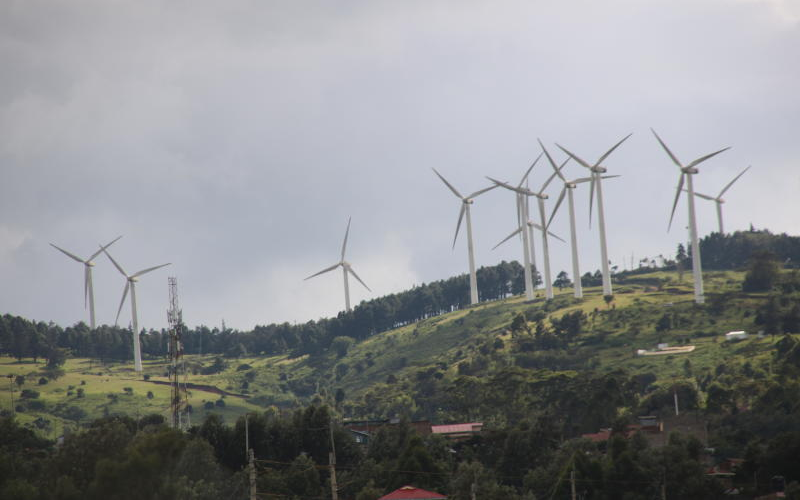
Kengen Wind power turbines in Ngong hills [David Gichuru, Standard]
I live under the Ngong hills.
On certain mornings, I look west and see them rising, seven quiet knuckles against the sky. From my window, the wind turbines look like white sentinels, turning slowly, almost lazily, as if they have nowhere urgent to be.
But up there, the wind is never lazy.
It is deliberate.
I have climbed Ngong Hills four times. However, I have conquered only three of the seven hills. Each time, the wind has reminded me that ambition and humility must travel together.
The first time I went up, I underestimated it. By the second incline, my calves were negotiating with my ego. For a first-time visitor to Ngong, Kajiado County, home to the seven hills, they are deceptive. They roll, then dip, and before you know it, they rise again before your breathing fully settles. Just when you think you have reached the peak, another ridge appears ahead, green and unapologetic.
Seasoned hikers talk casually about “doing all seven.” I have done only three, and those three rearranged me.
Long before you reach the first summit, you see them. The tall white wind turbines cutting clean circles into the sky.
The mighty and imposing turbines, something you only realise when you reach the summit, can be seen from nearby surroundings, from Ngong Road, Karen and Kiserian. In fact, from almost every angle of southern Nairobi.

The hills are impossible to ignore. Up close, they hum with quiet authority, harvesting wind from a ridge that has known gusts for centuries. The blades turn in wide, patient arcs, a choreography between technology and terrain.
Often times I have encountered children pointing at them in wonder. Photographers frame them against sunset. Hikers rest beneath them, dwarfed by their scale. Standing there, watching the blades slice through air that once carried only grass and grazing cattle, I think about continuity.
The Maa community named these hills enkong’u, meaning knuckles, because of their shape. For generations, they were grazing corridors, lookout points, markers of land and lineage.
Now they are also symbols of renewable energy and urban expansion. The land adapts, but the wind remains.
There is a reason seasoned climbers use Ngong as preparation for Mount Kenya. It is not about altitude. It is about rhythm.
The repeated ascents and descents train endurance. The wind strengthens lungs, while the unpredictability builds resilience.
You do not simply walk Ngong hills. You negotiate them. Every dip tests your knees, every climb tests your will, and every gust tests your balance.
By the time you finish two hills, your body understands something your mind had not fully accepted. Progress is rarely linear. Which may explain why I have not yet conquered all seven. Not because I cannot. It is because I am learning to respect the terrain.
There is something intimate about living under these hills. On clear afternoons, the turbines spin like silent metronomes. On stormy evenings, clouds gather dramatically around the peaks, wrapping them in mist before rain sweeps across the valley.
The hills are not just a weekend destination to me. They are the backdrop to ordinary life, school runs, grocery errands and conversations on balconies. When Nairobi feels overwhelming, the traffic, the political noise, the relentless notifications, I look west and, to my amazement, the hills stand unmoved.
On my third climb, I reached the second hill again. The wind was fierce that morning. It pushed so hard I had to lean forward, almost bowing to it. Talking was impossible. Even laughter was stolen mid-air. There is something about being unable to speak that sharpens reflection.

I looked at my guide, Gideon Kantai, and he gestured encouragement. I found new energy. I had to conquer the third hill this time round. My concentration turned to the beauty around me, not the almost impossible task ahead that my mind repeatedly whispered to me.
Without words, Kantai pointed at something. I noticed the way grass bent without breaking, the way strangers instinctively steadied each other, and the way the valley opened endlessly beyond the ridge.
From up there, Nairobi shrinks. The skyscrapers soften, the highways blur and the urgency dissolves.
“I could do it,” I whispered to myself. I looked yonder and realised how large the sky truly is.
Before I knew it, Kantai pointed out that we were already almost atop the third hill. His storytelling skills had me glued, and the hiking challenges became almost invisible.
After all, I reminded myself, if I had conquered Leopard Hill in Maasai Mara and Sleeping Warrior in Elementaita, I could do this.
“Before hiking boots and entry gates, these hills were living landscapes for the Maa community, grazing grounds, migratory paths and open spaces tied to identity,” Kantai said. “Even now, Maasai herders move cattle along lower slopes.”
Their presence is a reminder that this land is not merely recreational. It carries memory.
There is something honest about admitting limits. Ngong hills have taught me that conquest is not the only measure of experience. Sometimes showing up is enough. Sometimes retreating early is wisdom. Sometimes planning the next attempt is progress.
I am confident that one day I will conquer all seven hills. Perhaps when my lungs trust the wind more.
The hills do not offer luxury. There is no café at their summit. No curated soundtrack and no filtered lighting. Only wind, grass and the horizon.
And yet, I leave lighter every time.
Because Ngong teaches what Nairobi often forgets. Breath is available. Perspective is geographical. Endurance grows quietly. Balance requires leaning forward.