

Audio By Vocalize
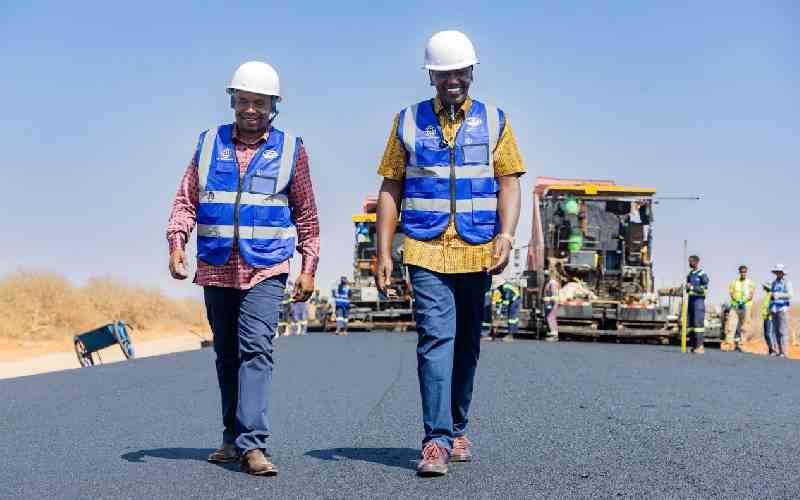
President William Ruto and Deputy President Kithure Kindiki inspect the Kulamawe–Garbatulla section of the 750km Isiolo–Mandera Road under the Horn of Africa Gateway Development Project. [PCS]
For decades, the dominant narrative about northern Kenya has been one of marginalisation. That history is real and well documented. Vastness, fragile infrastructure, and decades of underinvestment left the region behind. After devolution, the region must now confront a different question: What comes after marginalisation?
If the narrative remains unchanged 15 years later, the challenge may no longer lie solely in historical neglect but in how leadership and communities respond to new opportunities. Devolution fundamentally altered Kenya’s governance structure by transferring significant resources, planning authority, and decision-making power to counties. These tools were intended to stimulate local development and improve livelihoods.
The issue resurfaced recently after remarks by former Deputy President Rigathi Gachagua circulated widely on social media. He criticised what he described as limited visible development in northern Kenya despite years of devolved funding, alleging that some regional leaders were investing heavily in high-rise buildings in Nairobi instead of investing back home. While the tone of the criticism generated strong reactions, it also revived an important question: How effectively are devolved resources being translated into productive local economies?
Across several northern counties, the foundations for progress are beginning to emerge. Road networks, schools, health facilities, and expanding human capital are gradually taking shape. Improvements in access to education and healthcare show that progress is possible. In many respects, the region has begun laying the basic “hardware” of development.
The next phase, however, must move beyond infrastructure toward strategic interventions that unlock the economic potential of pastoral livelihoods. Counties must focus on systems that allow pastoral economies to function efficiently, sustainably, and competitively.
Pastoralism remains the backbone of livelihoods across the arid and semi-arid counties. Yet communities suffer heavy livestock losses during recurrent drought cycles. Too often, responses remain reactive and centered on emergency relief rather than long-term resilience.
County governments should prioritise programmes that strengthen the pastoral production system itself. Rainwater harvesting offers one practical starting point. Capturing seasonal rains through earth dams/pans can sustain livestock, support fodder production, and enable small-scale farming.
Investments in irrigation and pasture/fodder production along seasonal rivers and floodplains should complement water infrastructure and can diversify incomes. Counties should establish pasture banks capable of sustaining livestock during prolonged dry seasons.
Counties should learn from international examples. In Botswana, sustained investment in veterinary services, disease surveillance, and livestock health programmes has helped transform the livestock sector into a reliable economic pillar.
Botswana has strengthened drought resilience through feed supplementation and early destocking mechanisms that reduce livestock losses during dry periods. Livestock identification and traceability allow producers to meet international export standards. Combined with pastoral training and producer cooperatives, they have created a resilient and commercially viable livestock sector. Adapting similar approaches could significantly strengthen pastoral livelihoods across northern Kenya.
Mr Mohamed is a governance and public policy expert
Support Independent Journalism
Stand With Bold Journalism.
Stand With The Standard.
Continue
→
Pay via
Secure Payment
Kenya’s most trusted newsroom since 1902
Follow The Standard
channel
on WhatsApp
President William Ruto and Deputy President Kithure Kindiki inspect the Kulamawe–Garbatulla section of the 750km Isiolo–Mandera Road under the Horn of Africa Gateway Development Project.
[PCS]
For decades, the dominant narrative about northern Kenya has been one of marginalisation. That history is real and well documented. Vastness, fragile infrastructure, and decades of underinvestment left the region behind. After devolution, the region must now confront a different question: What comes after marginalisation?
If the narrative remains unchanged 15 years later, the challenge may no longer lie solely in historical neglect but in how leadership and communities respond to new opportunities. Devolution fundamentally altered Kenya’s governance structure by transferring significant resources, planning authority, and decision-making power to counties. These tools were intended to stimulate local development and improve livelihoods.
The issue resurfaced recently after remarks by former Deputy President Rigathi Gachagua circulated widely on social media. He criticised what he described as limited visible development in northern Kenya despite years of devolved funding, alleging that some regional leaders were investing heavily in high-rise buildings in Nairobi instead of investing back home. While the tone of the criticism generated strong reactions, it also revived an important question: How effectively are devolved resources being translated into productive local economies?
Across several northern counties, the foundations for progress are beginning to emerge. Road networks, schools, health facilities, and expanding human capital are gradually taking shape. Improvements in access to education and healthcare show that progress is possible. In many respects, the region has begun laying the basic “hardware” of development.
The next phase, however, must move beyond infrastructure toward strategic interventions that unlock the economic potential of pastoral livelihoods. Counties must focus on systems that allow pastoral economies to function efficiently, sustainably, and competitively.
Pastoralism remains the backbone of livelihoods across the arid and semi-arid counties. Yet communities suffer heavy livestock losses during recurrent drought cycles. Too often, responses remain reactive and centered on emergency relief rather than long-term resilience.
County governments should prioritise programmes that strengthen the pastoral production system itself. Rainwater harvesting offers one practical starting point. Capturing seasonal rains through earth dams/pans can sustain livestock, support fodder production, and enable small-scale farming.
Investments in irrigation and pasture/fodder production along seasonal rivers and floodplains should complement water infrastructure and can diversify incomes. Counties should establish pasture banks capable of sustaining livestock during prolonged dry seasons.
Counties should learn from international examples. In Botswana, sustained investment in veterinary services, disease surveillance, and livestock health programmes has helped transform the livestock sector into a reliable economic pillar.
Botswana has strengthened drought resilience through feed supplementation and early destocking mechanisms that reduce livestock losses during dry periods. Livestock identification and traceability allow producers to meet international export standards. Combined with pastoral training and producer cooperatives, they have created a resilient and commercially viable livestock sector. Adapting similar approaches could significantly strengthen pastoral livelihoods across northern Kenya.
Mr Mohamed is a governance and public policy expert
Follow The Standard
channel
on WhatsApp
By Mohamed Dagane