

Audio By Vocalize
Francis Ngiri, a farmer from Nakuru shows different varieties of sweet potatoes. [Rachel Kibui, Standard]
Agricultural research has often followed a top-down approach where technologies are developed by scientists and farmers are expected to adopt the innovations.
However, as experts are gradually finding out, research is more effective when farmers are part of the process.
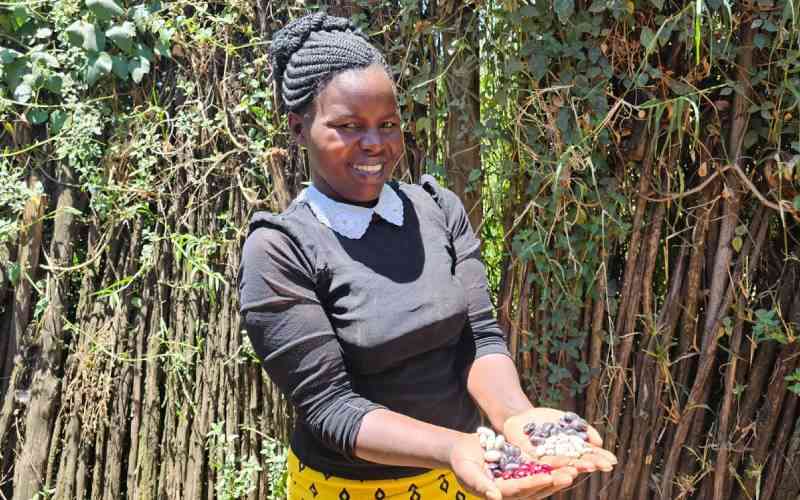
As the primary users of agricultural innovations, farmers have deep local knowledge of seeds, soils, climate, pests and diseases, utilisation, and other aspects that have been passed down through generations. Nancy Wangari, a farmer from Nakuru, shows different varieties of velvet beans. [Rachel Kibui, Standard]
In Western Kenya and the Rift Valley, over 7,500 farmers have been involved in research, working with scientists and other experts to analyse the traits and adaptability of crops right on their farms.
Through a participatory crowdsourcing approach, 2,550 farmers were engaged directly, while an additional 4,500 were reached through on-farm learning activities.
The initiative is a brainchild of Seed Savers Network in partnership with The Alliance of Bioversity International and CIAT, under the Biodiversity Restoration and Ecosystem-based Approaches for Resilient Livelihoods (B-REAL) project.
Nancy Wangari, a farmer from Nakuru, shows a flowered velvet beans plant. [Rachel Kibui, Standard]
“We have been working with farmers as partners rather than passive recipients, and this is key to ensuring that research findings are practical, relevant, and more widely adopted,” says Dr Yosef Gebrehawaryat, Senior Scientist, Alliance of Bioversity and CIAT.
Farmers evaluated 33 crop varieties, assessing key traits such as yield, adaptability, drought tolerance, and resistance to pests and diseases. Digital tools such as ClimMob and Open Data Kit (ODK) were used to collect and analyse field data, ensuring that farmers’ observations contributed to a broader evidence base.
“Instead of relying solely on research stations, the initiative tested crop varieties directly on farmers’ fields, where the real conditions of drought, pests, and soil variation are experienced,” says Mercy Ambani, a Programs Officer at Seed Savers Network.
Through the project, she adds, 100 seed ambassadors were trained, and they facilitated trials, recorded data, and helped share knowledge within their communities.
Farmers tested several traditional and underutilised crops that have the potential to thrive under changing climatic conditions.
During the long rains, trials focused on crops such as velvet bean (Mucuna spp.), dolichos (Lablab purpureus), and sweet potato (Ipomoea batatas). For the short rains, drought-tolerant cereals such as sorghum (Sorghum bicolor) and millet (Pennisetum glaucum) were evaluated.
In Nakuru County, the project successfully reintroduced velvet bean, a crop known for improving soil fertility and offering medicinal value.
In Western Kenya, dolichos, a once common but gradually forgotten crop, was also reintroduced. Several sweet potato varieties demonstrated strong adaptability and stable yields across different locations.
“I was involved in research for four sorghum and three millet varieties, and I really liked that I had an opportunity to participatively select what I would like to grow rather than being given seeds after studies were done elsewhere,” says Jairus Oyama, a farmer from Siaya.
Of the four varieties of sorghum, he adds, he liked the Nyaruong and Oloro varieties—red in colour, high yielding, and not prone to attacks by birds. A white variety and another one, which he only describes as originally from Central Kenya, did not yield well.
“I also tried three varieties of millet and I liked the red variety because it had good yields, unlike the black one, which was susceptible to attacks by birds, and another one, which took a long time to germinate and had low yields,” explains Oyama.
As for Petronilla Narakholo, a farmer from Kakamega, her favourite trials were sweet potatoes and velvet beans. She planted seven varieties of sweet potatoes and three varieties of velvet beans.
“I really liked the fact that we had an opportunity to exchange seeds with farmers from other counties,” says Narakholo.
However, she was disappointed by one variety she got from a farmer from Kisumu, as the yields were too low and the sweet potatoes were not sweet.
She says she liked the Munyekhera variety, which she got from a farmer from Bungoma, as it is not just sweet but also has an appealing yellow colour, cooks fast, and produces good yields.
“As for the velvet beans, I liked the black variety as it is high yielding and matures uniformly, although it takes a long time to germinate,” says Narakholo. She did not like the white variety because, although it germinates fast, it does not mature uniformly and has low yields, just like the dotted variety.
All the farmers engaged under this initiative will now concentrate on multiplying their best-performing varieties to enhance both seed and food security.
Beyond identifying resilient crop varieties, the project has been strengthening community seed systems by supporting the establishment and strengthening of local seed banks and nurseries. These community-managed systems ensure that farmers can access diverse, locally adapted seeds long after the project ends.
By recognising farmers not just as beneficiaries but as co-researchers and co-owners of agricultural innovation, the initiative offers a model for how science and local knowledge can work together to build resilient food systems in the face of climate change.
Support Independent Journalism
Stand With Bold Journalism.
Stand With The Standard.
Continue
→
Pay via
Secure Payment
Kenya’s most trusted newsroom since 1902
Follow The Standard
channel
on WhatsApp
Francis Ngiri, a farmer from Nakuru shows different varieties of sweet potatoes
. [Rachel Kibui, Standard]
Agricultural
research
has often followed a top-down approach where technologies are developed by scientists and farmers are expected to adopt the innovations.
However, as experts are gradually finding out, research is more effective when farmers are part of the process. Nancy Wangari, a farmer from Nakuru, shows different varieties of velvet beans. [Rachel Kibui, Standard]
As the primary users of agricultural innovations, farmers have deep local knowledge of seeds, soils, climate, pests and diseases, utilisation, and other aspects that have been passed down through generations.
i, a farmer from Nakuru, shows different varieties of velvet beans.
[Rachel Kibui, Standard]
In Western Kenya and the Rift Valley, over 7,500 farmers have been involved in research, working with scientists and other experts to analyse the traits and adaptability of crops right on their farms.
Through a participatory crowdsourcing approach, 2,550 farmers were engaged directly, while an additional 4,500 were reached through on-farm learning activities.
The initiative is a brainchild of Seed Savers Network in partnership with The Alliance of
Bioversity
International and CIAT, under the Biodiversity Restoration and Ecosystem-based Approaches for Resilient Livelihoods (B-REAL) project.
Nancy Wangari, a farmer from Nakuru, shows a flowered velvet beans plant.
[Rachel Kibui, Standard]
“We have been working with farmers as partners rather than passive recipients, and this is key to ensuring that research findings are practical, relevant, and more widely adopted,” says Dr Yosef Gebrehawaryat, Senior Scientist, Alliance of Bioversity and CIAT.
Farmers evaluated 33 crop varieties, assessing key traits such as yield, adaptability, drought tolerance, and resistance to pests and diseases. Digital tools such as ClimMob and Open Data Kit (ODK) were used to collect and analyse field data, ensuring that farmers’ observations contributed to a broader evidence base.
“Instead of relying solely on research stations, the initiative tested crop varieties directly on farmers’ fields, where the real conditions of drought, pests, and soil variation are experienced,” says Mercy Ambani, a Programs Officer at Seed Savers Network.
Through the project, she adds, 100 seed ambassadors were trained, and they facilitated trials, recorded data, and helped share knowledge within their communities.
Farmers tested several traditional and underutilised crops that have the potential to thrive under changing climatic conditions.
During the long rains, trials focused on crops such as velvet bean (
Mucuna
spp.), dolichos (
Lablab purpureus
), and sweet potato (
Ipomoea batatas
). For the short rains, drought-tolerant cereals such as sorghum (
Sorghum bicolor
) and millet (
Pennisetum glaucum
) were evaluated.
Stay informed. Subscribe to our newsletter
In Nakuru County, the project successfully reintroduced velvet bean, a crop known for improving soil fertility and offering medicinal value.
In Western Kenya, dolichos, a once common but gradually forgotten crop, was also reintroduced. Several sweet potato varieties demonstrated strong adaptability and
stable yields
across different locations.
“I was involved in research for four sorghum and three millet varieties, and I really liked that I had an opportunity to participatively select what I would like to grow rather than being given seeds after studies were done elsewhere,” says Jairus Oyama, a farmer from Siaya.
Of the four varieties of sorghum, he adds, he liked the Nyaruong and Oloro varieties—red in colour, high yielding, and not prone to attacks by birds. A white variety and another one, which he only describes as originally from Central Kenya, did not yield well.
“I also tried three varieties of millet and I liked the red variety because it had good yields, unlike the black one, which was susceptible to attacks by birds, and another one, which took a long time to germinate and had low yields,” explains Oyama.
As for Petronilla Narakholo, a farmer from Kakamega, her favourite trials were sweet potatoes and velvet beans. She planted seven varieties of sweet potatoes and three varieties of velvet beans.
“I really liked the fact that we had an opportunity to exchange seeds with
farmers
from other counties,” says Narakholo.
However, she was disappointed by one variety she got from a farmer from Kisumu, as the yields were too low and the sweet potatoes were not sweet.
She says she liked the Munyekhera variety, which she got from a farmer from Bungoma, as it is not just sweet but also has an appealing yellow colour, cooks fast, and produces good yields.
“As for the velvet beans, I liked the black variety as it is high yielding and matures uniformly, although it takes a long time to germinate,” says Narakholo. She did not like the white variety because, although it germinates fast, it does not mature uniformly and has low yields, just like the dotted variety.
All the farmers engaged under this initiative will now concentrate on multiplying their best-performing varieties to enhance both seed and food security.
Beyond identifying resilient crop varieties, the project has been strengthening community seed systems by supporting the establishment and strengthening of local seed banks and nurseries. These community-managed systems ensure that farmers can access diverse, locally adapted seeds long after the project ends.
By recognising farmers not just as beneficiaries but as co-researchers and co-owners of
agricultural innovation
, the initiative offers a model for how science and local knowledge can work together to build resilient food systems in the face of climate change.
Follow The Standard
channel
on WhatsApp
By Rachel Kibui