

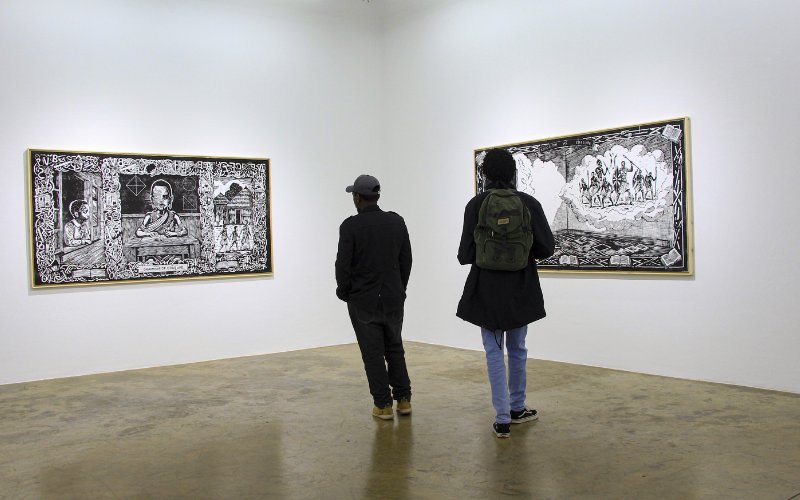
Multimedia artist Abdul Rop presents The Skin of Memory, a solo exhibition at The African Arts Trust.
Opened on March 13 and running until May 22, the show features five finished large-scale woodcut prints alongside two carved plates, allowing viewers to engage both the final image and the physical process behind it.
Rop, known for his woodcut prints and paintings, works by carving into wood, inking the surface, then pressing it onto fabric.
The scale of the works invites viewers to stand before them, fully immersed. Through the exhibition, he explores identity as both Kenyan and Nandi, with the pieces engaging the history of Nandi resistance against British colonialism.
One of the works, The Silenced Prophecy, depicts the killing of Koitalel arap Samoei under a flag of truce. Rop describes it as a foundational wound for the Nandi community.

While informed by historical accounts, the work reaches into what records cannot capture, including emotion and the silence left behind. Symbols such as the railway and looming threat make visible what documents only suggest.
In Grammar of Erasure, a stark black and white composition, a young girl sits in a classroom with one eye closed. A boy peers in through a window, while other children move outside. The piece reflects how historical narratives are stripped down and how what is taught in class often lacks fullness.
Woodcut, he explains, is a reductive process, carving away to reveal an image. In the same way, memory is shaped by what is removed, lost, or silenced. Printing on fabric adds a tactile, bodily dimension, holding and absorbing ink differently from paper due to its grain and softness.
“When you touch it, you feel the pressure of the hand that printed it. It becomes an encounter between bodies, mine and yours,” he says.
Repetition also carries meaning.
Each edition repeats the same image, yet no two prints are identical, as ink settles differently and pressure varies.

Rop likens this to how trauma moves through generations, with the same story retold, but never in exactly the same way. The plate itself is gradually destroyed in the process, mirroring how history is both preserved and worn away.
The exhibition title reflects memory as something worn like skin. The carved wood holds memory, while the print transfers that touch onto fabric, echoing inheritance passed from one generation to the next.
“History is something we wear like skin; it contains us, protects us, and records every wound,” he says.
The show was curated by Rop and Lincoln Mwangi, with exhibition text by Rose Jepkorir.
Rop hopes the exhibition brings history closer to younger audiences.
“I want young people to feel that history is not distant. It lives in our names, our silences, and the way we move through the world. If this work makes them ask questions about their own inheritance, what was silenced, what was passed down, then it has done its work,” he says.