

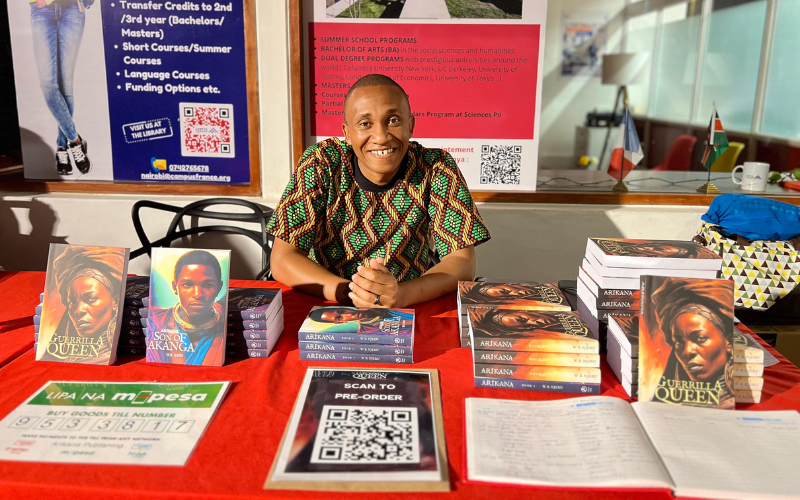
W.B. Njeru is a full-time author and publisher set on a mission to popularise the genre of fantasy fiction in Africa.
His Arikana fantasy fiction four-book series: Son of Akanga, The Sorceress of Harem, Day of the Dark Sun, and Guerrilla Queen. The books explore African mythologies and beliefs that were once told in oral storytelling traditions.
Growing up, he enjoyed listening to his brother telling amusing, great tales about warriors. Then he started reading books about them, such as Tales of Wamugumo by Peter Ngibuni Kuguru, which his father bought for him, as well as stories like Mfalme wa Majitu by Leo Odera Omolo and Ghost of Garba Tula by Wahome Mutahi.
His love for such books extended to global fantasy like the Harry Potter series by J.K. Rowling and the Samurai Jack series by Jim Zub. Seeing ordinary people do the impossible excited him. He also learnt about the story of Gikuyu and Mumbi and began to see how mythology and history could influence identity.
He tried to relive that old adventure through bookshop visits; one such adventure is of an ordinary warrior who picks up a sword and is sent to a distant country to slay a dragon. He says that you cannot find much of that kind of fiction nowadays.
“This planted an ambition in me to write stories for Africans, for the people who want to find these kinds of stories on the shelves,” he says.
What followed were seven years of writing Son of Akanga, set in a fantastical world in Africa. In the story, the main character Kenan is a young man who is at the cusp of becoming chief but has little understanding of what it is to be a ruler. He is supposed to be a chief, but he is not wedded, and while he is supposed to marry a woman from another chief, he is in love with a village girl.
He first imagined telling the story through film, but settled on writing books. This is after he observed that the most sold-out books in the world are fantasy fiction but are rare in African publishing.
“However, writing it is difficult. They are not real stories and real people you are familiar with. Still, audiences are willing to immerse themselves when the story is compelling,” he says.
His work is set in an imagined world of Arikana, which comes from the word ‘Afrikana’. “Arikana is a fictional place that has histories, people from different colours and ethnicities,” he says.
Fantasy fiction allows him to make possibilities that realism cannot. He describes it as living the life of another person and watching them at a distance and letting the story speak to him in a manner that reality would not let him explore.
“You remove the characters from reality and empathise with them, and then escapism and reality meet. For me, that is a powerful way of exploring and helps me to live a life I probably would not have, he says.
Despite drawing from mythology, Njeru says his inspiration comes from everyday life and spiritual reflection.
“I am surrounded by vivid images every day, with a constant reminder that faith and standing for something, being anchored in something spiritual, is important,” he expresses.
He believes that he is to tell African mythology, but not plainly, because he doesn’t have the weight of it since it is something that was passed down to him. Instead, he uses it as a tool to tell a much more human story. The themes in his works include bravery, family, forgiveness and spirituality.
Whether African fantasy is entering a new global era remains uncertain, he says, though several writers are pushing the genre forward, including Keith Kinambuga and Mutendei.
Internationally, authors such as Nigerian-American author Nnedi Okorafor have demonstrated the possibilities of African speculative fiction. However, publishing is a challenge. He lost money trying to publish with a Kenyan publisher and had to seek alternative routes, including grants.
“I keep a record of readers who buy my books. I have a goal of selling half a million copies before making my books into a film or TV series,” he says.
His work has already begun to travel far beyond Kenya. Copies of his books are now part of the collections at the Library of Congress and are available in universities such as Columbia University, Stanford University and Princeton University.
As a publisher, Njeru has brought to print The Black, by Peter Wanjohi. Further, he is running a school’s initiative, Pen Social, a ten-module course where students learn how to write fantasy fiction; afterwards, he will publish a collection of ten stories.