

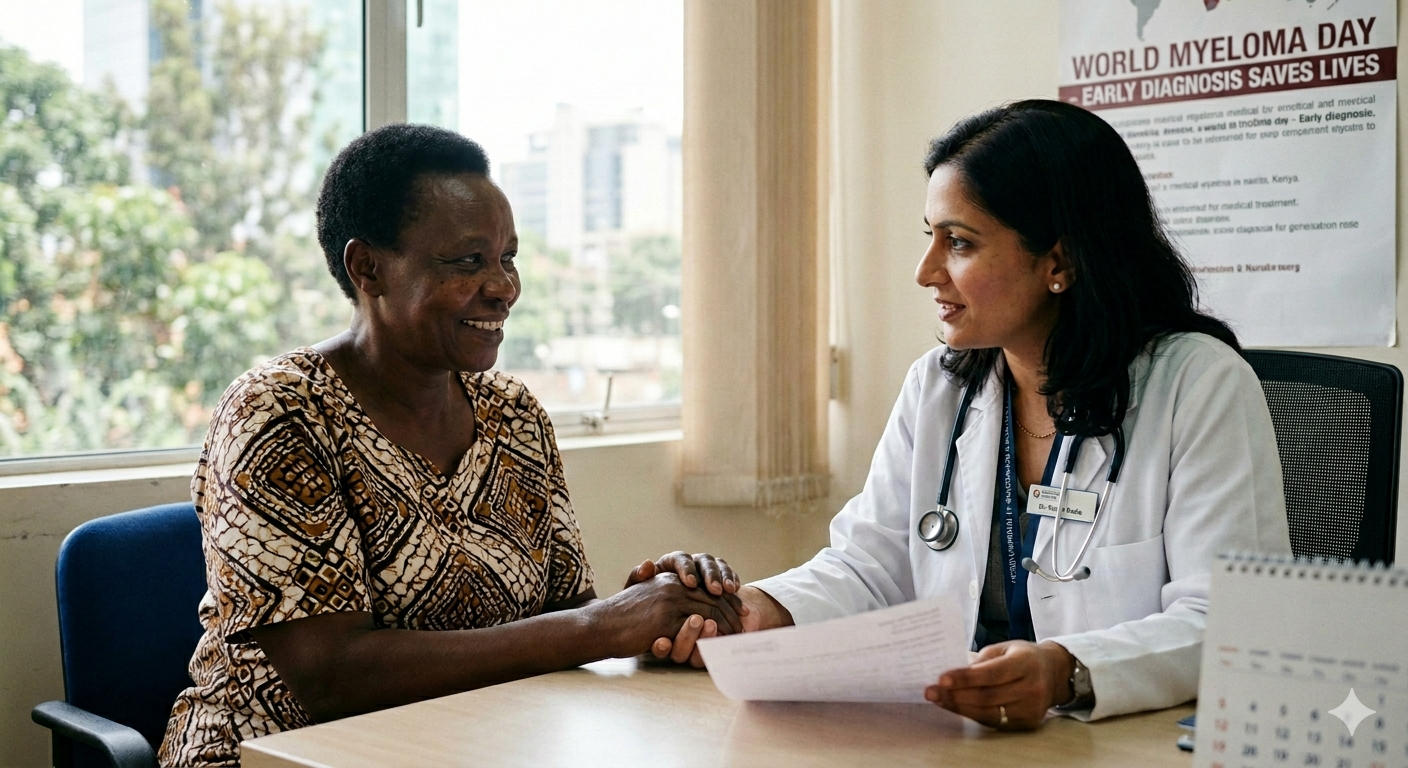
An iinteraction between a patient and a doctor at a hospital/AI ILLUSTRATION
On a quiet morning in Nairobi, Jane Njuguna recalls the moment her life changed. What began as persistent fatigue and unexplained pain soon spiralled into something far more serious — a diagnosis she had never heard of before: multiple myeloma.
“I didn’t understand what was happening to my body,” she says.
“I was always tired… and the pain wouldn’t go away.”
Her story is one of many that are coming to light as Kenya joins the world in marking World Myeloma Day — a moment to raise awareness about a rare but increasingly diagnosed blood cancer that affects plasma cells in the bone marrow.
For Njuguna, the journey to diagnosis was neither quick nor straightforward.
“I kept going from one hospital to another,” she says.
“At some point, I even thought maybe it was just stress.”
Multiple myeloma often presents with vague symptoms — fatigue, bone pain, recurrent infections — making it easy to miss in its early stages. By the time many patients are diagnosed, the disease has already progressed.
Dr Rohini Radia, a consultant haematologist and bone marrow transplant physician at The Nairobi West Hospital, says awareness remains one of the biggest gaps.
“Multiple myeloma is treatable, and in some cases, manageable long-term,” she explains.
“But early diagnosis significantly improves outcomes.”
According to Dr Radia, advancements in treatment — including stem cell and bone marrow transplants — are changing the outlook for patients in Kenya.
At The Nairobi West Hospital, the establishment of a specialised bone marrow transplant (BMT) unit marked a major milestone in the country’s cancer care landscape. The facility was among the first in Kenya to offer such services locally, reducing the need for patients to travel abroad for life-saving treatment.
Bone marrow transplant, also known as stem cell transplant, replaces damaged bone marrow with healthy cells and is used to treat conditions such as multiple myeloma, leukaemia and lymphoma.
For patients like Njuguna, access to such services within the country is not just convenient — it is lifesaving.
“I remember being told there was hope,” she says.
“That’s what kept me going.”
Dr Radia notes that Kenya is steadily building capacity in haematology and oncology, with increasing investment in specialised care and training.
“We are seeing progress in diagnostics, access to medication, and advanced therapies,” she says.
“But we still need more awareness so patients can come in earlier.”
Experts say stigma and lack of information often delay care-seeking behaviour, especially for conditions that are not widely discussed.
“People ignore symptoms or attribute them to normal ageing or stress,” Dr Radia adds.
“By the time they seek help, the disease is advanced.”
World Myeloma Day, observed annually, seeks to change that narrative — encouraging early screening, timely intervention, and stronger support systems for patients and their families.
For Njuguna, the journey has reshaped her outlook on life.
“You learn to appreciate every day,” she says. “And you realise how important it is to listen to your body.”
Her message to others is simple but urgent: “If something doesn’t feel right, don’t ignore it. Go and get checked.”
As Kenya continues to expand its cancer care capacity, stories like Njuguna’s serve as both a warning and a beacon of hope — a reminder that with early care, the right team, and access to advanced treatment, survival is not just possible, but within reach.