

Audio By Vocalize
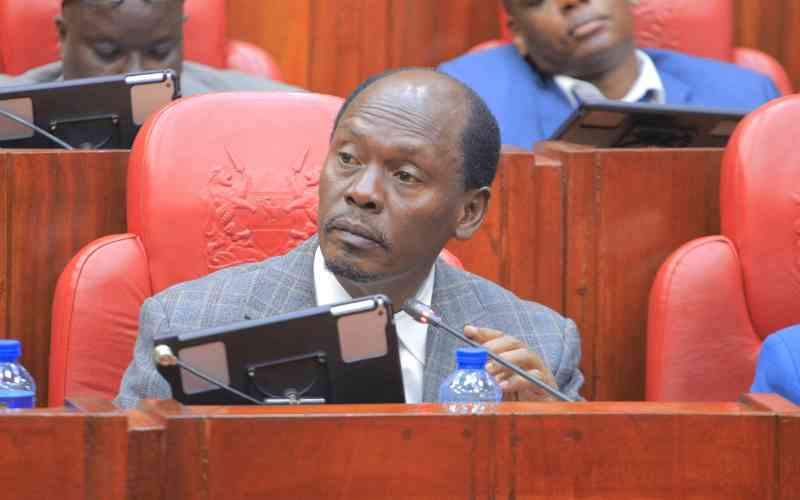
ICT Cabinet Secretary William Kabogo and PS John Tanui before the National Assembly Committee on NG-CDF to consider the status of digital hub projects at Parliament Buildings, Nairobi, on April 7, 2026. [Elvis Ogina, Standard]
The government has contracted Jomo Kenyatta University of Agriculture and Technology (JKUAT) to assemble computers for use in digital hubs to be established across the country, ICT Cabinet Secretary William Kabogo has said.
Kabogo noted that the digital hubs are expected to be set up in all 1,450 wards, each equipped with between 50 and 100 computers.
“This university secured a tender to assemble 3,000 devices, while another 7,000 will be assembled by other institutions. These computers will support the rollout of digital hubs in every ward,” he said.
Speaking at JKUAT main campus in Juja, Kiambu county on Thursday, during a tour of the assembly line, the CS said that the government is looking beyond simple assembly, with plans to have universities assemble computers from components locally.
“In the future, we want to reach a point where we can proudly say these computers are fully made here. That means bringing in parts and assembling everything locally,” he said.
Kabogo commended the progress made at the Taifa Computer Assembly Line, saying the government would support expansion to create more jobs for young people.
“If we scale up to five or six assembly lines, we will create more employment opportunities for young men and women. These hubs will also require technicians to handle maintenance and repairs,” he said.
He emphasized the need to train more youth to manage and maintain the computers deployed in digital hubs across the country.
JKUAT Vice Chancellor Victoria Ngumi said the facility is also playing a key role in training students through hands-on experience.
“We involve our students in the assembly process so they can gain practical skills and understand how an assembly line operates. This experience prepares them for future opportunities,” she said.
Prof Ngumi hailed the project and welcomed the government’s support, saying that the university has the capacity to expand production.
“We are very proud of this plant and honoured to host the CS. We appeal for more support, including consideration for special economic zone incentives, as we have the capacity to assemble more devices,” she said.
The VC revealed that the university is already planning to move to a larger facility dedicated to the project.
“This facility can assemble even more computers, and we are setting up a bigger space to increase production of computers and other gadgets,” she said.
Support Independent Journalism
Stand With Bold Journalism.
Stand With The Standard.
Continue
→
Pay via
Secure Payment
Kenya’s most trusted newsroom since 1902
Follow The Standard
channel on WhatsApp
ICT Cabinet Secretary William Kabogo and PS John Tanui before the National Assembly Committee on NG-CDF to consider the status of digital hub projects at Parliament Buildings, Nairobi, on April 7, 2026.
[Elvis Ogina, Standard]
The government has contracted Jomo Kenyatta University of Agriculture and Technology (JKUAT) to assemble computers for use in digital hubs to be established across the country, ICT Cabinet Secretary William Kabogo has said.
Kabogo noted that the digital hubs are expected to be set up in all 1,450 wards, each equipped with between 50 and 100 computers.
“This university secured a tender to assemble 3,000 devices, while another 7,000 will be assembled by other institutions. These computers will support the rollout of digital hubs in every ward,” he said.
Speaking at JKUAT main campus in Juja, Kiambu county on Thursday, during a tour of the assembly line, the CS said that the government is looking beyond simple assembly, with plans to have universities assemble computers from components locally.
“In the future, we want to reach a point where we can proudly say these computers are fully made here. That means bringing in parts and assembling everything locally,” he said.
Kabogo commended the progress made at the Taifa Computer Assembly Line, saying the government would support expansion to
create more jobs for young people.
“If we scale up to five or six assembly lines, we will create more employment opportunities for young men and women. These hubs will also require technicians to handle maintenance and repairs,” he said.
He emphasized the need to train more youth to manage and maintain the computers deployed in digital hubs across the country.
JKUAT Vice Chancellor Victoria Ngumi said the facility is also playing a key role in training students through hands-on experience.
“We involve our students in the assembly process so they can gain practical skills and understand how an assembly line operates. This experience prepares them for future opportunities,” she said.
Prof Ngumi hailed the project and welcomed the government’s support, saying that the university has the capacity to expand production.
“We are very proud of this plant and honoured to host the CS. We appeal for more support, including consideration for
special economic zone incentives
, as we have the capacity to assemble more devices,” she said.
The VC revealed that the university is already planning to move to a larger facility dedicated to the project.
Stay informed. Subscribe to our newsletter
“This facility can assemble even more computers, and we are setting up a bigger space to increase production of computers and other gadgets,” she said.
Follow The Standard
channel on WhatsApp
By Gitau Wanyoike