

Audio By Vocalize
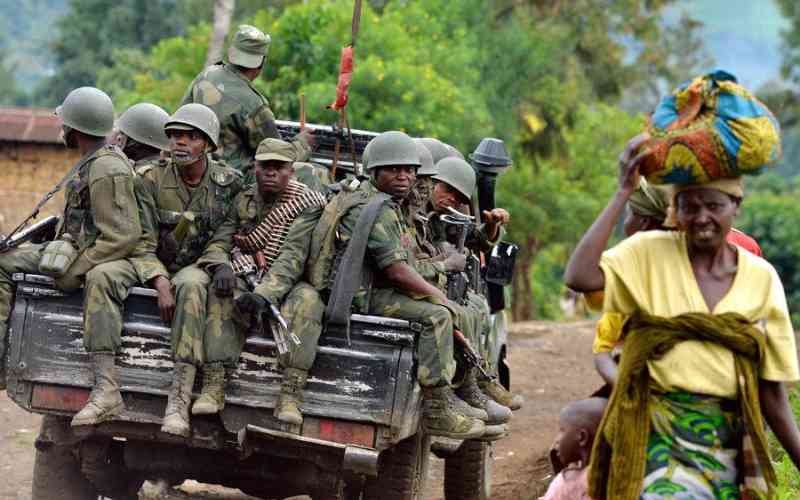
Armed men patrol Eastern DRC. [Agencies]
A recent interview by Rwanda’s President Paul Kagame by the news magazine Jeune Afrique has been doing the rounds on social media.
In it, Kagame declares that he will not bow to external pressure and lift Rwanda’s defensive measures, whether troops or equipment, until the threat the FDLR, remnants of the military that committed genocide against the Tutsis, poses to Rwanda is fully eliminated.
His detractors termed the statement a direct rebuke of the recent peace deal brokered by US President Donald Trump. They claim, after all, that the Democratic Republic of Congo (DRC) is moving to neutralise the FDLR. But things are not as simple as they make them out to be. The real spoiler of peace may not be the one we were told to watch.
First, there is absolutely no evidence that Kinshasa is neutralising the FDLR, despite claims to the contrary. Since Rwanda and DRC signed a security agreement on 27 June 2025, there have press releases signaling Kinshasa’s intentions, but zero real progress.
The Congolese army, which had 90 days from that date to neutralize this U.S.-designated terrorist group, first called on its members to stop collaborating with the FDLR. Then it announced a ‘sensitization campaign’ to convince FDLR fighters to disarm voluntarily. And only a few days ago, it announced a troop buildup in Kisangani, the capital of Tshopo province, supposedly to take on the genocidal militia.
In other words, these three gestures from the Congolese army have stretched across eight months. Real action may take much longer, or never come at all. And there are two main reasons why. The first is political optics. President Félix Tshisekedi, who is more and more openly chasing an unconstitutional third term, knows exactly which fantasy to sell, short of delivering real results.
His obsession with image and clinging to power has gotten in the way of actual implementation, as he chases an elusive military solution while paying lip service to agreements he signs. Take the manipulation around sequencing: Kinshasa insists that Rwanda must lift its defensive measures and disengage troops. Kigali says that verifiable neutralization of the FDLR must happen, given it is the reason for the measures in the first place.
The language of the Concept of Operations (CONOPS) agreed in Luanda in October 2024 and adopted in the final peace agreement points to a phased approach: the DRC carries out verifiable military operations to eliminate the security threat while Rwanda gradually lifts defensive measures. That mirroring was designed to build mutual trust and preserve a win-win dynamic, where implementation wouldn’t feel like capitulation.
Tshisekedi’s domestic messaging and political ambitions demand a winner and a loser, even at the expense of peace. The second reason is pure military calculation. The FDLR is the most effective fighting force in Kinshasa’s coalition. As long as the war with M23 continues, Tshisekedi will not cut off the hand that feeds his military ambitions.
He has often publicly voiced contempt for the army he inherited, blaming his predecessor, not without reason, for the state of security institutions. More recently, he expressed hope that the Americans would help train his army to acceptable standards.
No surprise, then, that he has recruited anyone willing to fight for cash or mineral sites: Burundian troops, SADC soldiers, European mercenaries, Wazalendo and other armed groups scattered across the country. And now, having lost SADC support, he needs the FDLR more than ever, especially as he repeatedly vows to reclaim all territory lost to M23.
So where does that leave us? Peace between the DRC and Rwanda may have been signed in Washington, but on the ground it remains elusive. As long as Kinshasa uses the FDLR as a proxy to fight M23, that alliance will provoke Kigali’s wrath. This means the internal conflict feeds the interstate one, which could easily trigger a regional implosion through a cascade of alliances.
If mediators are serious about peace, they must do two things urgently. First, press for peace talks to resume between Kinshasa and M23, and finalize the process that began in Doha. Second, support an inter-Congolese dialogue aimed at restoring social cohesion, because that would put an end to Tshisekedi’s third-term ambitions, which risk deepening an already dire crisis.
If successful, these two steps would remove any need to use the FDLR against M23, and in doing so, pave the way for the FDLR’s neutralisation, as it would have finally reached its expiry date. These steps would also put an end to the desperate scramble for optical wins.
After all, the DRC does not need to defeat Rwanda, or vice versa. What they need is to make peace with each other. And the Washington Accords represent the best bet to get there.
-The author is a Congolese researcher and member of the Congolese Diaspora Civil Society
Support Independent Journalism
Stand With Bold Journalism.
Stand With The Standard.
Continue
→
Pay via
Secure Payment
Kenya’s most trusted newsroom since 1902
Follow The Standard
channel on WhatsApp
Armed men patrol Eastern DRC.
[Agencies]
A recent interview by Rwanda’s President Paul Kagame by the news magazine Jeune Afrique has been doing the rounds on social media.
In it, Kagame declares that he will not bow to external pressure and lift Rwanda’s defensive measures, whether troops or equipment, until the threat the FDLR, remnants of the military that committed genocide against the Tutsis, poses to Rwanda is fully eliminated.
His detractors termed the statement a direct rebuke of the recent peace deal brokered by US President Donald Trump. They claim, after all, that the Democratic Republic of Congo (DRC) is moving to neutralise the FDLR. But things are not as simple as they make them out to be. The real spoiler of peace may not be the one we were told to watch.
First, there is absolutely no evidence that Kinshasa is neutralising the FDLR, despite claims to the contrary. Since Rwanda and DRC signed a security agreement on 27 June 2025, there have press releases signaling Kinshasa’s intentions, but zero real progress.
The Congolese army, which had 90 days from that date to neutralize this U.S.-designated terrorist group, first called on its members to stop collaborating with the FDLR. Then it announced a ‘sensitization campaign’ to convince FDLR fighters to disarm voluntarily. And only a few days ago, it announced a troop buildup in Kisangani, the capital of Tshopo province, supposedly to take on the genocidal militia.
In other words, these three gestures from the Congolese army have stretched across eight months. Real action may take much longer, or never come at all. And there are two main reasons why. The first is political optics. President Félix Tshisekedi, who is more and more openly chasing an unconstitutional third term, knows exactly which fantasy to sell, short of delivering real results.
His obsession with image and clinging to power has gotten in the way of actual implementation, as he chases an elusive military solution while paying lip service to agreements he signs. Take the manipulation around sequencing: Kinshasa insists that Rwanda must lift its defensive measures and disengage troops. Kigali says that verifiable neutralization of the FDLR must happen, given it is the reason for the measures in the first place.
The language of the Concept of Operations (CONOPS) agreed in Luanda in October 2024 and adopted in the final peace agreement points to a phased approach: the DRC carries out verifiable military operations to eliminate the security threat while Rwanda gradually lifts defensive measures. That mirroring was designed to build mutual trust and preserve a win-win dynamic, where implementation wouldn’t feel like capitulation.
Tshisekedi’s domestic messaging and political ambitions demand a winner and a loser, even at the expense of peace. The second reason is pure military calculation. The FDLR is the most effective fighting force in Kinshasa’s coalition. As long as the war with M23 continues, Tshisekedi will not cut off the hand that feeds his military ambitions.
He has often publicly voiced contempt for the army he inherited, blaming his predecessor, not without reason, for the state of security institutions. More recently, he expressed hope that the Americans would help train his army to acceptable standards.
No surprise, then, that he has recruited anyone willing to fight for cash or mineral sites: Burundian troops, SADC soldiers, European mercenaries, Wazalendo and other armed groups scattered across the country. And now, having lost SADC support, he needs the FDLR more than ever, especially as he repeatedly vows to reclaim all territory lost to M23.
So where does that leave us? Peace between the DRC and Rwanda may have been signed in Washington, but on the ground it remains elusive. As long as Kinshasa uses the FDLR as a proxy to fight M23, that alliance will provoke Kigali’s wrath. This means the internal conflict feeds the interstate one, which could easily trigger a regional implosion through a cascade of alliances.
If mediators are serious about peace, they must do two things urgently. First, press for peace talks to resume between Kinshasa and M23, and finalize the process that began in Doha. Second, support an inter-Congolese dialogue aimed at restoring social cohesion, because that would put an end to Tshisekedi’s third-term ambitions, which risk deepening an already dire crisis.
If successful, these two steps would remove any need to use the FDLR against M23, and in doing so, pave the way for the FDLR’s neutralisation, as it would have finally reached its expiry date. These steps would also put an end to the desperate scramble for optical wins.
Stay informed. Subscribe to our newsletter
After all, the DRC does not need to defeat Rwanda, or vice versa. What they need is to make peace with each other. And the Washington Accords represent the best bet to get there.
-The author is a Congolese researcher and member of the Congolese Diaspora Civil Society
Follow The Standard
channel on WhatsApp
By Innocent Nteziryayo