



Audio By Vocalize
Several years ago, cassava was one of the most reliable and widely grown staple crops in the country, particularly thriving in the western, Nyanza and coastal regions.
Farmers valued cassava not only for its versatility as a food source but also for its remarkable resilience. Its ability to withstand prolonged drought, tolerate poor soils and adapt to changing climate conditions made it a vital crop for ensuring food security and supporting rural livelihoods.
However, over time, this once-thriving crop began to face significant threats: From emerging diseases such as cassava mosaic disease and cassava brown streak disease to pest infestations such as whiteflies and mealybugs.
These challenges weakened the plant’s health, reducing the yields and in many cases, led to complete crop failure. As a result, household food supplies were disrupted, and farmers who relied on cassava for both subsistence and income suffered substantial economic losses.
As if that was not enough, cassava also carried a heavy stigma, often dismissed as a “poor man’s crop,” grown only for subsistence rather than profit.
Yet, despite the neglect and setbacks, cassava has endured and continues to grow, quietly and persistently, waiting for broader recognition of its true value.
Today, efforts are underway to revive cassava farming in Kenya through biotechnology. These initiatives aim to protect the crop from destructive diseases, expand the area under cultivation and increase overall production, ultimately strengthening food security in the country.
The Kenya Agricultural and Livestock Research Organisation (Kalro) has developed cassava varieties using genetically modified organism (GMO) technology to help the crop resist severe viral diseases that could destroy even 100 per cent of the yields in farmers’ fields.
Confined field trials
Julia Njagi, the deputy director of Technical Services at the National Biosafety Authority (NBA), said the project received approval in 2013 to conduct confined field trials.
She explains that after more than 10 years of research, the collected data was submitted to the NBA for consideration for an environmental release. Approval was granted, and the project proceeded to National Performance Trials, which were conducted over two seasons. The seeds are now ready.
“This cassava has completed field and variety trials. The varieties have been approved and are ready for immediate distribution to farmers,” she said.
Njagi added that the next step is to distribute them across all major cassava-growing regions in Kenya, making them accessible to both small- and large-scale farmers.
However, due to ongoing court cases, the cassava cannot be distributed yet.
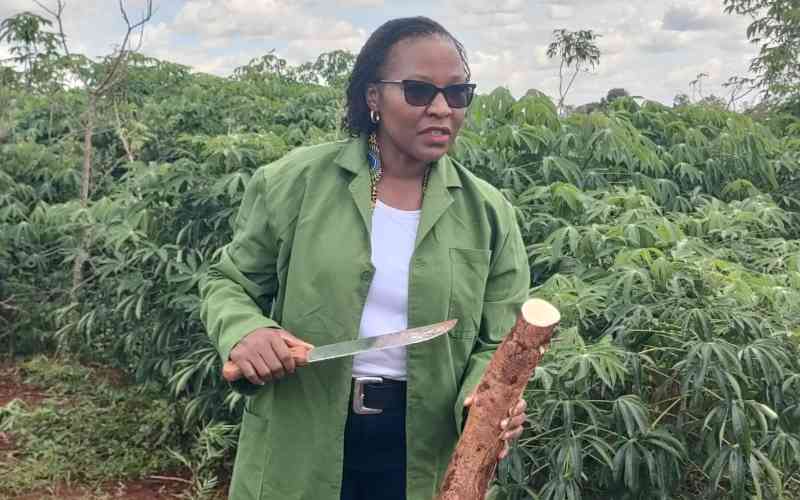
A visit to Kalro’s Kandara National Field Trials site, one of seven locations where cassava trials have been conducted, paints a clear picture of the extensive research that has been done. Other sites include Mtwapa, Alupe, Matuga, Diani, Kakamega and Kiboko.
Njagi said the agency ensures all research is conducted within the law. Facilities must be secured 24 hours a day to prevent unauthorised removal of materials, and strict protocols must be followed.
“Confined field trials are essential for evaluating crop performance, assessing agronomic traits, generating data on food and environmental safety and providing the regulatory information required for approval,” she explains.
The established technology mainly targets cassava brown streak disease, which causes rotting of the tubers. Another common disease is cassava mosaic disease, which affects the leaves, causing yellowing and withering.
“Cassava is an important indigenous crop, but production has been declining due to diseases. This technology could significantly improve yields, boost food security and provide farmers with a reliable source of income,” Njagi added.
Regulatory framework
Anne Muia, principal biosafety officer at the NBA, assures Kenyans of the safety of the technologies as they operate under a strong regulatory framework.
These technologies undergo rigorous food safety assessments, environmental evaluations and socioeconomic analyses.
“We can confidently assure the public that any approved biotechnology is safe for humans, animals, and the environment,” she said.
She reiterates that public awareness is key, as it helps counter misinformation and ensures people understand these technologies.
Muia notes that misinformation often stems from a lack of understanding, especially when people do not fully understand a technology and think it is harmful. This may push them to avoid it as a precaution.
So far, the authority has processed about four applications, including Bt cotton approved in 2019 and commercially cultivated since 2020.
Bt maize was also approved, while virus-resistant cassava has already been approved, but its release remains pending due to court cases.
Other applications in the pipeline include GMO potato and another type of GMO maize with a different trait.
Support Independent Journalism
Stand With Bold Journalism.
Stand With The Standard.
Continue
→
Pay via
Secure Payment
Kenya’s most trusted newsroom since 1902
Follow The Standard
channel on WhatsApp
Several years ago, cassava was one of the most reliable and widely grown staple crops in the country, particularly thriving in the western, Nyanza and coastal regions.
Farmers valued cassava not only for its versatility as a food source but also for its remarkable resilience. Its ability to withstand prolonged drought, tolerate poor soils and adapt to changing climate conditions made it a vital crop for ensuring food security and supporting rural livelihoods.
However, over time, this once-thriving crop began to face significant threats: From emerging diseases such as cassava mosaic disease and cassava brown streak disease to pest infestations such as whiteflies and mealybugs.
These challenges weakened the plant’s health, reducing the yields and in many cases, led to complete crop failure. As a result, household food
supplies were disrupted
, and farmers who relied on cassava for both subsistence and income suffered substantial economic losses.
As if that was not enough, cassava also carried a heavy stigma, often dismissed as a “poor man’s crop,” grown only for subsistence rather than profit.
Yet, despite the neglect and setbacks, cassava has endured and continues to grow, quietly and persistently, waiting for broader recognition of its true value.
Today, efforts are underway to
revive cassava farming
in Kenya through biotechnology. These initiatives aim to protect the crop from destructive diseases, expand the area under cultivation and increase overall production, ultimately strengthening food security in the country.
The Kenya Agricultural and Livestock Research Organisation (Kalro) has developed cassava varieties using genetically modified organism (GMO) technology to help the crop resist severe viral diseases that could destroy even 100 per cent of the yields in farmers’ fields.
Julia Njagi, the deputy director of Technical Services at the National Biosafety Authority (NBA), said the project received approval in 2013 to conduct confined field trials.
She explains that after more than 10 years of research, the collected data was submitted to the NBA for consideration for an environmental release. Approval was granted, and the project proceeded to National Performance Trials, which were conducted over two seasons. The seeds are now ready.
“This cassava has completed field and variety trials. The varieties have been approved and are ready for immediate distribution to farmers,” she said.
Njagi added that the next step is to distribute them across all major cassava-growing regions in Kenya, making them accessible to both small- and large-scale farmers.
However, due to ongoing court cases, the cassava cannot be distributed yet.
A visit to Kalro’s Kandara National Field Trials site, one of seven locations where cassava trials have been conducted, paints a clear picture of the extensive research that has been done. Other sites include Mtwapa, Alupe, Matuga, Diani, Kakamega and Kiboko.
Njagi said the agency ensures all research is conducted within the law. Facilities must be secured 24 hours a day to prevent unauthorised removal of materials, and strict protocols must be followed.
Stay informed. Subscribe to our newsletter
“Confined field trials are essential for evaluating crop performance, assessing agronomic traits, generating data on food and environmental safety and providing the regulatory information required for approval,” she explains.
The established technology mainly targets cassava brown streak disease, which causes rotting of the tubers. Another common disease is cassava mosaic disease, which affects the leaves, causing yellowing and withering.
“Cassava is an important indigenous crop, but production has been declining due to diseases. This technology could significantly improve yields, boost food security and provide farmers with a reliable source of income,” Njagi added.
Anne Muia, principal biosafety officer at the NBA, assures Kenyans of the safety of the technologies as they operate under a strong regulatory framework.
These technologies undergo rigorous food safety assessments, environmental evaluations and socioeconomic analyses.
“We can confidently assure the public that any approved biotechnology is safe for humans, animals, and the environment,” she said.
She reiterates that public awareness is key, as it helps counter misinformation and ensures people understand these technologies.
Muia notes that misinformation often stems from a lack of understanding, especially when people do not fully understand a technology and think it is harmful. This may push them to avoid it as a precaution.
So far, the authority has processed about four applications, including Bt cotton approved in 2019 and commercially cultivated since 2020.
Bt maize was also approved, while virus-resistant cassava has already been approved, but its release remains pending due to court cases.
Other applications in the pipeline include GMO potato and another type of GMO maize with a different trait.
Follow The Standard
channel on WhatsApp
By Nanjinia Wamuswa