



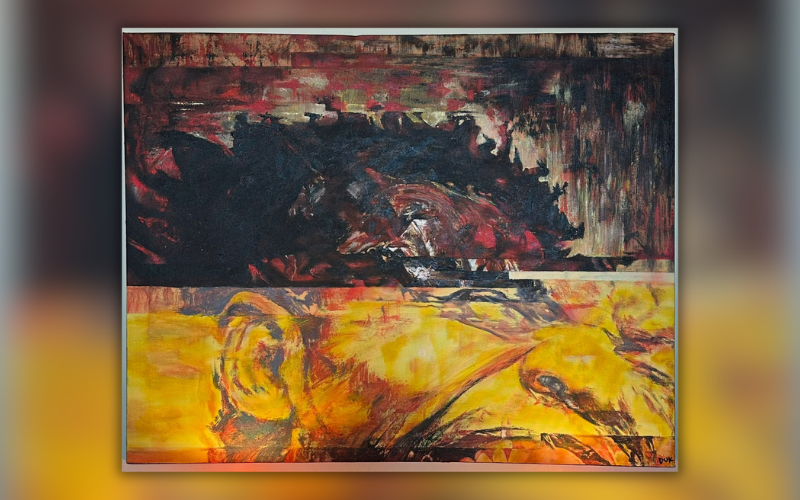
In Instruments of Becoming, Ryan ‘Duk’ Engoke explores the human body through distortion, fragmentation, and movement.
His work features distorted bodies and fragmented faces suspended between controlled movement and disrupted stillness. The figures seem to be breaking apart while also holding together, thus creating a tension and contradiction between control and release.
The exhibition, featuring ten works, is held at Arthaus Studios in Karen, Nairobi, on May 9 and 10. Presented by Ardhi Gallery, the exhibition is curated by David Kihumba and the gallery’s founder, Christine Oguna.
Engoke uses fractures, bold colours, layered textures, repeated forms, and geometry to suggest inner conflict and movement, an ongoing push for clarity and control.
Through fractured faces, he examines identity, grief, memory, internal conflict, pressure, resilience, discipline, and the constant process of becoming.
“The fragmented works show that identity is not fixed. Life experiences and personal struggles leave marks on the body. The body becomes an instrument that carries the whole process of becoming,” he says.


Engoke lost his parents in a span of three years. He copes with this grief through long-distance running, and it was during these runs that he came up with the idea for this exhibition, which is also his first series.
He says running made him more aware of the body as a record of fatigue, resilience, discipline, and emotional pressure. While training, he learned to trust physical feeling and awareness before metrics or performance. This relationship with the body influenced how he approached the works in the exhibition.
Movement is expressed throughout the series through shifting forms, repetition and disruption. Faces are sliced, compressed, shifted and repeated to show them moving forward and being pulled back.
In Green Light, he uses a neon green colour and a toothbrush to make distortions and misalignment on the subject’s face. He used neon green to symbolise permission that he has earned internally through discipline and circumstance.
“When I run, I cope with grief and get ideas. The piece is a moving meditation centred on momentum and self-permission. It is about embracing the progress I have made for my own good without seeking approval,” he says.

Another work titled Trauma Bonding layers more than 25 faces into a single composition.
The piece uses repetition, slicing, shifting, compression, and repeated forms to show the ways people are tied together through shared experiences of pain. He uses colours to depict trauma and psychological pressures, and the shifting of faces to feel like something is being pulled back as it wants to move forward.
Another piece, titled Fault Line, portrays fragmentation and pressure through fractured faces that look unstable and restrained. Engoke says he was interested in creating pieces that looked broken while still holding together.

Curator David Kihumba says the distortion and fragments show the uncertainty and resilience that accompany personal change and the need to keep moving forward even when the path is unclear.
“In these fragmented forms, we are reminded that becoming is not perfect or complete but ongoing, and that even in uncertainty, there is direction,” Kihumba says.
Although Instruments of Becoming is his first series, he previously painted on shoes and clothing before going into large-scale wall pieces. He says working on canvas allowed him to explore his ideas more fully and experiment with texture and movement. The exhibition, he says, has changed the way he views himself as an artist.
“I am less concerned with perfection or works that look impressive. I am more focused on making something that feels true,” Engoke expresses.