



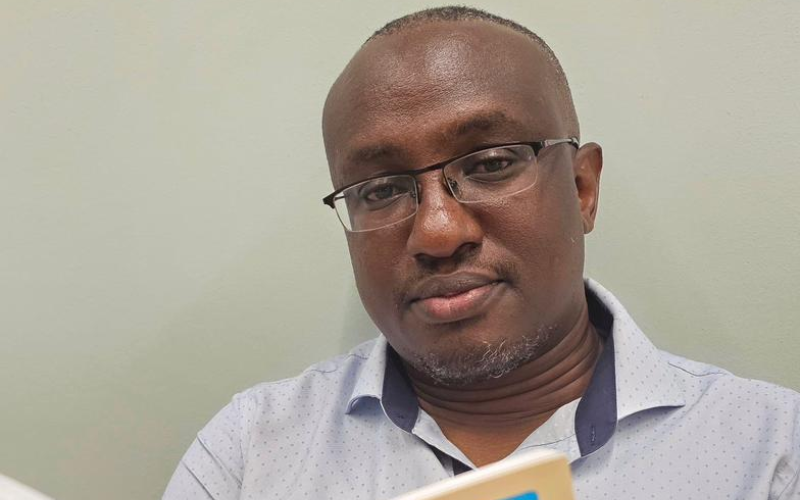
Kinyanjui Kombani, popularly known as “The Banker Who Writes”, is a multiple award-winning novelist, playwright, scriptwriter, and literary activist whose work spans children’s literature, young adult fiction, and novels. His writings depict societal experiences and personal observations of everyday life while exploring themes of struggle and resilience.
His latest work, Dear Mama, ushers in a personal turn in his writing journey. Written as a dated letter to his late mother, the epistolary autobiography dives into grief, memory, resilience, and the making of a writer. It is also historically significant as the first autobiography approved as a compulsory Grade 10 set book under the school curriculum.
Dear Mama began when Kombani’s publisher challenged him to write his autobiography. Though he doubted anyone would care about his story, he completed the manuscript, which was later selected by the Kenya Institute of Curriculum Development as a set book.
Speaking about the decision to write his autobiography as a personal letter to his mother, Kombani said he wanted to break away from the conventional autobiographical style.
“Most autobiographies follow a pattern of somebody who came, saw, and conquered. I did not see anything unique enough about my life for people to buy the book,” he says.
What compelled him was asking himself who would really care about his story, and he realised that the most meaningful audience was his mother.
“She got us to a place where we were self-sufficient, but she never got to see the fruits of her labour. So I wrote a series of letters telling her about things she never knew happened to me, like being bullied in school, because I never wanted to burden her with more problems,” he says.
The writing process was a way of revisiting his past and understanding it differently. He references Steve Jobs, who said that life is about joining the dots backwards. Writing this book allowed him to connect moments from his childhood and understand how they influenced who he became.
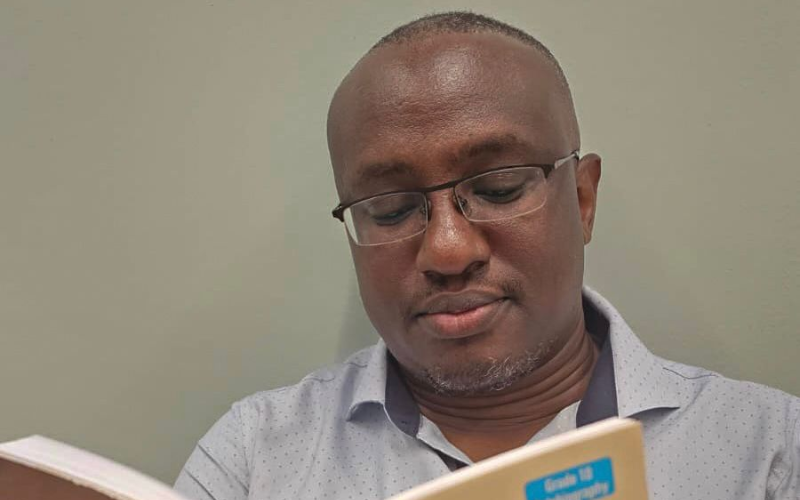

He notes that unlike many memoirists, he did not rely on diaries or written records. Instead, he wrote from memory and reflection. He also credits writer Wahome Mutahi as a major influence.
“What made Mutahi great was that he told humour using simple words and characters. That influenced my writing. I realised this years ago: that one did not need very complex language to tell stories,” he says.
Born in Molo in Nakuru County, Kombani was the last-born in a family of five children. Raised by his mother in a single-roomed mabati house after she separated from his father before his birth. His fiction focuses on ordinary people who go through scarcity, hardship, and resilience.
He began writing in 2004 while studying at Kenyatta University. His first major project was Carcasses, a play written for the Meat Trade Awareness project by the Born Free Foundation. The production was widely staged by the Kenyatta University travelling theatre and reached more than 60,000 rural viewers and later went to audiences across Africa, Europe, and the United States.
He also scripted Mizoga, the film adaptation of the play. Then he penned a debut novel, The Last Villains of Molo, which started off as a short story and was first published in 2008 by Acacia Publishers. At the time all he wanted was to see his books displayed at a Bookpoint, a now-closed bookshop.
“At first, all I wanted was to see my book displayed at a bookshop window. That was the extent of my ambition then. My expectations grew depending on the achievements of my next books,” he says.
The success of The Last Villains of Molo after Longhorn Publishers published it in 2012 led to its adoption as a university study text in Kenya and abroad, including at Kenyatta University.
His second novel, Den of Inequities, published in 2014, continued his exploration of urban inequality and informal settlements in Nairobi, and it too became an academic text in universities in Kenya and Rwanda. Even though his books are studied in academic institutions, he insists that recognition was never the original intention.
“I write because I have a story that I feel is interesting and worth telling. When the books become study texts, it is a milestone that adds pressure and responsibility, but the starting point is always creativity,” he expresses.

His other novels are Of Pawns and Players, a winner for the Wahome Mutahi Literary Award, and Hawkers-Pokers.
Kombani has written extensively for younger readers. His children’s books and young adult fiction include We Can Be Friends (2007), Wangari Maathai, Mother of Trees (2007), Lost But Found (2012), Imani and the Missing Mace (2017), The Bike Thief (2018), Finding Colombia (2019), Eve’s Invention (2019), and Do or Do (2019), which won the Jomo Kenyatta Prize for Literature, Youth Category.
Finding Colombia was adopted as a Grade 7 study text and won the 2018 CODE Burt Award for African Young Adult Literature, while The Bike Thief is read in lower primary.
“For children’s literature, I think about what my own children would enjoy reading. Students are now inviting me to schools, and that is my literary focus right now,” he says.
Kombani says delays in publishing and the industry’s focus on set books have pushed many authors toward self-publishing. He also recently challenged the pricing of Dear Mama after a bookstore listed it at Sh1,000, leading to a public debate that later saw prices adjusted.
“I am fighting for something bigger than myself. If readers can only afford one expensive book in one bookshop visit, then the purchasing power of literature is reduced,” he observes.
He continues: “I would rather they buy as many books from different authors. I would rather sell a million affordable copies than a few highly priced ones.”
He further noted that if more writers joined in the conversation, there would be a stronger collective voice.
Now based in Singapore after relocating in 2020 through his work with Standard Chartered, Kombani says Dear Mama has made him think about legacy.
“After writing this memoir, I started thinking about legacy differently. For me, legacy is about whether people learn something meaningful from my work and whether I create a strong foundation for my children,” he says.