



Through a group print exhibition titled Matrix & Multiples, which showcases 119 artworks, artists from the Seven Artists Collective are working to create a new movement for printmaking in Kenya.
The artists hope to build the medium’s practice by encouraging more artists to engage with printmaking and pushing its growth in the contemporary art scene.
The exhibition, which opened on May 1 and is on view until May 23 at Kobo Trust, Riara Road, presents works by Maori Wasike, Nadia Wanjiru, Robart Mugambi, Waithaka Lynn, Jebet Chemng’orem, Santana Sino, Husna Nyathira, Mbogo Weru, and Chelide Billy. The works explore labour, repetition, experimentation, and culture.
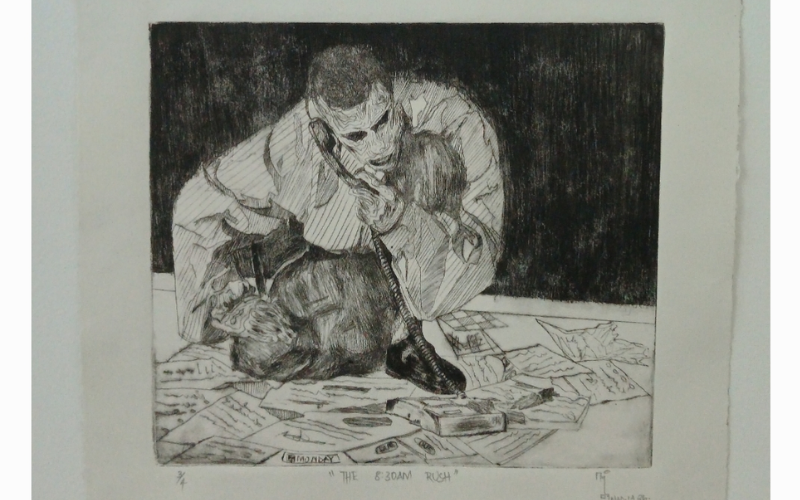
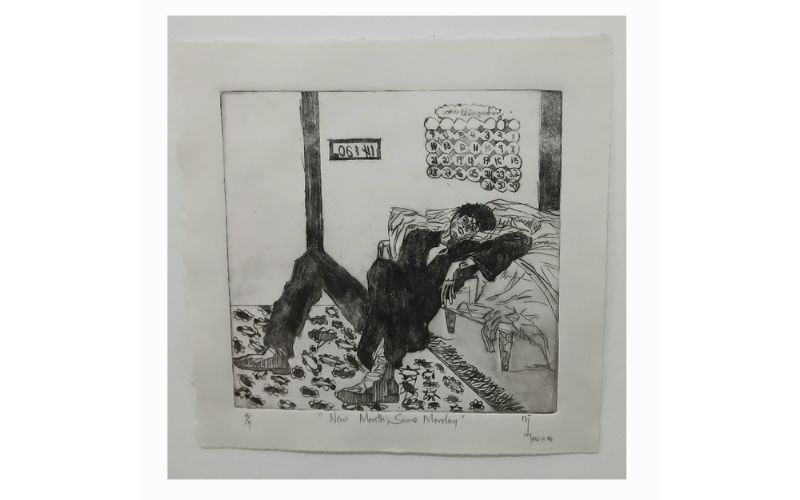
Nadia Wanjiru’s works in the exhibition revolve around the theme ‘Monday Blues’, inspired by the struggle that Mondays can have on people regardless of profession. She is exhibiting 27 works.
She experimented her way into printmaking. Her interest in how prints looked and felt made her explore the medium and eventually immerse herself in intaglio practice.


She believes a successful print starts with a properly worked plate. Since the whole intaglio process requires a lot of labour, she says it has taught her patience and attention to detail.
Working with plates has changed how I look at imagery. Printmaking pushed me to think critically about factors such as shape, size, and material of the matrix,” she says.
She thinks about the sketches and then draws them in a sketchbook until she comes up with the final form. The repeated sketches and revisions in her sketchbook, she says, represent the process of producing multiple impressions from a single plate.
Though prints may appear identical, she approaches each impression as original, with subtle differences in pressure, ink, and texture.
“These are the things that make editions special. I want the print to feel human,” she says.
Maori Wasike’s 23 art pieces in the exhibition examine, document, and preserve culture by telling stories of his Bukusu community. It speaks about identity, rites of passage and cultural memory, with a particular focus on Bukusu circumcision rituals and the symbolism surrounding them.
One of his featured works is The Night Of, a mezzotint piece exploring the anticipation, anxiety and uncertainty around two important nights in the Bukusu initiation ritual — the night before circumcision and the night of the reassimilation into the community, three months after circumcision, when one ceases to be an initiate and is now considered an adult.
Wasike explains that mezzotint, an intaglio technique, involves texturing a copper plate to produce rich blacks before selectively polishing areas to create lighter tones and contrast.
His journey into printmaking started with relief techniques such as woodcut, before he encountered intaglio through the work of Peterson Kamwathi. Once he saw Kamwathi’s aquatint works, he recalls, he wanted to learn intaglio.
Wasike explains that printmaking has transformed his workflow by demanding greater intentionality at the sketching and drawing stage. Since marks made on a printing plate cannot easily be erased, the process requires precision and patience.
A successful print, to him, is one that he feels embodies his intent, the right variation of tones, a clear image, and crisp lines, especially in drypoint etching.

Like Wanjiru, Wasike sees printmaking as connected to repetition and variation. While impressions are approached as reproductions, he says subtle differences created during inking, wiping and pressing mean that every print becomes a new original.
“These variations introduce features you either like or dislike. They influence whether you replicate them or solve them as problems in later prints,” he says.
He hopes audiences pay attention not only to the imagery but also to the technical application and subtle differences between editions.
On the other hand, Wanjiru outlines the challenges facing printmaking in Kenya, particularly intaglio, such as the cost of materials and tools and limited access to inks, paper, printing presses, and other equipment. However, she notes that other forms, such as woodcut and screen printing, are gaining momentum.
She credits collaborative learning and workshops that contributed to her artistic growth. A workshop facilitated by Kamwathi and Abdul Rop, she says, impacted her practice and grew her interest in etching.

“It showed me how shared knowledge can shape someone’s practice and create growth in artistry,” she says.
Wasike also sees collaborative learning as vital to the growth of printmaking. Working in a collective, he says, has contributed significantly to his technical and conceptual growth through the constant exchange of skills and ideas.
“Workshops and mentorships are important when it comes to learning skills and a way of thinking from seasoned artists such as Kamwathi. They are invaluable learning platforms for young artists,” he says.
Wasike sees the exhibition as the beginning of what they hope will become a movement for printmaking. He hopes to see more Kenyan artists embrace printmaking and eventually establish dedicated studios that support practising artists and students.
“It has been an honour being one of the new printmakers in the scene and part of a movement that wants to bring a new renaissance of printmaking. This is only the beginning of a new age of printmaking in the country,” he says.